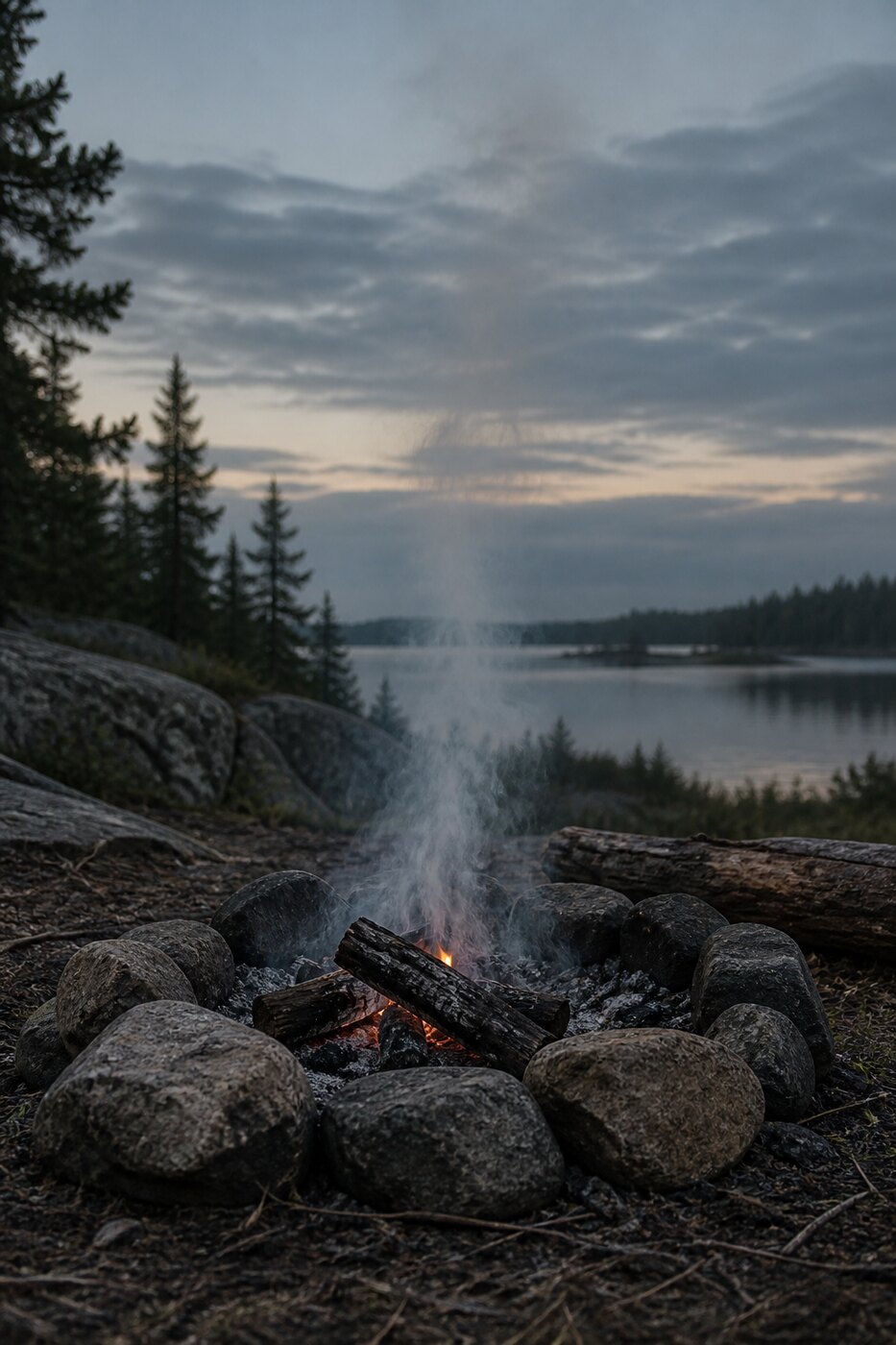
The alarm went at four and the kitchen was black and cold and I did not turn on the big light. I turned on the one over the stove because more than that felt like a lie about the hour. There was a roast to cook and it was the kind of roast that owns the day before the day starts. A whole shoulder, most of a lamb, the sort of thing you do not cook so much as attend.
Fire first. Everything else waits on the fire.
Outside the grass was wet and the cold came up through my boots before I had gone ten feet. The pit was where I had left it, a black scar in the ground ringed with stones I carried up two summers ago, still holding a little gray ash from the last time, packed down by rain into something like felt. I raked it out with a stick. The old ash was damp and heavy and smelled of nothing.
I had kept the kindling dry, which is the only thing you can do that matters. A milk crate of split cedar under a tarp on the porch, brought out the night before so it would not sweat. In the dark you build a fire by hand and memory. Small stuff first, the thin splits that snap when you bend them, laid in a loose weave, not a pile. A pile smothers. Then a curl of birch bark I had been saving, oily and papery, that takes a match like it has been waiting for one.
The first match blew out. The second caught the bark and the bark caught the cedar and there was a small orange working sound down in the dark, low, private, before there was any light to it. That sound comes before the flame you can see. You hear a fire before you watch it.
Then the smoke. Smoke before sunrise goes straight up because the air is not moving yet, a pale column you can only see against the one gray place in the sky where morning is thinking about it. I fed the fire the way you feed anything nervous, a little at a time, not crowding it. It climbed into the bigger splits. The heat reached my face and left my back cold, so I turned, the way you turn a roast, to even it out.
There was no coffee yet. That was the part that felt wrong every time. You are up, you are working, you are cold, and the fire is not yet a cooking fire, it is a young thing that needs watching, and you cannot leave it to go put the kettle on. So you stand. You stand in the dark and smell of smoke and wait for a fire to become coals, which it does on its own schedule and not yours.
That is the thing nobody tells you about cooking this way. The fire is not there to be nice. It is a clock. A shoulder that size needs hours over coals, not flame. Flame chars the outside and leaves the inside raw and cold and tasting of the outdoors in the bad way. You want coals, a deep bed of them, gray-skinned and red-hearted, and coals take time to make, and the time they take is why you are standing in wet grass at half past four with no coffee, smelling like a chimney.
My neighbor’s light came on across the field. He would know what the smoke meant. Nobody starts a fire that early for a reason that is not a lot of meat.
I put on the bigger wood as the small stuff burned down. This is the ugly patient middle of it. The fire has to be built up and then it has to be let to fall, and both of those are just waiting with your hands busy. I split a few more pieces on the block by feel, the maul finding the grain in the near-dark, the halves falling apart with that clean dry knock. The pieces went on. The column of smoke thickened and then thinned as the flames took hold and stopped making smoke and started making heat.
The sky did its slow thing. Not sunrise, not for a while yet, just a loosening of the black, the trees separating themselves out from the dark behind them, going from one shape to many. My hands were black at the knuckles. There was ash on my sleeve and in the creases of my palm and I could taste the smoke at the back of my throat, that flat mineral taste that stays for hours, that would still be on me when people showed up later smelling of soap and expecting to be fed.
The coals began. Around the edges first, where the earlier wood had spent itself, a raking-out of orange under gray, the good deep stuff, no flame on it now, just a hard even glow that pushed heat at you like a hand held up. I broke a bigger split apart with the poker and the whole side of it collapsed into embers, throwing up a brief storm of sparks that died before they cleared the stones.
Not enough yet. Not near enough. A shoulder needs a bed you could roast over for hours and I had maybe a quarter of it, a foot of good coals along one side and raw wood still burning on the other. So more wood, and more standing, and the light coming up gray and slow while the fire did its work at its own pace and ignored me completely.
The roast was still in the kitchen, cold, on the counter, waiting. The coffee was still not made.
Out at the pit the coals ticked and settled, and a thread of smoke lifted off a fresh split just catching at the edge, going straight up into air that had not yet decided to move.