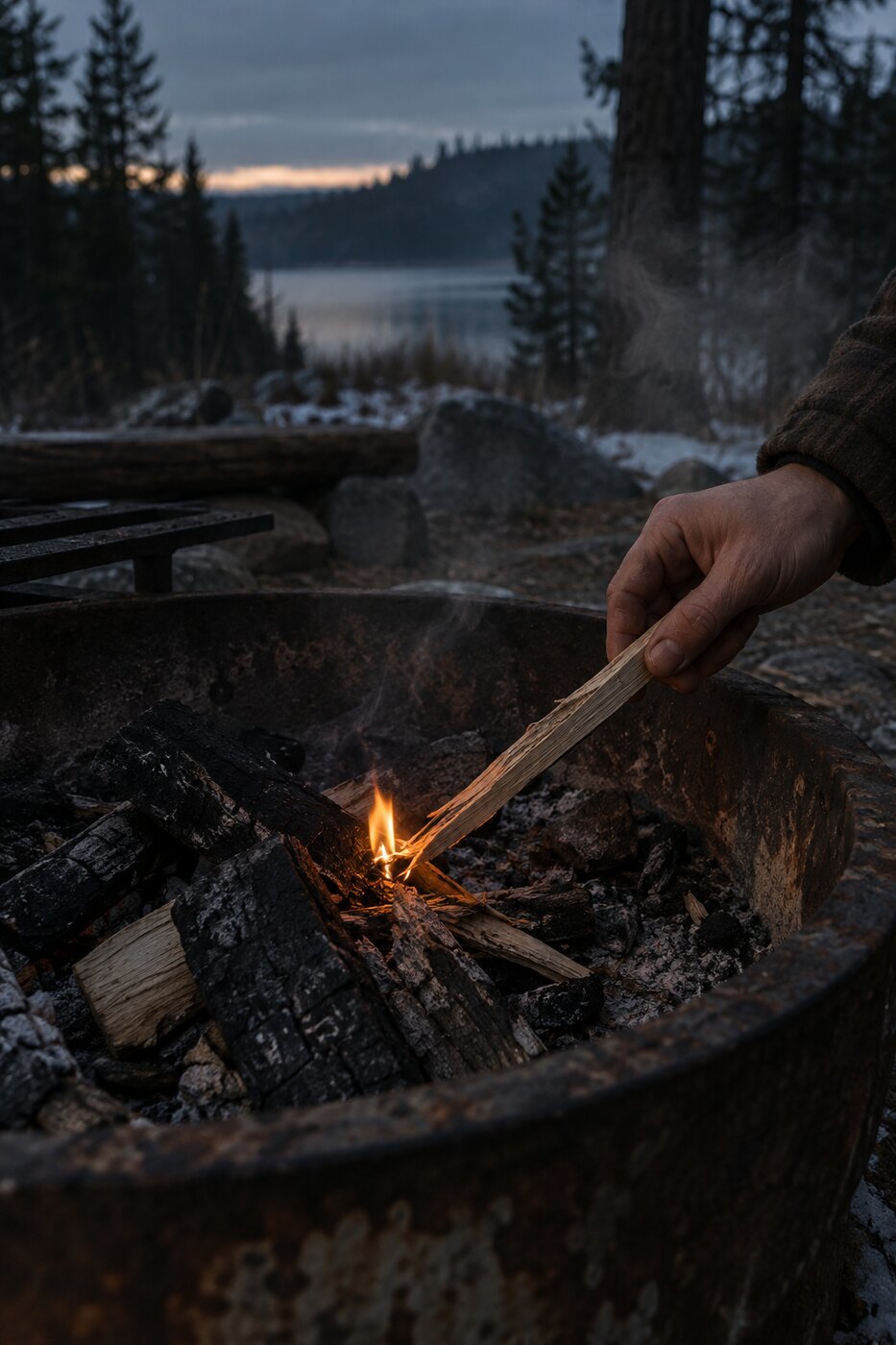
You light it in the dark. That is where this kind of cooking starts, not at the table but hours before it, in the cold before the light, when the yard is still gray and your breath shows and nobody else is up to see you crouched over a pit blowing on a small flame that keeps threatening to go out. The kindling is cold and a little damp on the outside and you have to find the dry splinters and build up slow, a flame that lives on birch bark first, then pencil wood, then something the width of your thumb, and until it takes you are on your knees in the frost feeding it one stick at a time and cupping your hands around it against the wind. This is the private part. All the good parts of fire cooking are private, and all the public parts come at the end.
Then you wait for coals, which is the longest wait and the one nobody has patience for who has not done it. The flame is not the tool. The flame is just the wood announcing it will eventually become coals, and the coals are an hour off at least, and you cannot rush it, so you feed the fire and you stand there and the sky comes up slowly behind the trees while the wood burns down. There is nothing to do in this hour but keep the fire fed and honest, and it is the hour that decides everything, because a fire built wrong in the dark gives you bad coals at noon and there is no fixing it then.
You tie the meat while the fire works. That is a job with its own patience in it, the twine going around and under and around, pulling the shape tight so it cooks even, so no thin flap hangs loose to burn while the thick middle stays raw. Your fingers get greasy and the twine slips and you tie it again, and the whole time you are half-watching the fire over your shoulder, reading the flame, listening to it settle.
Then the long tending, which is the true body of the day. The fire wants feeding and it wants it on its own schedule, and you learn to read when a coal bed is fading before it fades, to slide new splits in at the edge so they are catching by the time the middle gives out. The fat starts to render and drip and that is when the fire starts making decisions of its own, because fat on coals flares, and a flare is flame, and flame chars, so you are moving the meat off the flare or pulling the coals from under it, managing a fire that has decided it wants to burn the thing you are trying to cook slowly. A drip, a flare, a hiss, a shift. That is the rhythm for hours. You smell like smoke by the second hour and by the third the smell is in your hair and your coat and it does not come out for two washes, and you stop noticing it until someone who was not there tells you.
The people come out around the smell. This is a reliable thing. Nobody hovers while you are lighting a fire in the frozen dark, but let the fat start dripping and the smoke turn savory and they appear, drifting out to the yard in their coats, standing a little too close, warming their hands, pretending they came out for the fire and not the food. They hover and pretend not to hover. Someone always says the fire looks good and means the meat looks good, and someone always drifts to the exact spot where the smoke is going and has to move. And there is always the first one to ask. Is it ready. It is never ready when they ask. The first time it gets asked is always too early, by a wide margin, and you say not yet and they nod and drift off and come back twenty minutes later to ask again.
And then, at the end, the public part. The carving. This is the only piece of the whole day that looks like something, the meat off the fire and onto the board, the knife going in, the first slice falling away and the inside showing, and everybody gathers close for this because this is the part that was worth waiting for and also the only part they saw. The hours in the cold, the coals, the tying, the feeding, the flares managed one at a time, none of that is in the room. Only the carving is in the room. The private labor becomes the public meal in about ninety seconds and then it is gone, eaten, and the day that took from before dawn is over by the time the plates are full.
I do not mind that the hours do not show. That is the shape of the work and I knew it going in. But the fire knows. The fire took the whole day and gave back ninety seconds of carving and it does not pretend otherwise.
The pit is still warm now, hours after, the last coals gone to a gray crust with an orange thread somewhere underneath, throwing just enough heat to keep the frost off the stones around it, and I have not decided whether to bank it for morning or let it die.