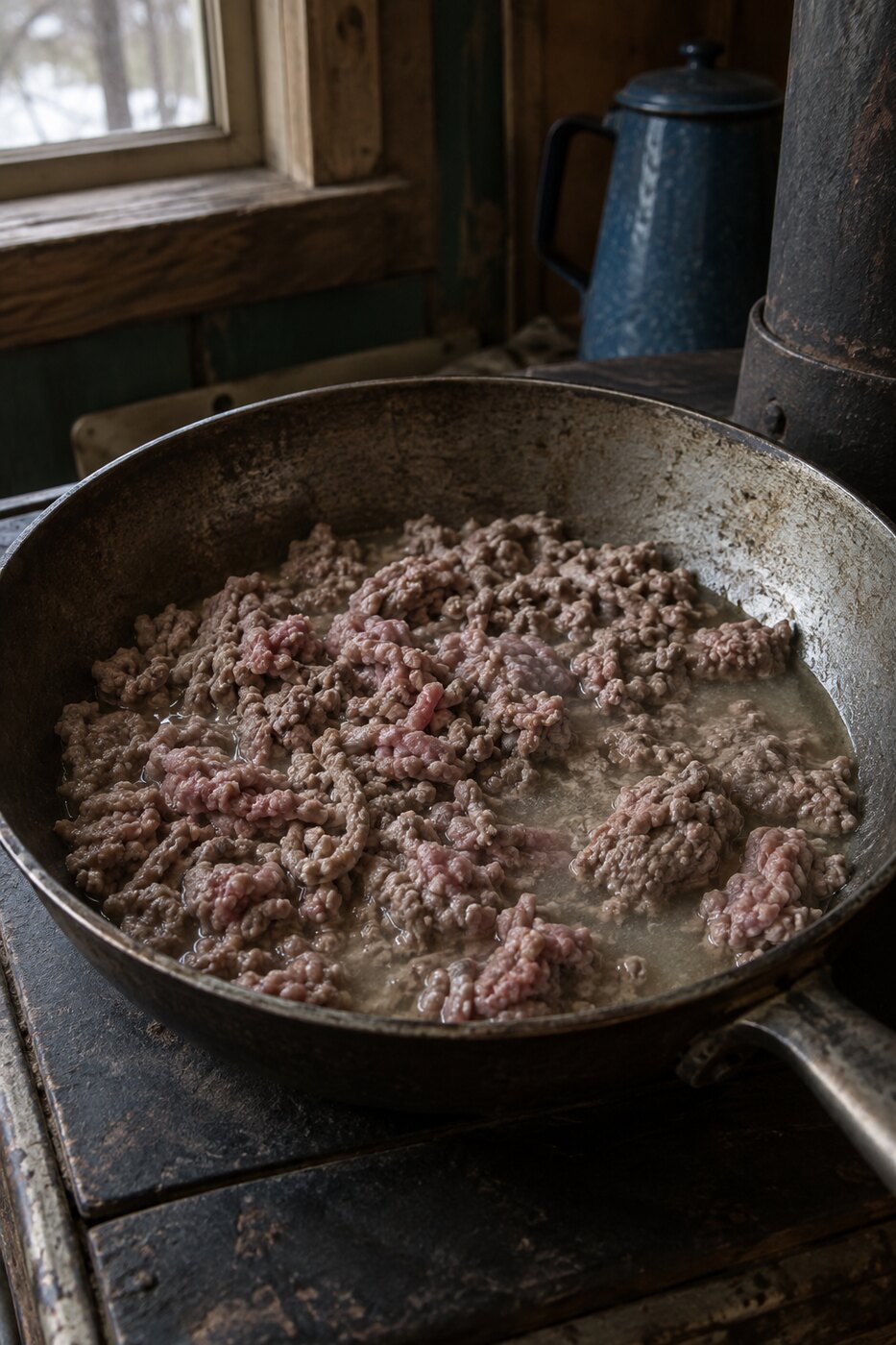
The meat goes gray first. Nobody films this part. You put ground beef in a pan and instead of the brown crust the pictures promise, it goes gray, a wet flat gray, and it leaks. Water comes out of it and pools and the meat sits in its own gray broth and steams, and it looks less like cooking than like something being boiled against its will. This is the true middle of it and the shows cut it out. They jump from the raw red to the finished brown and leave out the twenty minutes in between where the thing looks like a mistake. The gray is not a mistake. The gray is the water leaving, and the water has to leave before the meat can brown, because browning is dry work and there is no browning while there is a puddle. You wait through the gray. The puddle cooks off, the pan goes quiet then loud, and the gray finally darkens at the edges into the brown you were told to expect. The wrong look was a stage, not a failure.
Onions do it too, in their own direction. You want them golden and sweet and instead they go sweaty first, translucent and slick, sliding around the pan in their own released water, pale and limp and smelling raw and sharp. It looks like nothing is happening. It looks like they might just dissolve. But the sweating is the sugar coming available, the cell walls breaking down and letting the water out, and only after the water goes can the sugar catch and color. The sweaty stage is ugly and it is also mandatory. Rush past it with high heat and you get onions burnt at the edges and raw in the middle. You let them look wrong. You let them sweat and slump and pale until, almost when you have stopped believing in them, they turn.
Dough under a towel is the most alarming, because it looks dead. You mix a lively springy dough and set it in a bowl under a cloth and come back and it has slumped, gone soft and shapeless, spread to fill the bowl and lost every bit of the tension it had when you covered it. It looks like it failed. It looks slack and defeated. But under that slack surface it has doubled, filled with gas it made itself, and the slumping is the sign it worked, not the sign it quit. A dough that still looks tight and muscular after an hour is a dough that did nothing. You want the slump. The wrong look is the proof.
Beans soaking look like nothing at all, a bowl of hard stones going soft in cloudy water, the water gone gray and thick, and if you did not know better you would pour it out and start over. Stock jelling in the fridge looks worse, a wobbling brown solid with a cap of pale fat set hard across the top, and it looks spoiled and it is the opposite of spoiled, the jelly is the collagen that means you cooked the bones long enough, and the fat cap is a seal keeping the air off. You break the cap, you warm the jelly, and the wrong-looking solid becomes the clearest broth you have.
Cabbage in the pan goes from a crisp pale wedge to a wilted gray-green heap that looks like it has given up, the volume collapsing to a quarter of what went in, and the smell in that stage is not a good smell, it is the sulfur smell that makes people say they hate cabbage. Push through it. The wilt is where the sweetness comes from, the same as the onion, and the smell fades as the sugar builds. And soup, before the salt, is the wrongest-looking food of all, a pot of gray flavorless liquid with vegetables floating in it looking exactly as sad as they will ever look, and you taste it and it tastes of hot water and disappointment. Then the salt goes in and the whole thing wakes up, the flavors that were there but muffled come forward all at once, and the gray water becomes soup. Nothing changed but the salt and the believing.
I think about this more than I probably should. Not as a lesson, because I distrust the lesson, but as a plain fact of the work. Most of cooking is spent looking at food that has not become itself yet, food in the sweaty slumping gray middle, and the whole skill is knowing which wrong is on its way to right and which wrong is just wrong. There is a burnt that does not come back. There is a curdled that does not come back. The judgment is in telling those apart from the wrongs that are only stages, and you learn it the way you learn everything here, by getting it wrong first.
The pan of gray meat is on the burner now, the puddle just starting to hiss down at the edges, still more gray than brown, and I cannot yet tell from across the kitchen which way it is going.