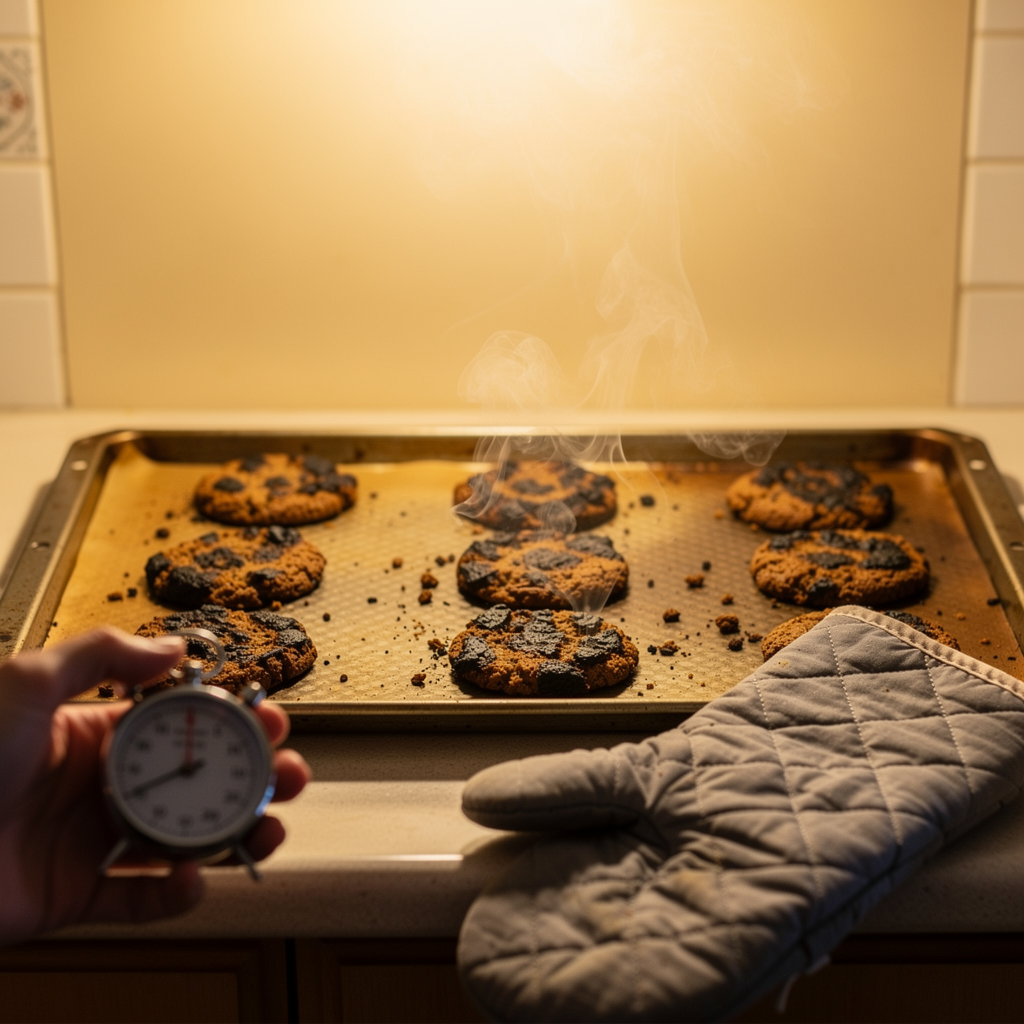
The sheet pan is not flat anymore. It warped years ago, the first time it went from a hot oven to a cold wet counter, and now it has a low spot in the middle and a rise at one end, so oil runs to the corner and whatever I roast browns unevenly, dark where the metal touches and pale where it lifts away. I know this pan. I know to turn it halfway through and to put the thing I care about over the low corner where the heat pools. A new flat pan would cook more evenly and I would have to learn it from scratch. The dent is not damage exactly. It is information I already paid for.
That is what these things are. Not decoration, not heritage, not the good knife on the magnet strip that people photograph. They are small machines for making a judgment repeatable, so that the guess I got right once I can get right again. The old roasting fork, two long tines and a wooden handle gone dark with grease, is a machine for telling me whether the meat is done without cutting it open and letting the juice out. You slide it in and feel for resistance and then touch it to the inside of your wrist, and cool means raw and warm means getting there and too hot to hold means past done. The fork does not measure anything. It carries the heat out to where my skin can read it. That is the whole function.
The thermometer does the same job with less faith required. It is the tool for when the fork’s answer and the eye’s answer disagree, when the outside looks finished and something in you says the middle is still cold. You put the probe in the thick part, away from bone, and wait for the number to stop climbing, and the number settles an argument that would otherwise ruin either the meat or the evening. I resisted it for years as a crutch. Then I served pink chicken to company once, sure it was done because it looked done, and now the thermometer lives in the drawer and I do not call it a crutch. A crutch is a tool you use because you were wrong before, and being wrong before is the only qualification any of these have.
The measuring cup is chipped at the lip, which matters more than it sounds, because the chip is right at the half-cup line and I read past it now without thinking, the eye correcting for the missing piece. The bread knife has one job and does it and is useless at everything else, a long serrated blade that saws through crust without crushing the crumb and cannot dice an onion to save its life. You keep it for the one thing. A tool that does one thing well is worth more drawer space than a tool that does five things poorly, and most gadgets are the second kind.
The ladle has a burn mark on the handle where it slid too far into the pot and the plastic sat against the rim and melted a flat brown scar into itself. It still ladles. The scar is a lesson about where the handle balances and I have not repeated the mistake since. The air fryer basket, which I did not want and now use more than I admit, is a machine for crisping without a pot of oil, and its whole value is the mesh that lets the hot air reach the underside, and its whole failure is that the mesh clogs with drippings and has to be scrubbed with a brush that fits between the wires, and if you do not, the next thing tastes of the last thing.
Foil earns a place here too, which sounds absurd until you have used it for structural work. A sheet folded three times into a stiff strip becomes a wall you build across a pan to keep two things from touching, or a tent you raise over a roast so the top stops browning while the inside catches up, or a sling to lift a whole loaf out of a tin without tearing it. It is not measuring anything, but it is making a judgment hold its shape, which is the same family of work.
And the cooler on the porch is a fridge when the fridge is full, a machine for holding cold that runs on nothing but the cold you put in it and the cold outside the door, and its judgment is a bag of ice and how often you are willing to change it. It fails the way all of these fail, slowly and then all at once, the ice going to water, the water going warm, the thing you trusted it to keep turning quietly into the thing you should have checked.
The sheet pan is back in the oven now, empty, seasoning a little darker each time it heats. The low corner has gone almost black where the oil always ends up, and I keep meaning to sand it and never do.