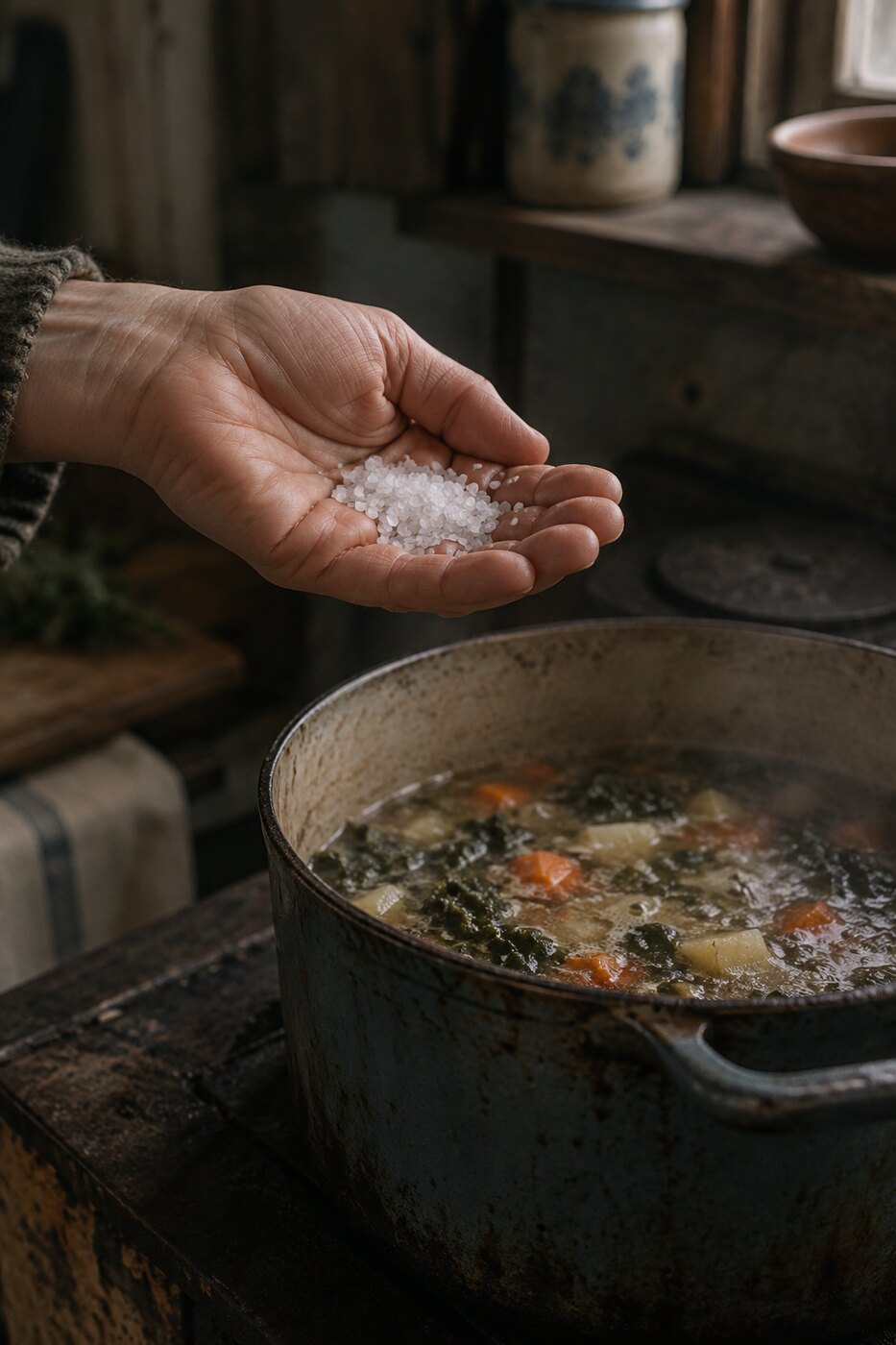
The salt goes in the palm first. Not the spoon. I pour it out of the box into the cup of my hand until the mound feels like the right weight, and the right weight is a thing my hand knows and I could not tell you in numbers. A teaspoon is an idea. My palm is a memory. It remembers the soup that came out flat and the soup that came out ruined, and it settles somewhere between those two before I have thought about it at all. Then I throw the salt from a height so it scatters, because salt dropped from six inches lands even and salt tipped from a spoon lands in a clot, and a clot of salt in one corner of the pot is its own small disaster you will not find until someone’s spoonful.
Flour is the honest one, because flour talks back. You never know how much a dough wants, not really, because the flour changes with the weather. A dry cold day and the flour is thirsty; a wet one and it has already drunk from the air and wants less water, or more flour, and the recipe that worked in August lies to you in November. So you do not measure flour into dough. You feed it. You add and work and add and work, and you are listening the whole time to how the dough answers your hands. Too wet and it clings, it webs across your fingers, it will not let go of the bowl. Too dry and it cracks at the edges when you fold it and stays stiff and sullen. You add flour until the arguing stops. That is the whole measure. The dough goes from sticky and difficult to smooth and cooperative, and there is a moment where it stops fighting you and turns over easy under the heel of your hand, and that moment is the amount. No cup measures it. Only the change does.
Oil in a pan is a look, not a volume. You want the bottom to shine, a thin bright film that runs when you tilt the pan and coats the whole floor of it. If it pools, if it gathers into a little lake at the low side, that is too much, and the food will not fry so much as swim, and it comes out greasy and pale. If it beads and leaves dry patches, that is too little, and the food will grab the metal and tear when you turn it. So you pour a thread of it and tilt and look and add a little if the shine breaks. The pan tells you. A cold pan and a hot pan want different amounts because hot oil thins and spreads and cold oil sits, so even this you learn to read against the temperature under it.
Coffee I make by the morning. That is not a poetic way of saying I guess. It means the scoop I use changes with how the day looks. A dark morning, cold, a lot ahead of it, and the scoop comes up heaped and I do not level it. A slow warm one with nothing pressing and I let the grounds ride lower in the scoop. My hand adjusts to a thing that has nothing to do with the coffee, and the coffee comes out matched to the day more often than a scale would manage, because the scale does not know what kind of day it is and my hand, apparently, does.
Water into soup is the last and the hardest, because it is the one you cannot take back. You can add water. You cannot remove it, not without cooking it down and cooking out the freshness with it. So you go under. You add water until the spoon moves through the pot with a little resistance, until it drags just slightly, and you stop there, below where you think it should be, because the vegetables will still give up their own water as they soften and the pot will thin itself without your help. A soup you thinned to the right point at the start will be watery by the end. The spoon knows before the tongue does. You feel the body of the soup in how the spoon pulls, and when the pull is right you leave it alone.
A measuring cup is a good tool and I own several and I use them for baking, where the chemistry does not forgive a wrong hand and a cake is a machine that fails all at once. But for the rest of it, the daily cooking, the pot and the pan and the dough, the better tool is a hand that has been wrong. Precisely wrong, many times, in ways it remembers. The cup gives you the same amount every time whether or not the day, the flour, the weather want that amount. The hand gives you the amount this one needs.
The salt box is on the shelf with the lid off, the way I always leave it, and there is a ring of it dried onto the shelf underneath where the damp got in and the salt caked and I have not scraped it up.