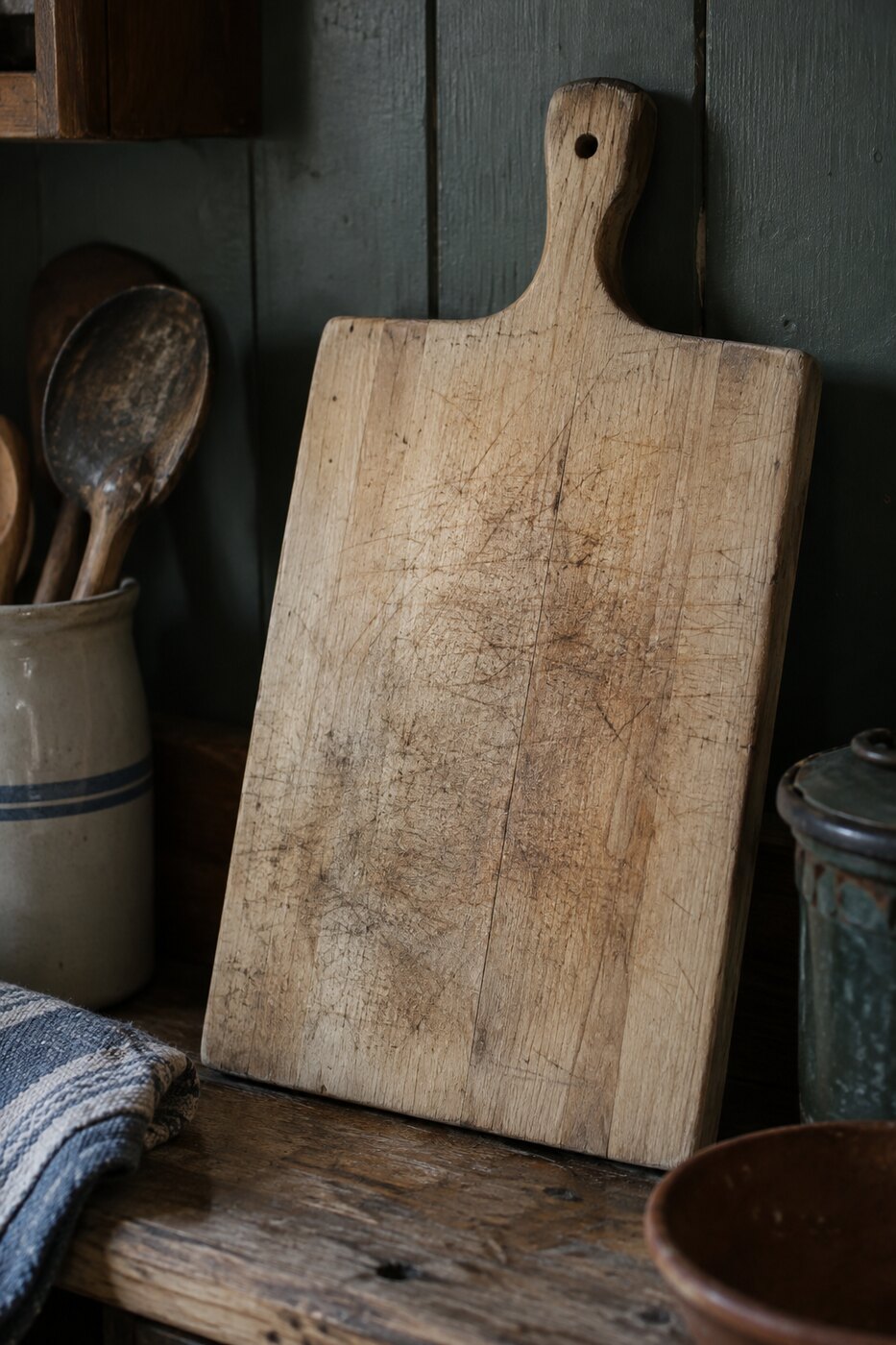
The board is maple, edge grain, the kind glued up from strips so the end you cut on is the tough face of the wood and not the soft flat of it. It came to me already used, already gray at the middle where a thousand cuts had worn a shallow dish into the surface, and it has a warp now that lets it rock a little on the counter if I do not set it on the towel. I cut an onion on it on a Tuesday. That is the whole event. One onion, halved, peeled, laid flat and sliced down and then across into the small dice that goes into everything.
An onion does not cut clean the way it looks like it should. It cuts wet. The knife opens the cells and the cells let go, and what comes out is not juice exactly but something thinner and more volatile, a sap that goes straight to the air and to your eyes and, it turns out, into the wood. You can see it happen if you watch the board after. The surface goes damp along the cut lines, and then the damp sinks in, following the grain, drawn down into the open ends of the wood fibers that a cutting board is nothing but a field of. The face you cut on is all end grain. That is the whole design. Every one of those tubes is a little straw, and the onion filled them.
I washed it the way I always do. Hot water, a squeeze of soap, a stiff brush run with the grain and then against it, and then a rinse and a stand on edge against the backsplash to dry, because a board left flat in its own damp goes black underneath. It looked clean. It was clean, by any test you could put to your eyes. The knife scars stood pale and dry, the worn dish in the middle held no film, the smell right after washing was soap and warm wood and nothing else. I put it away.
Wednesday I took it down to cut an apple for the kid’s lunch and the apple came off the board tasting of onion. Not strongly. A whisper, a wrongness, the way a glass of water tastes of the dish soap that did not get rinsed. Enough that the kid noticed and set the slice down. I smelled the board and there it was, faint but certain, onion, risen back up out of the wood overnight the way water rises in a wick.
I washed it again, harder this time. Coarse salt this time, a half cup of it poured onto the wet board and scrubbed around with the cut face of a lemon, which is the trick people swear by, the salt to scour and the acid to cut the oil that carries the smell. The salt went gray and slushy and I could smell onion coming up out of it as I worked, so something was moving, something was leaving. I rinsed it and dried it and smelled it and it smelled of lemon and salt and, underneath, still, quieter but not gone, onion. The wood had taken it deeper than the salt could follow. Whatever the onion left had gone down into the grain past the reach of anything I could rub across the surface, and it was going to come back up on its own schedule, a little each day, into whatever I cut next.
This is not a flaw in the board. I want to be plain about that. It is the board doing exactly what a wooden board is for. A wooden board is soft enough to save your knife edge, and the thing that makes it soft, the open porous grain, is the same thing that drinks the onion and holds it and gives it back. A glass board or a plastic one would not have kept the smell. It also would have dulled the knife by Thursday and cracked it by Christmas. You take the memory because it comes attached to the give. The board that forgets the onion is the board that ruins the blade.
I have a shed like this. Old, board-walled, and it held gasoline in a can for a decade and now it is a woodshed and has been a woodshed for years, and it still smells of gasoline the second you close the door on a warm day. The wood took the fumes the way the maple took the onion, down into the grain, and no amount of airing it out has ever pulled it all back. You open the door in July and the shed hands you 2009 whether you asked for it or not. I do not mind it in the shed. In a thing I cut apples on it is more of a problem.
So now I keep two boards. The maple is the onion board and the garlic board and the anything-with-a-smell board, and there is a second one, plainer, newer, that I keep for fruit and bread and cheese, the mild things that have no business tasting of the loud ones. It is a small piece of order I impose on the kitchen, a wall between the strong and the weak, and it works most of the time.
The maple is standing on its edge against the backsplash now, dry to the touch, pale in the knife scars, smelling of nothing at all from a foot away. I put my nose right down to the worn dish in the center where I cut the onion four days ago. It was still there.