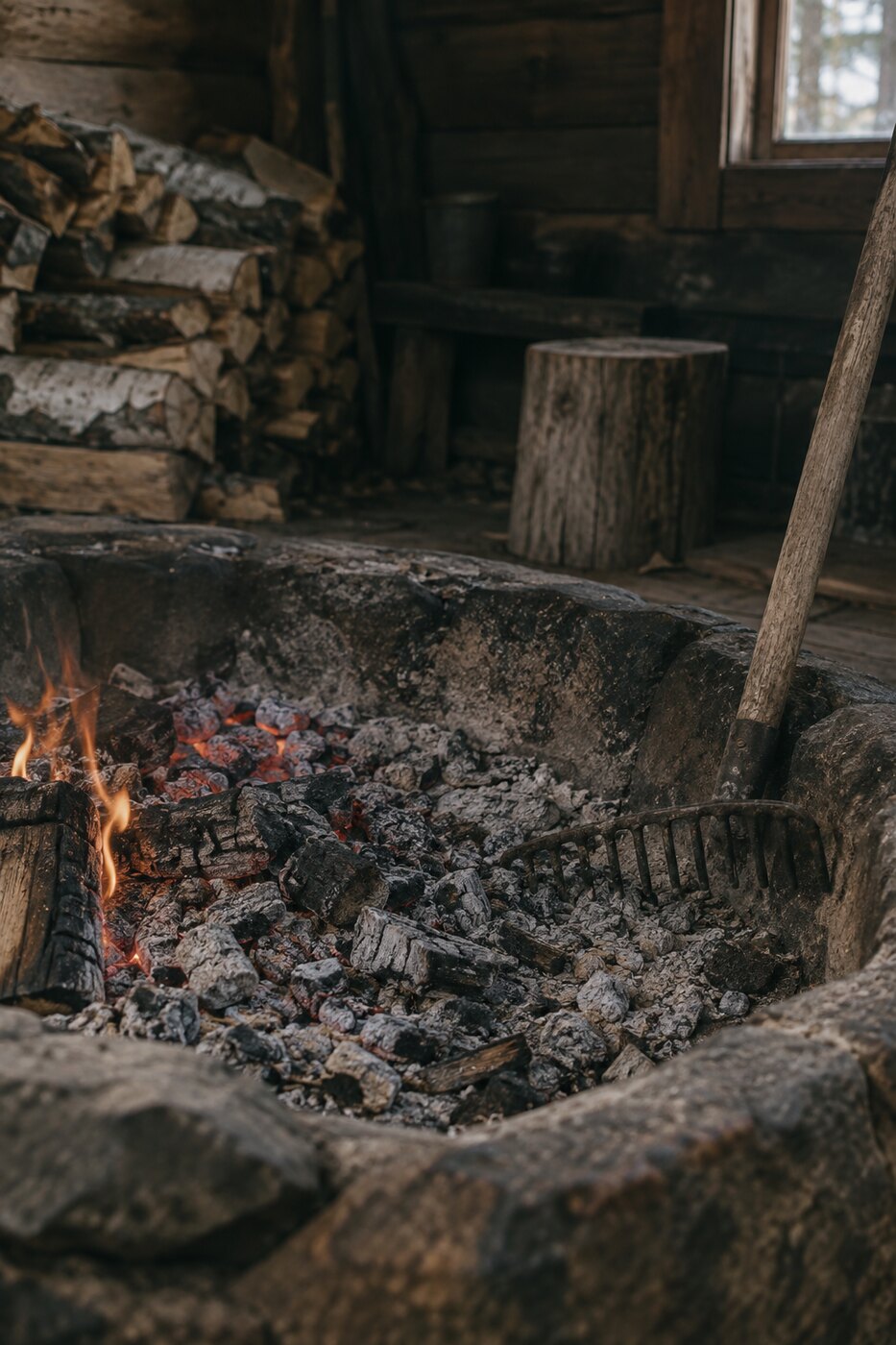
I lit the fire at four because I knew the wood. Birch and a little spruce for the start, then the split maple that takes an hour to give up its flame and settle into coals, and I had done the arithmetic in my head the way you do when you have burned the same wood in the same pit enough times to trust it. Fire at four, coals by six, meat on shortly after, people at seven. That was the plan and the fire held up its end of it exactly. The people did not.
By six the flames had gone down. The maple had done what maple does, burned bright and hard and then collapsed into a bed of coals the size of my fist and smaller, gray on the outside where the ash had formed, and underneath the gray a deep orange that pulsed when the wind found it. That is the tell. You do not go by the flame. Flame is the announcement, not the work. You go by the coals, and you know they are ready when the ash coats them evenly and the heat coming off is a steady wall you can feel on your face from three feet back, a heat with no flicker in it, patient, mean. I held my hand over the bed at the height the meat would ride and counted. Three seconds and I had to pull it away. That is about right for what I was cooking. Any hotter and the outside chars before the inside warms; any cooler and you are drying the meat out slow instead of searing it.
The coals were ready. Nobody was there.
This is the part of fire cooking that the pictures never show, because there is nothing to photograph in it. A man standing over a pit of perfect coals with no meat on them, holding a rake, checking his watch. The fire does not care that the guests took a wrong turn or stopped for gas or simply lied about when they would leave. The fire is on its own schedule and its schedule is chemistry, not courtesy. Wood becomes coals and coals become ash and there is a window in the middle, maybe forty minutes wide for a bed this size, where the heat is exactly what you want. Before that it is too fierce. After that it is fading, and you are feeding in new splits and starting the whole wait over, and the new wood is never quite in phase with the old.
So you manage it. That is the whole job in that hour. I raked the coals into a low even bed and then, when they ran too hot, I spread them thinner, pulling them wide with the rake so the heat had more room to leave. When they cooled past where I wanted, I raked them back into a heap to concentrate what was left. I banked a reserve of live coals off to one side under a shelf of unburned maple, keeping them fed just enough to hold, a bullpen I could call on when the bed in the middle gave out. You are not cooking yet. You are keeping a fire at a boil it wants to fall off of, over and over, buying time the fire does not want to sell.
There is a decision in it, too, and it is not a small one. At some point you either commit the meat or you do not. I could have put it on at six and had it done by six-forty and then let it sit wrapped and cooling while I waited, which is a way to lose everything good about it, the juices going gray and gathering in the foil, the fat congealing back to white. Or I could hold the meat off the heat and keep feeding the fire and gamble that the guests would show before my reserve ran out and the whole bed went to ash. I held. That is what you do. You hold, and you feed the reserve, and you watch the ash creep across the coals, and you do the arithmetic again, faster now, because the numbers have changed and you were not the one who changed them.
They came at seven-twenty. By then I had fed the fire twice more than the plan wanted, and the flavor of that would be in the meat, a little more smoke than I would have chosen, from wood that had not fully turned to coal before I needed its heat. The bed I finally cooked over was my third bed, not my first, and it was fine, it was good even, but it was not the bed I had built at six. That one was gone. It had come ready on time and waited as long as coals will wait, which is not long, and then it had done the only thing coals do, which is turn slowly into something colder.
I laid the meat on when they were still taking off their coats. The fat found the coals right away and the coals answered, a flare, a hiss, a column of smoke going up sideways in the wind, and the smell of it reached the porch before the people did.
Off to the side the reserve pile was down to a handful of live coals under a gray crust, throwing almost nothing now, and I did not know yet whether it would hold long enough to finish or whether I would be splitting more maple in the dark.