The counter was already full.
Coffee maker on the left, pushed back against the tile. Toaster beside it, crumb tray never quite empty. Knife block, salt crock, a cutting board leaning where it shouldn’t. The space between them was negotiated daily, wiped around, resented in small ways. The laminate was finite. It had been claimed by use.
Then the air fryer arrived.
It came in a box that seemed larger than the appliance itself, packed with cardboard forms and a thin plastic bag that split at the seam before I’d finished unwrapping. The cord was folded tight, kinked in three places from the factory. The manual smelled like ink and something else, something chemical that didn’t belong near food.
I kept the receipt in a drawer. I did not throw it away. I did not read it.
I set it on the counter where the cutting board used to lean. The board moved to the other side of the sink. The air fryer didn’t apologize. It just displaced the space.
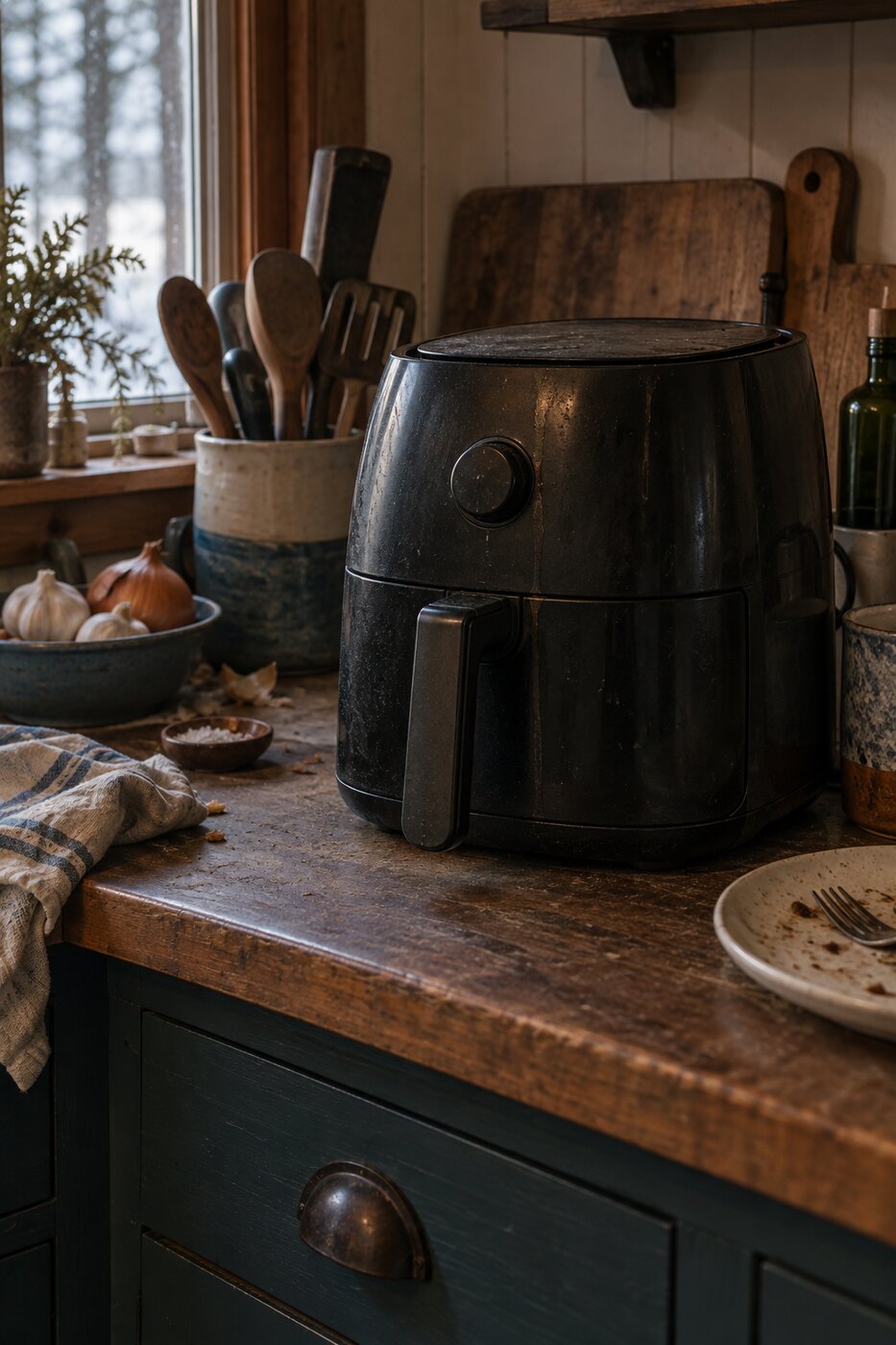
The machine was black plastic, mostly. A handle stuck out from the front like a drawer on a filing cabinet. Vents along the back. Rubber feet that gripped the counter with more confidence than the situation warranted. The basket inside was perforated, coated in something that was supposed to be nonstick but felt provisional. The whole thing had the look of office equipment that had made a wrong turn.
The first time I ran it, empty, the way the manual insisted, the kitchen filled with the smell of hot plastic. Not burning, exactly. More like a new hair dryer left on too long. The fan kicked in with a sound that belonged in a bathroom ceiling, not a room where people eat. The cabinet above the machine got warm. The wall behind it got warm. I put my palm against the wood. It ticked as the heat expanded the grain.
I did not trust it.
But I kept using it. Not because I’d decided to. Because the skillet was full and the potatoes were damp and someone was hungry forty minutes before dinner had any right to be ready.
The potatoes were cut badly. I’d used a dull knife on a cutting board that was still wet from the lettuce. Some were wedges. Some were slabs. One was too thick to ever cook through. I tossed them in oil with salt that clumped in one corner of the bowl and barely touched the rest. Then I slid the basket in, pushed the drawer shut, and set the dial to something I’d guessed.
The drawer shut with a clunk that sounded cheap. It still does. Every time, the same plastic thud, like a car door on a vehicle that cost less than it should have.
The fan started. The smell changed. Hot plastic gave way to something older, something that had already been cooked once and was now being reheated in the air. Fat from the previous Tuesday. Oil from the chicken thighs. A ghost of frozen fries. The machine had begun to accumulate a past.
The potatoes went in pale and came out with edges. Not all of them. The small pieces had gone too far, shrunken and dark, almost hollow. The large ones were still soft in the center, resistant to the fork. But the middle pieces, the ones cut with something approaching attention, had browned. They had a skin now. They held salt.
This was still supper.
The skillet finished the chicken while the potatoes waited on a plate that had been warm an hour ago. The lettuce stayed wet. The towel on my shoulder picked up grease and water and whatever the counter had been holding. But the potatoes were crisp, and the machine had bought me twelve minutes, and twelve minutes is the difference between a kitchen that’s behind and a kitchen that’s merely crowded.
The air fryer did not become beautiful. The basket never looked clean again. A film settled into the perforations, a seasoned residue that soap could reach but never quite remove. The handle developed a slight stick. The cord kept its kink. The fan still announced itself every time, loud enough that I had to raise my voice if someone asked a question from the other room.
But the counter began to make room. Not because the machine had shrunk. Because I’d stopped seeing it as an intruder and started seeing it as a tool that showed up when the better plan failed. Counter space is paid in use.
The machine had no charm. The beep it made when the timer ended was shrill and insistent, a sound with no nose for whether anything was actually done. I learned to check early. I learned the dial was optimistic. I learned the basket needed shaking halfway through, that oil pooled in the bottom tray, that yesterday’s fish would flavor today’s Brussels sprouts if I didn’t wipe it down with a paper towel that immediately shredded.
None of this was in the manual.
The manual had photographs of food that had never been near this machine. Golden fries stacked in a cone. Chicken wings glazed and glistening. Vegetables arranged in a fan. The paper was glossy. The promises were specific.
So I kept a notebook on the fridge door. I wrote down times and temperatures. The pages curled from steam. I crossed out entries when the results were wrong. Four hundred for twenty minutes. Three seventy-five for twelve. Shake at six. The paper yellowed near the magnet. The instructions were not perfect. They were just true enough for Tuesday.
The air fryer is not romantic. It does not connect me to some older way of cooking. It is a plastic box with a fan and a heating element and a basket that never feels fully clean. It smells, faintly, of everything it has ever cooked.
And when the skillet is full and the potatoes are damp and dinner is behind schedule, I reach for it. The basket slides in. The fan starts. The potatoes go in pale and come out with edges. The machine has paid its rent.
The basket is still not clean. Clean is sometimes a legal category, not a physical one. The drawer sits half open on the counter. A thin line of grease runs down the side of the plastic housing. The cord waits for the plug.