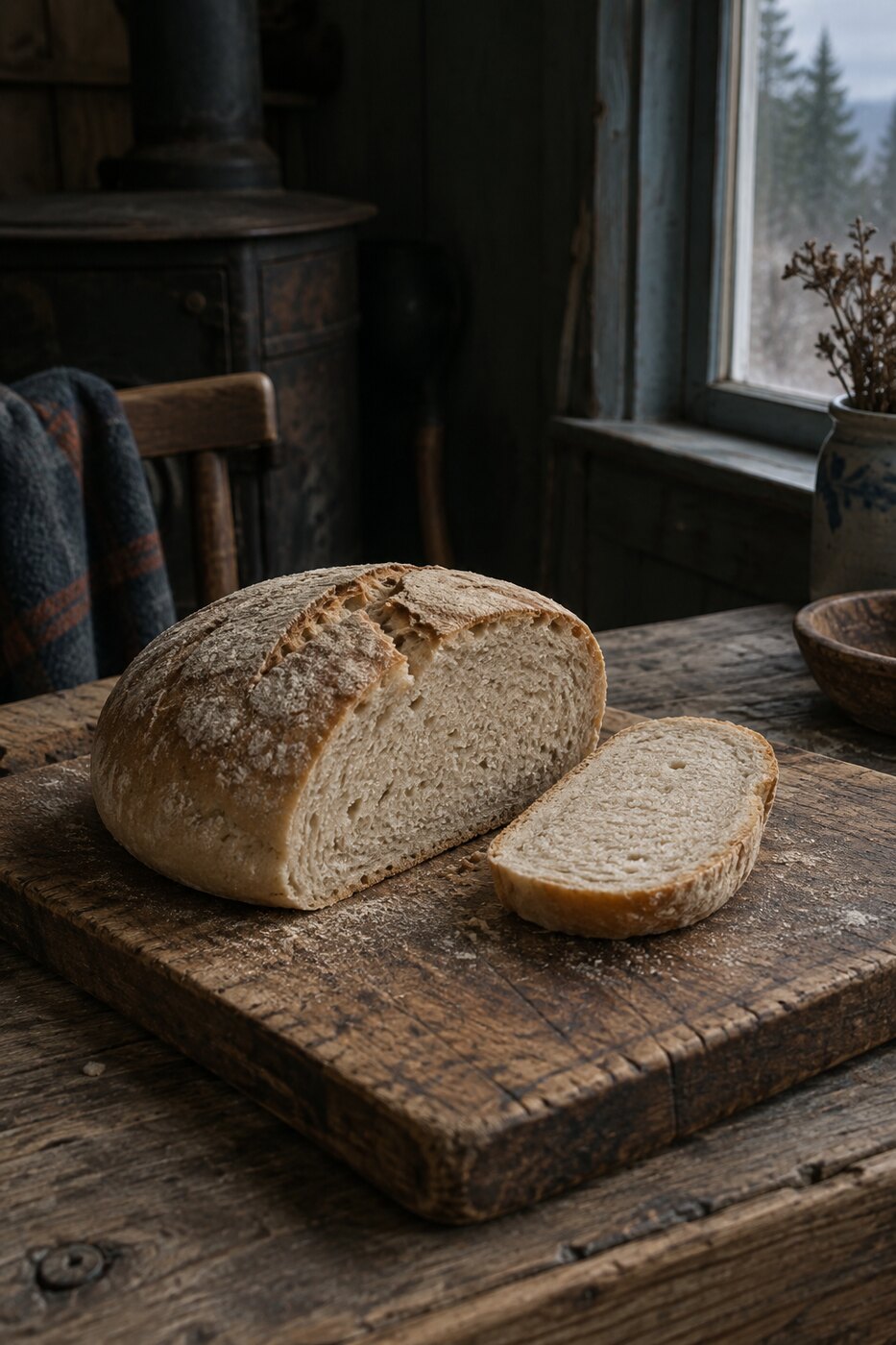
It came out squat. You know before it’s all the way out of the oven, when you’ve slid enough loaves onto enough racks that the eye does the math on its own — this one didn’t stand up. It sat in the pan low and pale, the crust gone gold instead of brown, the dome that should have crowned above the rim barely reaching it. Heavy, when I turned it out. Heavier than bread that size has any right to be. Heavy as a private opinion, the kind held hard and kept to yourself.
You knock the bottom to be sure. That’s the test — rap the base with two knuckles and a good loaf answers hollow, a drum note, air in it, a room in there. This one answered thud. A packed, close, dead sound, the sound of something solid all the way through. No room in it. Whatever was supposed to open up the inside had not opened it. The knock told me the whole story before I ever cut it.
Cut it anyway. The knife met resistance a good loaf doesn’t offer, and the slice fell over thick and tight, the crumb — if you can call it crumb — close and moist and slightly translucent near the middle, the holes small and mean where they should have been wide and airy. Pinch it and it doesn’t spring. It stays pinched. It has the gum to it, that slightly wet claggy chew that tells you the inside never fully became bread, just sat there dense and underdone in spirit if not in temperature.
Something went wrong and I’ll never be sure what. That’s the honest part. It’s always a guess and the guess never quite settles. The kitchen was cold yesterday — the rise might have stalled, the dough sitting there sullen while I waited and then gave up waiting and baked it before it was ready. Or the yeast was tired, an old packet, the leaven gone weak so the gas it should have thrown off came slow and thin. Or I knocked it back too hard, or shaped it too tight, or cut the second rise short because the oven was hot and I was impatient. Any of those. Some of those. I’ll never run the experiment that tells me which. The loaf keeps its own counsel, dense and unhollow, and I’m left with a suspicion instead of a cause.
It is not good bread. There’s no arguing it into good bread. Fresh, warm, with butter — the moment when even a mediocre loaf gets away with a lot — this one still sat heavy on the tongue and the plate. You could eat it. It wasn’t spoiled, wasn’t burnt, wasn’t anything but wrong. Just a loaf that failed at the one thing a loaf is for, which is to be light.
And here’s what happens to a loaf like that, in a house that doesn’t throw bread away: it gets demoted. Not binned. Demoted. It loses its rank as bread and gets reassigned downward into the ranks of ingredients, where its faults turn into qualities.
Because a dense loaf toasts hard and doesn’t fall apart. Cut thin and put under the flame, the gum dries out and the tightness becomes crispness, and a slice that was a failure at the table is suddenly the right structure for something to be piled on. Cut into cubes and dried harder, it’s crouton, and the very density that ruined it as bread makes it hold up in a bowl without dissolving. Torn into a pan where sausage or bacon left its drippings, it drinks the fat the way light bread never could — light bread just goes to grease-soaked mush, but this close heavy crumb takes the drippings in and stays itself, and that’s dressing, more or less, or the beginning of it.
The failure gets a second trade. That’s the whole move. You don’t own a mistake by eating it grimly as what it was meant to be; you own it by finding the job it’s secretly good at. A loaf too dense to enjoy is a loaf dense enough to work. Its flaw was only a flaw relative to the ambition it was born with. Lower the ambition — call it not bread but body, not a loaf but a starch that holds up — and the flaw becomes the reason to reach for it.
The last of it went into soup. A thick soup, beans and whatever, and the heel of the failed loaf torn into rough pieces and pushed down under the surface with the back of the spoon. Light bread would have vanished. This didn’t vanish. It sat in the broth and softened at the edges and held at the core, taking the soup up into all that tight mean crumb, and it did the job — a job it was never shaped for, never rose for, never meant to do — and it did it well enough that no one at the table knew they were eating a failure, the last dense pieces of it going soft in the bowl and holding their shape a while longer than they should have.