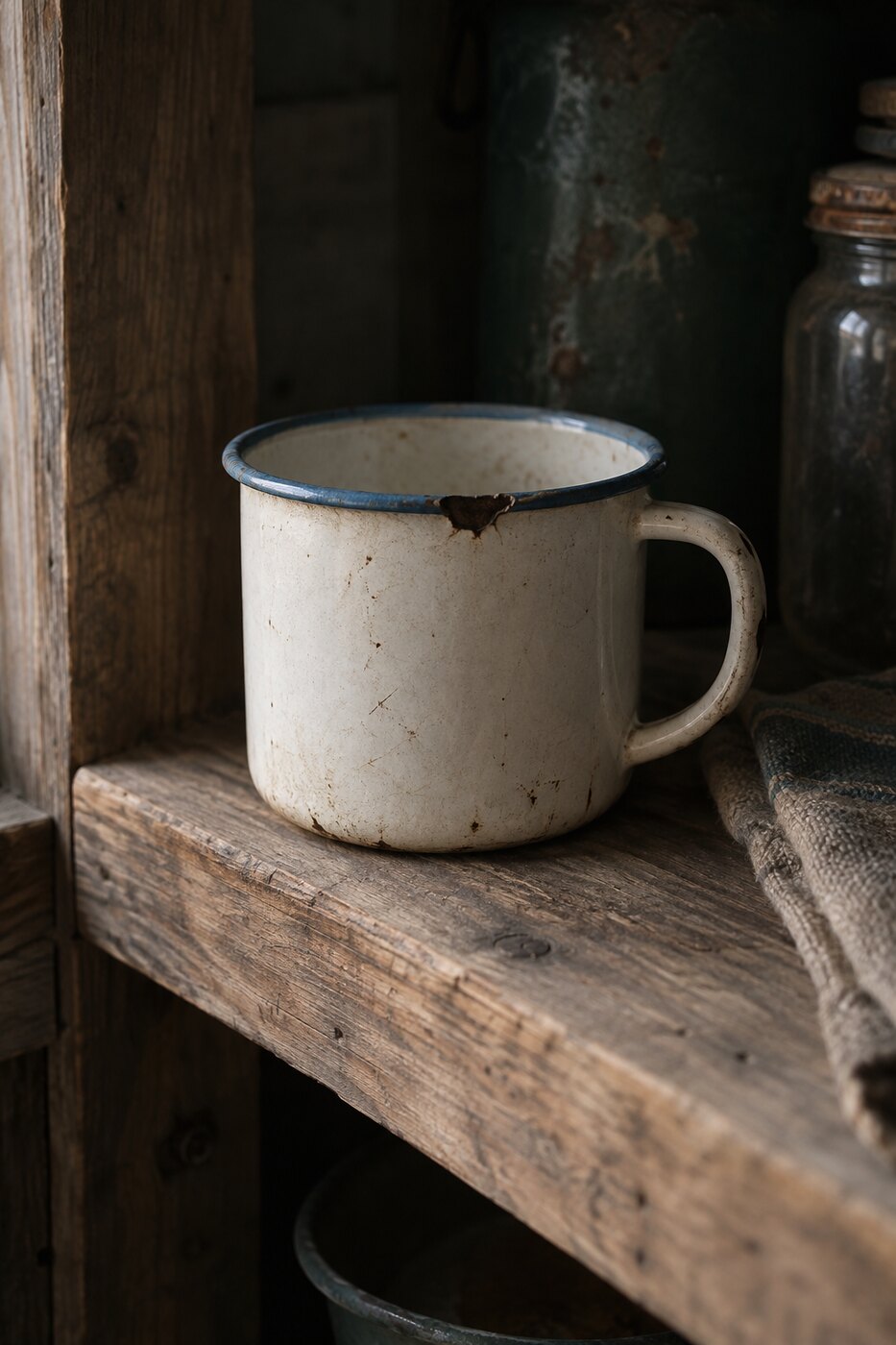
White enamel, a blue line running the lip. That was the whole design, and it was a good one — the blue a hair below the rim, so it framed whatever you were drinking from just under your nose. The enamel is thick, poured onto steel and fired, and it has the faint waviness of a hand-dipped thing, a little pooling here, a run there, nothing a machine would allow.
The chip is at about two o’clock if the handle is at three. A piece of the enamel let go — hit the edge of a sink, probably, or knocked against a tap — and took a small comma-shaped bite out of the rim. Where it broke away, the dark metal underneath shows, gray going to brown at the very edge where it’s started to rust in the finest line. The break isn’t smooth. Run a thumb across it and there’s a low ridge where the enamel ends and a slight roughness on the bared steel, and then the metal edge itself, which is thinner than the enamel and a little sharp.
You’d think that would end it. A cup you drink from that has a sharp bared edge at the rim — that’s a cup for the bin, or the shelf of retired things, or the nail in the shed where old cups go to hold screws. It didn’t end it. What happened instead is that my mouth learned the chip.
It goes like this. You pick up the cup and before it reaches your lip your hand turns it. A quarter turn, sometimes less, bringing the good rim to your mouth and the chip around to the far side, and you do it without a thought, without ever having decided to do it, the way you step over the raised board in a floor you know. The mouth won’t drink over the chip. It’s not a rule anybody made. The lips just decline that spot and the hand serves the lips, and the whole small negotiation happens below noticing, every single time, so smoothly that I only caught myself doing it because I set out to watch for it.
There’s more the mouth knows. The metal at the chip runs a different temperature than the enamel. On a cold morning the bared steel is colder, a little bite of it if you brush it; on hot coffee it heats faster and hotter than the enamel around it, so the chip is where you’d scald a lip if you drank there, and the mouth knows that too, and steers. The enamel holds heat slow and even. The metal is quick and extreme. You could read the cup’s whole construction with your lips in the dark — here enamel, even and mild; here, one small arc, the raw fast metal underneath.
And here’s the thing I can’t quite argue my way out of: there are whole cups in the cupboard. Mugs without a mark on them, sound all the way round, a whole shelf of unbroken vessels that would hold coffee just as well and ask nothing of the mouth. And this chipped one is the one my hand goes to first. Every morning. Before the kettle’s even on, it’s down off the shelf and in my hand, chip and all, and one of the good mugs stays exactly where it is, being fine, being ignored.
I’ve stopped pretending that’s an accident. It isn’t in spite of the chip. If anything it’s a little because of it. The chip is how I know the cup in the dark, how my hand finds it without looking, how it’s become this cup and not a cup. The flaw is the identifying mark. The quarter-turn is a thing my body does that it does for no other object in the house, a small daily fluency, and you don’t give up a fluency lightly. Loyalty to a broken thing looks like foolishness from the outside — why drink from the sharp one — and from the inside it’s just sense, worn smooth: the cup works, the mouth has solved it, the solving is by now part of how the morning goes. The chip is a reason I keep it, not a reason I’d retire it. You don’t throw out the thing you’ve learned by heart just because the learning was made necessary by a wound.
I rinsed it and set it back up on the shelf. I put it down with the chip turned to the wall — not for any reason I could defend, just the way it goes back, break to the plaster, blue line and good rim facing out. It sat there next to the whole mugs that don’t get used, first in line for tomorrow, the bared metal at its lip catching a thin edge of light, a rust line thinner than a hair growing along the break where the enamel gave up and the steel took over.