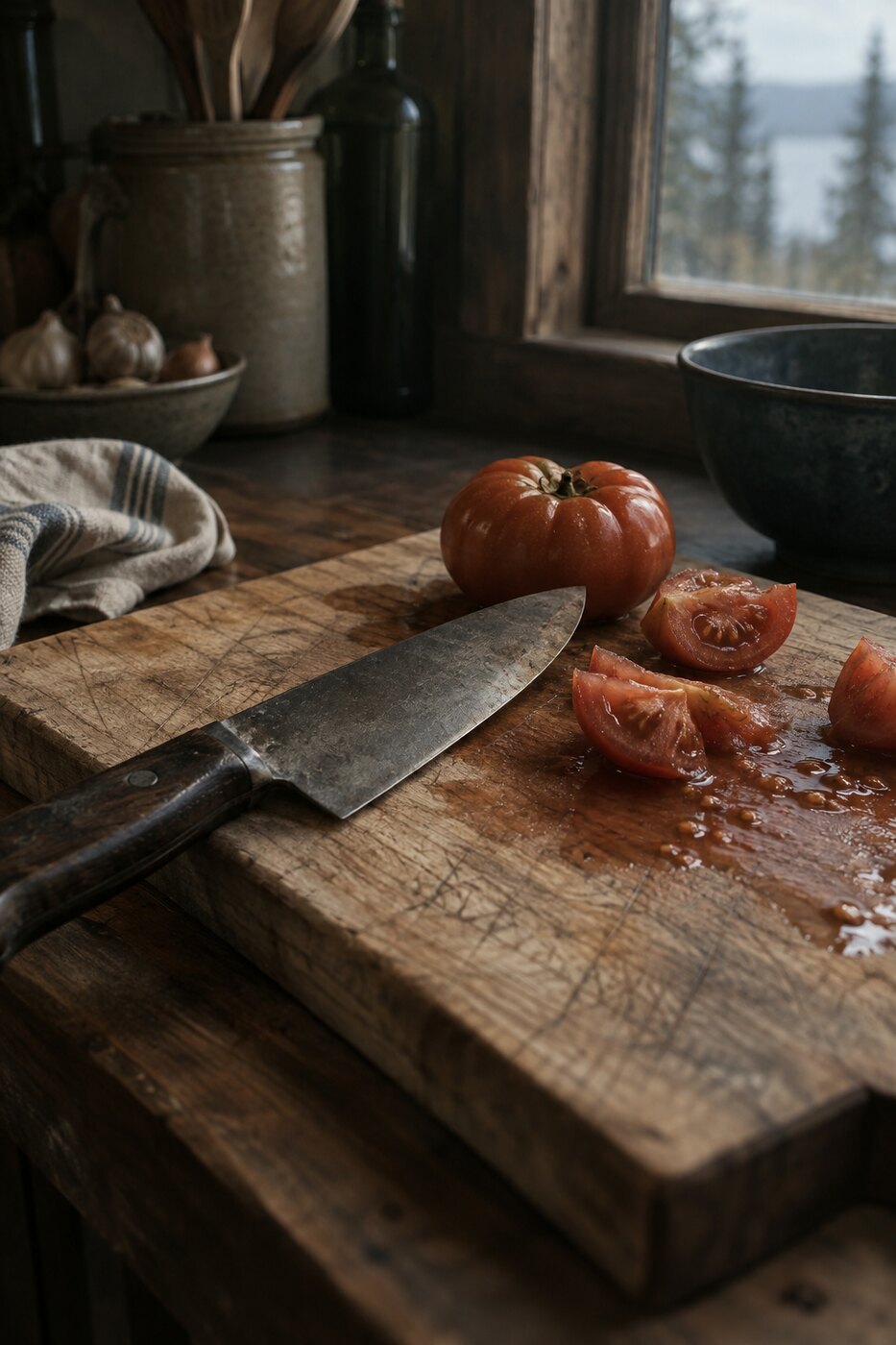
The knife made a wooden sound before it made a cutting sound.
The cutting board is maple, scarred from years of work. A damp towel folded underneath keeps it from walking across the counter. The board was here first. The knife arrived second, descending through the air with the weight of an assumption.
It hit the wood with a dull thuck. Not the clean tick of a sharp edge finding its depth. This was a softer report, a sound with give in it. The noise a tool makes when it is knocking rather than entering. The noise had juice in it. I kept going, because the onions were already sweating in the pan and the recipe did not account for hesitation.
I was cutting a tomato.
The blade rested on the skin the way a thumb rests on a bruise. Not breaking through. Waiting for instruction. I pressed, and the skin dimpled inward, stretching into a steep V that deepened without parting. The tomato flattened slightly. Its roundness became a kind of wince. Then the skin gave way, not because it had been sliced, but because the pressure had become too much for anything to hold shape. It mashed first, then agreed to be divided.
Juice arrived before the cut was made.
The seeds slid out onto the board and settled into the old grooves, the ones that run crosswise from years of other tomatoes. They looked comfortable there. They had been there before.
I blamed the tomato first. This is common in households.
A mealy one. A soft one. The kind that was already thinking about the compost before it left the vine. I turned the knife slightly, as if it had a better side. I wiped the blade on the towel beside the board. That did not improve its character. It only spread the damp around.
Supper had already started becoming supper. The onions were translucent in the pan. The oil had raised its voice once and then settled. There was momentum in the room, the kind that fills a kitchen around six o’clock and does not wait for equipment to be perfect.
My index finger moved up to press directly on the steel spine.
The hand had started making decisions. The wrist locked before I had admitted anything. The palm tightened around the handle in a grip that had stopped being cooking and started being work. A small rivet, slightly raised where the wood met the bolster, pressed exactly into the joint of my thumb. I registered the pressure but did not release it.
The shoulder leaned in. The whole arm took over the work of the edge.
The slice came off ragged. Thick at one end. The seeds were pressed into a paste. The skin on the bottom edge was not cut so much as torn. It made pieces. They were just not the pieces I had asked for.
I kept cutting.
The knife was dull. I had known for weeks.
Knowing is not maintenance. Knowing sits in the front of the brain and watches the hand do the wrong thing. It does not interrupt. It takes notes. It had been taking notes all summer, every time I reached past the whetstone in the second drawer to pull out the same knife, the one with the walnut handle and the German name worn faint. The one that had once gone through a butternut squash without asking me to brace my weight.
The stone was not lost. The drawer slides on soft-close runners, and the stone sits beside the can opener and the small scissors I use for herb stems. The drawer has its own weather. Paper receipts curl at the corners. A rubber band has gone brittle and waits to snap the next time someone asks it to work. I see the stone when I open the drawer. I close the drawer.
The knife goes back to the block with the edge still folded over on itself, invisible to the eye but present in the arm.
A dull knife is more dangerous than a sharp one. It doesn’t bite. It skids. The edge has quit, but the weight remains, and the arm has to supply what the steel won’t.
That is the trouble with it. If the knife stopped working altogether, I would sharpen it or replace it. Neglect breeds best where the failure is partial. Badly is a kind of working. A dull knife applies. It asks for increments. A little more pressure this week than last week. A slightly higher grip. A more patient sawing motion through chicken skin. The body adjusts in units too small to notice, and then one evening the hand is tired before the chopping is done, and the tiredness feels like age or a long day, not like a tool that has quit under contract.
Dinner still gets made. The slices are inconsistent, the basil bruises instead of cutting, the pepper seeds scatter across the board instead of staying in their pale architecture. But the food reaches the table. The evidence washes off with warm water and a sponge. The hand forgets until the next tomato.
I finished the tomato. I scraped the pieces into the pan, and they hissed in the oil. The board got wiped. The knife got rinsed. The handle was slick with grease and water. It sat on the board like a tired animal.
The arm remembered what it had done. The shoulder held a small ache that would be gone by morning, or would not be, and either way would not be mentioned. The hand flexed once around the dish towel and then forgot.
The knife is back in the block, waiting for the next meal, the next tomato, the next quiet surrender of the body to a tool that stopped helping months ago. The pressure has moved out of the steel and into the shoulder. That is where it lives now.
The stone is not lost. That makes it worse.