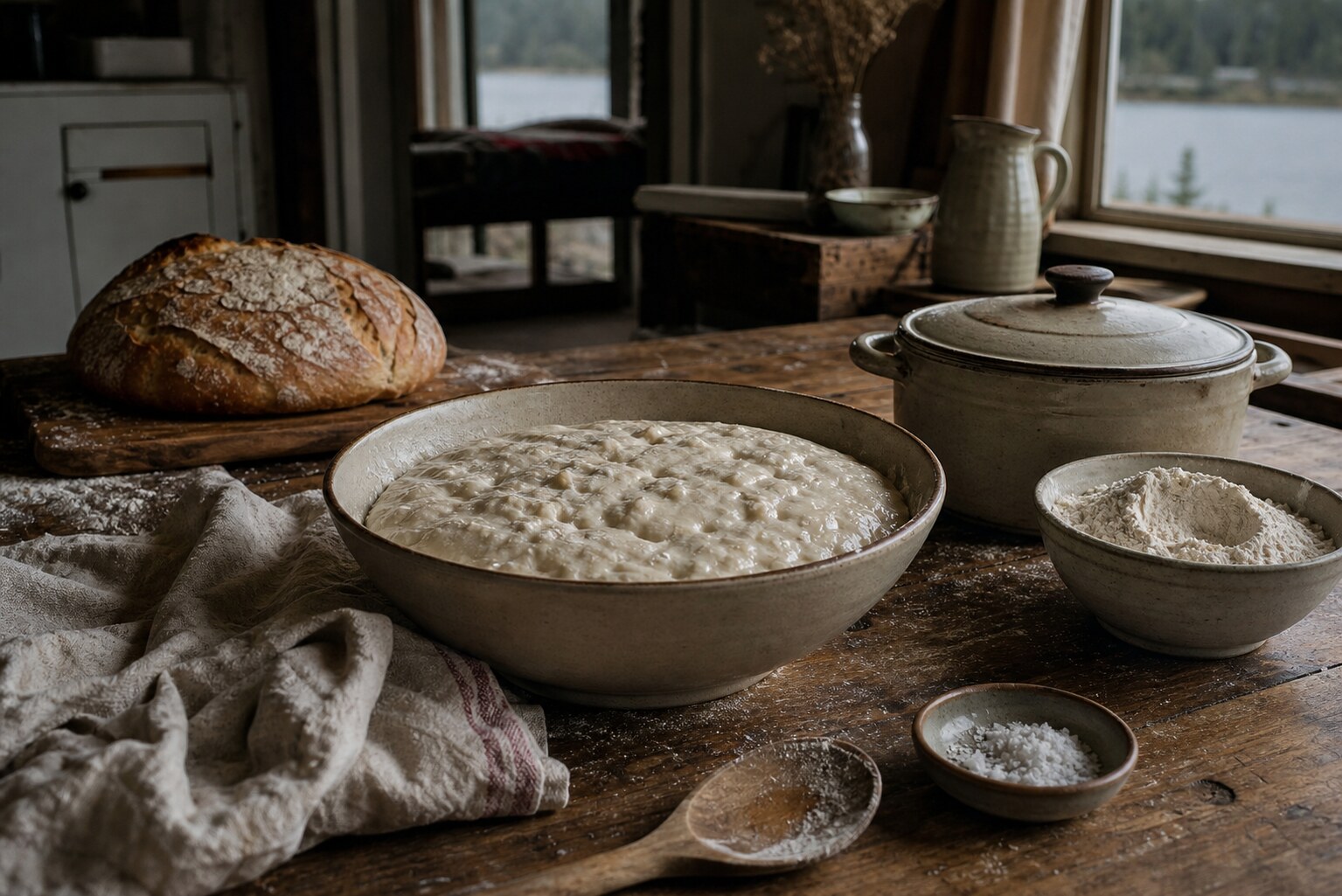
It starts wet. The bowl holds a slack of it, water and flour beaten to a paste that has no dignity yet, and when I put a hand in, it grabs. Not sticky like tape. Sticky like it wants to come with you — it webs between the fingers, hangs off the knuckles in strings, and won’t be shaken off, only scraped, and the scraping just moves it to the other hand.
The recipe says cups. It always says cups. Three and a half, or five, some number arrived at by someone in a kitchen that wasn’t this one, on a day whose weather I’ll never know, with flour that had sat in its bag a different length of time than mine has. The number is a starting place. It gets the wet mass into the neighborhood. After that the number goes quiet and something else takes over, and the something else lives in the hand, not on the page.
So I add flour by the handful now, not the cup. A scoop from the bin, thrown across the surface of the mass, and then the working — fold, press, turn, the heel of the palm driving down and away, the whole thing rotated a quarter, fold again. At first the dough eats every handful and asks for more. It stays slack. It stays grabby. You could pour flour into it all morning if you went by fear.
But the hand isn’t reading the flour. The hand is reading the push-back.
There’s a moment, and it doesn’t announce itself, when the dough stops taking and starts giving. Under the heel of the palm it changes. The slack goes out of it. Where it used to smear, it now presses back — a firmness that answers your weight with a little weight of its own, a spring, the faint resistance of something that has decided to hold together instead of falling apart. The surface, which was tacky, turns to something closer to skin. Tacky and sticky are not the same and the hand knows the border exactly: sticky comes away on you, tacky just kisses and lets go. When it goes from sticky to barely tacky, when it pushes when you push, that’s enough. That’s the whole reading. No cup measures it. There’s no line on any vessel for the feel of enough.
I couldn’t tell you the number of cups it took today. I stopped counting handfuls around the third one because counting was the wrong instrument. The right instrument was the nerve in the heel of my hand comparing this push-back to every push-back before it, all the doughs already worked and baked and eaten, the too-wet ones that spread flat and gummy in the pan, the too-dry ones that baked up tight and crumbled at the crust. Those loaves are gone. We ate the evidence. But the hand kept what the loaves taught it, and the lesson wasn’t a number, it was a feel — this much spring, this much tack, stop here.
That’s the part that’s hard to hand to anyone. You can give someone the recipe. The recipe is honest as far as it goes. But the recipe can’t give them the border between sticky and tacky, or the exact spring that says done adding, because those aren’t information, they’re memory stored somewhere below language, in the meat of the palm. You learn it the only way it’s learnable: by getting it wrong, by baking the flat gummy failure and the dry crumbling one, by eating your mistakes until the hand quietly recalibrates without ever telling you it has. Nobody teaches you the moment. You just accumulate enough wrong that the right one becomes recognizable.
And it stays wordless even when you have it. That’s what strikes me. I know the feel of enough flour better than I know almost anything with my hands, and I still can’t say it. I can only do it. Ask me how much flour and I’ll say “until it feels right,” which sounds like nothing, like a dodge, and is actually the most precise thing I could tell you — it’s just that the precision is in the palm and doesn’t survive the trip to the mouth.
The dough today came together clean. It went from a bowl of grab to a smooth ball that held its shape and pulled off the sides in one piece, the surface gone from tacky to a dry-ish satin, springing back slow when I pressed a thumb into it and watched the dent fill itself halfway. I stopped adding flour. I didn’t decide to stop, the way you decide things with your head. The hand just quit reaching for the bin, the way it quits when the reading comes back right, and I noticed after the fact that I’d stopped.
I turned it into a greased bowl and drew a cloth over it and set it on the back of the stove where the warm is. It’ll double, if I read the flour right. There’s no way to know now. The bowl sits under its cloth doing its slow work in the dark, and all I have — all I ever have, at this stage — is the small certainty in my hand that I stopped at the right time, arrived at by no number, unprovable until the loaf comes out or doesn’t, the dent I pressed still there in the surface, filling in.