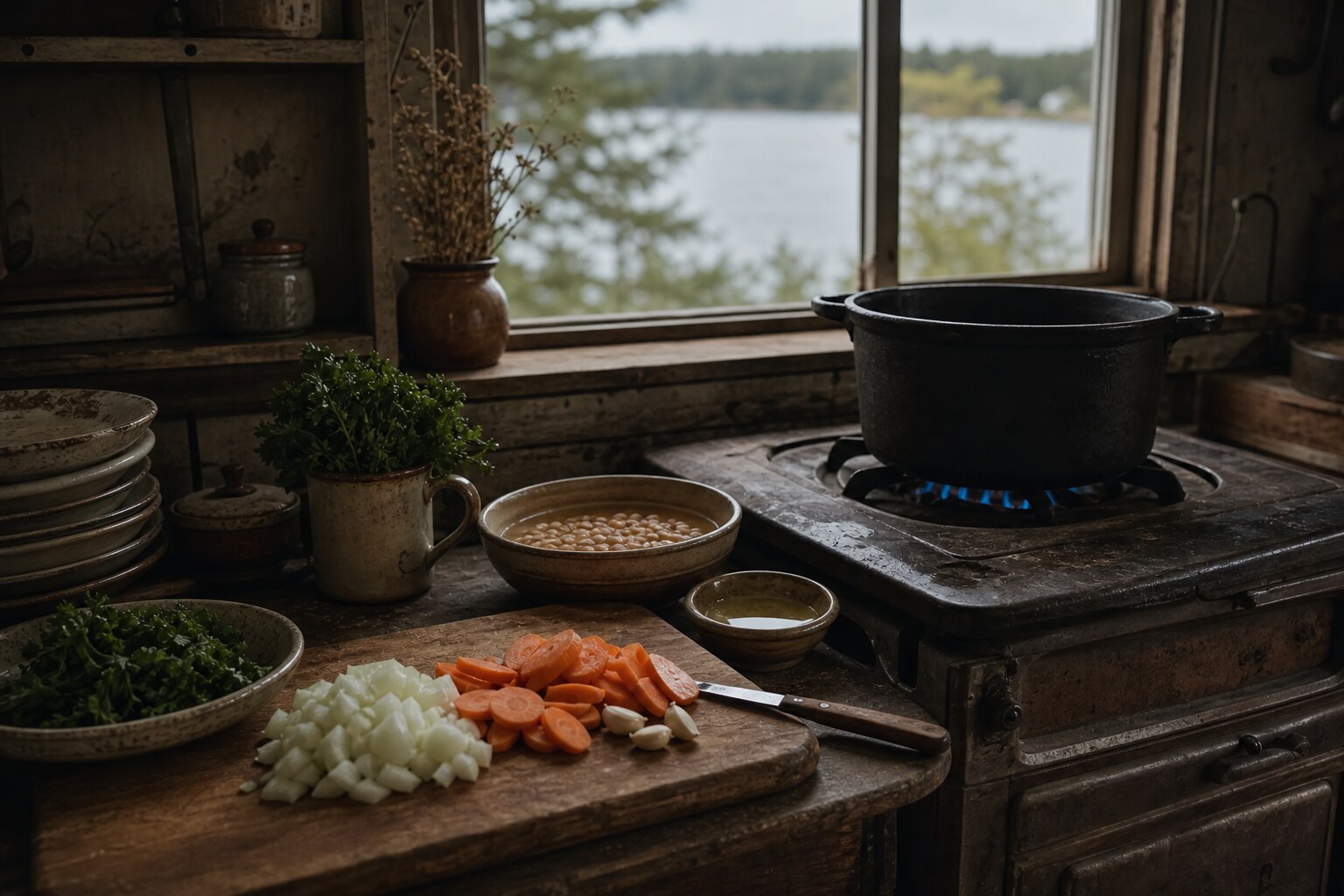
You lift it with two hands, or with one wrist braced and locked, elbow in, because a pan this heavy taken casually is how a wrist learns a lesson. The handle runs cold longer than the body. The weight of it is the first honest thing about it — it doesn’t pretend to be convenient. It sits on the burner like it grew there.
The surface is black. Not painted black, not enameled. Black the way a creek stone is black under water, a black that has depth to it, that catches light in a low sheen rather than a shine. Run a finger across it dry and it’s smooth, almost waxy, with a faint grain you can feel more than see. That’s not the iron. The iron underneath is gray and rough. This black is on top of the iron, laid over it, and it is made entirely of things that used to be food.
There’s one dull patch, off-center, toward the front where the heat pools. Matte where the rest is sheened. Something acidic went in there once — tomatoes, most likely, left too long, left to bubble down while I did something else — and the acid ate through the built-up black and bared the gray for a coin-sized spot. It’s been slowly healing over ever since, meal by meal, but you can still find it. It’s the scar that tells you what the rest of the surface is, by showing you the absence of it.
The black is seasoning, which is a tidy word for an untidy fact. It is polymerized fat. Oil and grease driven into the metal by heat, over and over, each firing laying down a film so thin you couldn’t measure it, the next one bonding to the last, until after years there’s a surface that isn’t the iron and isn’t the food but something the two of them made together without anybody deciding to. Some of it I put there. A lot of it I didn’t. The pan came already black, handed on, carrying layers from a stove I never stood at, meals I never ate, cooked by hands that seasoned it without once using the word. I’ve just been adding to a total that was well underway before me.
None of it was planned. That’s the part I keep coming back to. You don’t sit down and build a seasoning the way you’d build a fire, log by intended log. It happens as a side effect of feeding people. Bacon builds it. Cornbread builds it. Every time something fries and the fat takes the heat, a little more black gets laid down, an accident that accumulates into the whole functioning surface. The pan works because of everything that was ever cooked in it. Its usefulness is made of its past.
So the tending is strange, because the tending is mostly not-doing. You’d think a black greasy thing would want scrubbing. It wants the opposite. Hot water while it’s still warm, and a wad of chain mail — little steel rings — to knock off what’s stuck, worked in circles, firm but not angry. No soap flood. A splash if something really went wrong, rinsed fast, but not the sink full of suds you’d give a plate. Soap doesn’t ruin it the way people say — that’s mostly a story — but the flood, the soaking, the long submersion, that’s what lifts the black. Water is the enemy, not soap. Standing water most of all.
Then dry it, and here’s the one active step that matters: dry it on the burner. Rinse, back onto the flame, low heat until the last film of water steams off and the surface goes flat and dull-dry, then a wipe of oil on a rag, thin, the excess taken back off so it isn’t tacky. Hang it up. That’s the whole liturgy. Most of it is holding yourself back — not scrubbing to the metal, not soaking to get it “really clean,” not chasing the shine with force. The shine, such as it is, comes from restraint. You build it by declining to destroy it.
That took me a while to trust. The instinct is to make a thing cleaner by working harder at it, and cast iron punishes that instinct exactly. Scrub it bright and you’ve torn off years. The pan taught me that tending something sometimes means recognizing when it’s already right and keeping your hands off it — that the care is knowing the difference between dirt, which comes off, and seasoning, which is the point, and that the two of them can look almost the same to a nervous hand. A dry wipe. A knock of the chain mail. Leave the rest. The pan knows more about being a pan than I know about cleaning it.
It went back on its hook by the stove, still faintly warm through the oil film, black and smooth and matte-dry over the one healing scar. Below the hook the wall has a faint gray shadow where the pan swings against it. Hung up and ready, carrying under its surface every meal it ever made and every one it made for people I never met, none of them named, all of them still in there, waiting to season the next thing that doesn’t know it’s being cooked in the sum of everything before it.