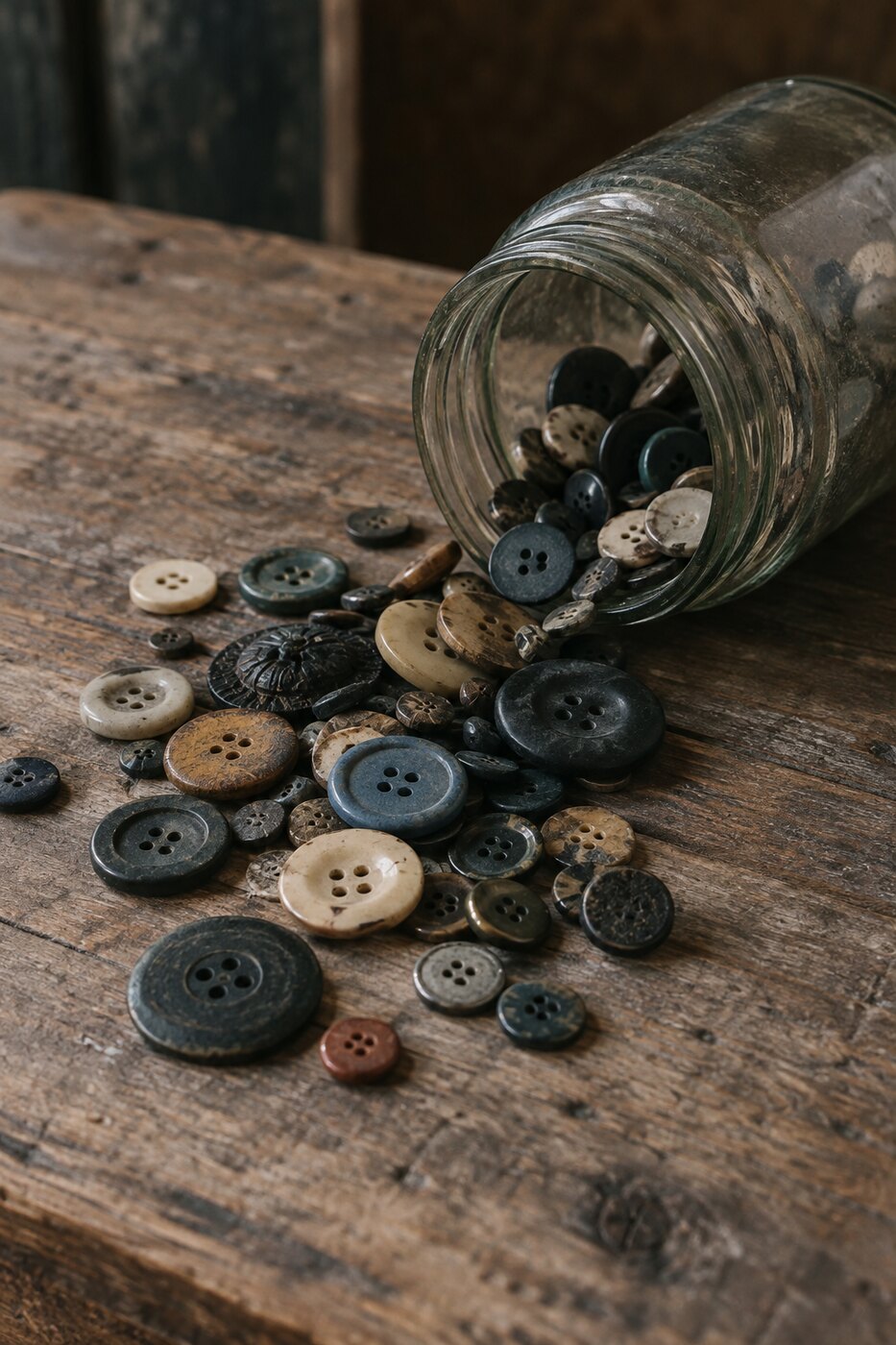
It’s a jam jar, or was, the label soaked off years ago and the glass gone slightly cloudy from the dishwater it never should have seen. I tipped it out onto the table and the sound is the first thing. Not a clatter. A pour. Buttons don’t fall like coins, all edge and ring. They fall soft and various, a hundred small taps in different pitches at once, and then a few loners rolling on their rims to the edge of the table where you catch them before they go over.
Spread out, they stop being a mass and become a crowd. Every one is different and every one is specific.
There’s horn — three or four of real horn, brown and streaked and slightly translucent at the thin edge, off a coat heavy enough that the buttons had to be sewn on with waxed thread. There’s brass, a domed military button with an eagle worn nearly smooth, from nothing anybody in this house ever wore, which means it came in already an orphan, in a bag of buttons from a table at somebody’s estate. There’s a shank button covered in cloth that used to match something, the cloth now faded to no color, the shank still sound. A toggle, wooden, the kind off a duffel coat, its partner loop long gone. A big flat four-hole in a red that was loud once.
And then the fours. There are always fours, or fives, or a run of the same button, and they are the saddest and the most useful. Four white shirt buttons, identical, the plastic gone a little yellow, cut off a shirt that was cut up for rags before the buttons were worth saving off it. Five black ones off a cardigan. They travel in packs because they came off one garment, all at once, someone sitting with the scissors deciding the wool was done but the fasteners weren’t.
That’s the thing about the jar. Each button is the last evidence of a piece of clothing that does not exist anymore. The horn coat is gone. The red-buttoned dress is gone. The military man is gone in a way that started before any of us. What’s left of each of them is this — one hard round object, or four, that outlived the cloth it was made to close. The garment rotted or tore or got handed down or torn into strips for washing the floor, and the buttons were cut off first, because a button is too much trouble to make and too easy to keep. So they went in the jar. And the jar remembers the wardrobe of the dead the way a graveyard remembers a town.
I was after a match. That’s why the jar comes out — never to admire it, always because a shirt has lost one and you need a twin. And here is the reliable cruelty of the button jar: the match is never there. I had the orphaned shirt-button in my palm, a pearl-gray four-hole, ordinary as bread, and I went through the whole spread twice. Grays, plenty. Four-holes, plenty. The right gray four-hole of the right size with the right depth of dish to it — no. Close ones. A shade off, a size off, a hole-pattern off. Close enough to mock, not close enough to sew. The jar holds a thousand buttons and never the one you came for. It holds the buttons off the shirts you already lost, not the shirt you’re trying to save.
You could throw it out. That thought arrives every time, somewhere in the second pass, when the match has failed and you’re just running your fingers through the pile listening to the pour of it. What is this, really. It is fasteners for clothes that are ash. It is the hardware of the departed. Nobody in this house has ever, in my memory, successfully replaced a lost button with the exact right one from this jar. The success rate is essentially zero.
And yet you cannot throw it out, and I know exactly why, and the why is not sentiment. It’s the argument the jar makes on its own behalf, which goes: a button is too useful to discard and too particular to ever use up. Both halves are true and that’s the trap. Too useful — because someday, maybe, a button will match, or you’ll need any button of roughly the right kind for the inside of a waistband where no one looks. Too particular — because you can never work through them, never render them down, they don’t combine or diminish, each one is its own single thing that answers to nothing else. So the pile only grows. Every garment that dies adds to it and nothing subtracts.
It’s a museum, is what it is. A small clouded-glass museum of clothes that no longer exist, admission by accident, assembled by scissors and thrift and the simple refusal to let a good closure follow a bad garment into the bin. Nobody planned the collection. It accreted. Coat by coat, cardigan by cardigan, one estate sale’s worth of somebody else’s fours at a time.
I gave up on the match. I usually do. I swept the spread back toward the mouth of the jar with the side of my hand, and they went in the way they came out, soft and various, the pour running backward, a few rims rolling. The military eagle went in face-up and looked at me for a second before a horn button covered it.
I screwed the lid down. It’s preparedness, is the story I tell. It’s a jar of readiness, in case. What it really is, is clutter with a legal defense — every last button too useful to throw away, and the shirt I came in for still hanging in the closet with a bare thread where the button ought to be.