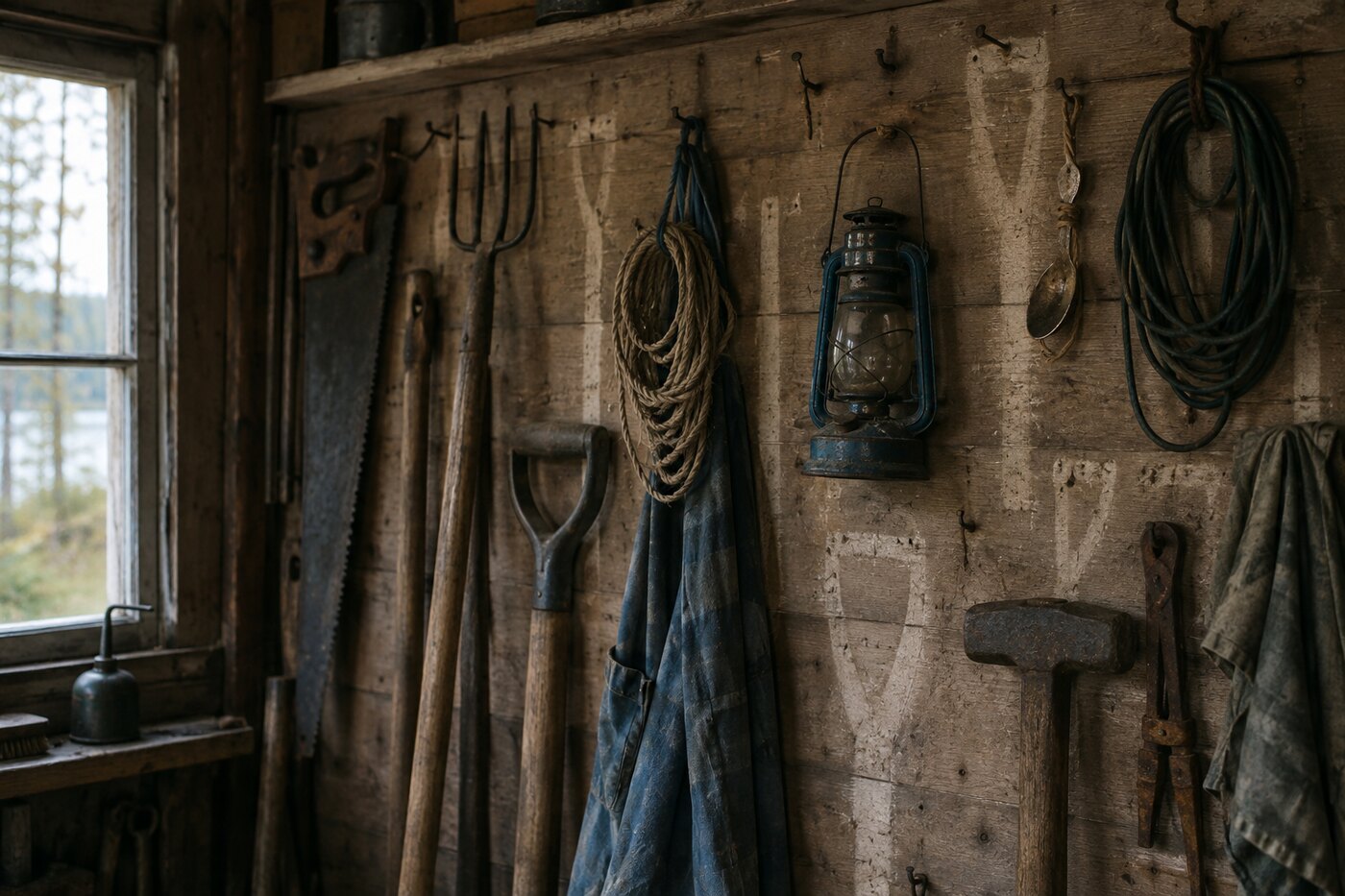
The wall by the door was the working wall, and you could tell because it was the one that had grown hooks. The other three walls held shelves, or held nothing, or held a window. This one held hooks, and the hooks had not arrived all at once. Nobody stood in that shed one afternoon and planned a wall. The hooks came one at a time, each one driven in on the day it was needed, at the height of the hand that needed it, and over years that produced a wall that no designer would draw and no hand could improve.
They were not even mostly hooks. That was the first thing. A few were proper hooks, the cup type you screw in, brass gone dull. But most were nails — big nails, driven halfway and then bent up with a hammer to make a lip, which is all a hook has ever really needed to be. One was a spike. One was a length of dowel jammed into a drilled hole and left to hold a coil of hose. And one, the good one, was a spoon. An ordinary tablespoon, bent double at the neck and screwed to the stud by its bowl, the handle curving out and up into a perfect small hook, and on it, a loop of twine. Somebody had needed a hook, had had no hook, had had a spoon, and had solved it. The spoon had been holding twine long enough that the twine had worn a bright groove across the curve of the handle where it rode.
The arrangement was by use, not by kind. This is the thing about a wall like that — it does not sort the tools the way a store would, all the wrenches together, all the pliers together. It sorts them by how often the hand reaches, and how far. The things used every day hung at the center of the wall, at chest height, where you could take them without looking: the flat pry bar, the hand saw, the hammer whose claw had its own dedicated bent nail worn shiny by the claw’s return. The things used less often drifted up and to the sides, into the corners, up near the top where you needed the step stool. A post-hole tool hung highest of all, in the far top corner, because you dig post holes once in a great while and when you’re done you want it gone, up and away, out of the daily reach. The wall was a map of frequency. Center meant often. Edges meant seldom. Height meant rarely. Nobody wrote that rule. Every hand that ever hung a tool back knew it anyway.
And the wall kept a record of what wasn’t there. Around each tool, over the years, the wood had darkened everywhere except behind the tool itself, where the hanging thing had shaded the wall from dust and light and hand-grease and the slow tan of age. So each tool sat in front of its own pale silhouette, its ghost, an outline the exact shape of itself. Which meant the empty hooks weren’t really empty. The empty hooks had ghosts too — a pale pair of pliers on the wall where the actual pliers were off somewhere in a pocket or lost in the grass by the fence, a clean bright shape waiting for a tool that might or might not come back. You could take inventory of the whole shed just by reading the wall, counting not the tools but the shadows, and the shadows outnumbered the tools, because a working wall is always missing a few of its own, out doing the work it exists to enable.
Some of the hooks held things that weren’t tools at all. A ring of keys, most of them to locks that were surely gone. A dog leash, stiff, the clip rusted, the dog presumably gone too, the leash left hanging because a hook holds what you put on it and asks no questions about whether you still need it. A cap. A single work glove, the right hand, its mate lost, kept in the honest belief that the left would turn up. The wall did not distinguish between the useful and the merely retained. A hook is a decision to keep a thing off the floor and within reach, and once made, the decision tends to stand long after the reason for it has quietly expired.
I hung the pry bar back when I was done, and my hand went to its place on the wall without my eyes, found the bent nail at chest height in the center, and the bar dropped onto it and swung once and stopped, exactly covering its own pale ghost, the shape matching the shape. That is the closest thing a working wall has to a made bed. Everything over its own shadow. Everything home.
Down at the bottom of the wall, below the lowest hook, a few things had given up hanging and simply leaned — a shovel, a rake, a length of rebar — and behind them, screwed into the stud at ankle height for no reason anyone now living could give, one more bent nail, holding nothing, its small pale ghost still on the wood behind it, waiting.