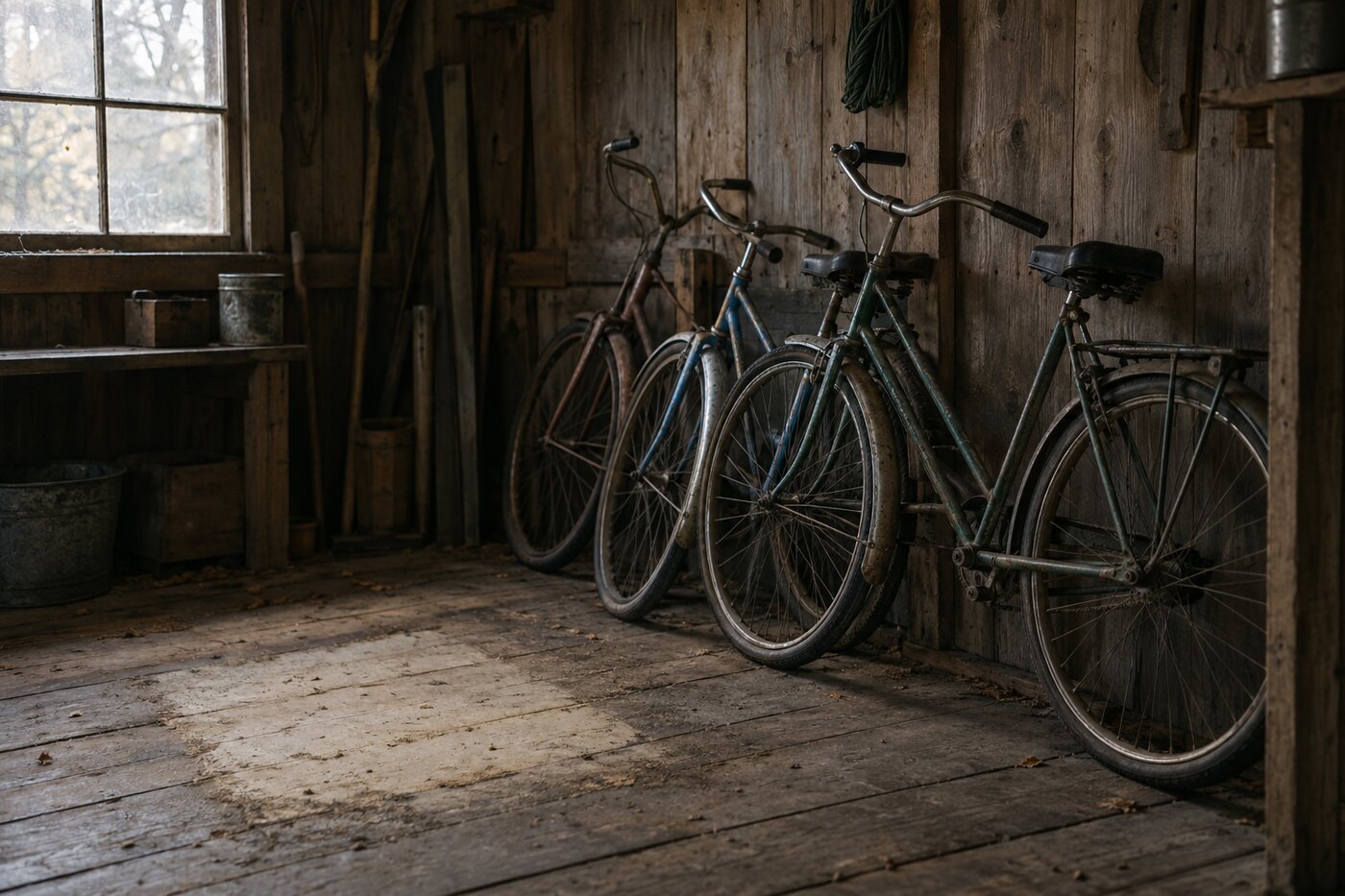
The door swelled in the frame, so you had to lift the handle and pull, and the shed let go of the jamb with a sound like a word. Inside it was dim and close and it smelled like gasoline. Not strong. Not fresh. The old kind of gasoline smell, the kind that has soaked into wood grain and stayed, gone slightly sweet, the volatile part long since evaporated off and only the heavy part left behind, down in the fiber. There had not been gasoline in that shed for years. There were three bicycles.
They leaned against the long wall, and they only fit because someone had turned the middle one’s handlebars sideways, cranked ninety degrees so the bars nested into the gaps left by the two beside it. That was the shed’s capacity, stated in bicycles: three, if you respected the handlebars. A fourth would have to lie down. The bikes were a family’s worth — a big one, a middling one, and a small one with training wheels still on, though the small one’s tires had gone soft and the rubber had taken a flat where it had sat too long in one spot against the floor.
The floor told the older story. In the middle of the planks there was a rectangle, roughly three feet by two, where the wood was a different color — darker, stained, the grain gummed with something that had dried to a low shine. That was where the mower had stood. Years of it. The drips off the deck, the little overflows from filling the tank, the black weep of oil from the crankcase gasket, all of it going down into the same rectangle of floor, week after cutting week, summer after summer, until the wood there stopped being wood the way the rest was wood and became a kind of record. The bicycles stood off to the side of it. Nobody parks a bicycle where the mower’s ghost still is. You just don’t. The rectangle keeps its place at the center of the floor and the new tenants arrange themselves around it.
Along the back wall, a shelf held the leftovers of the old job that the new job hadn’t cleared out. A funnel with a crust in its throat. A red plastic can, empty, the spout capped, kept because an empty gas can is still a gas can and you do not throw one out. A spark plug, single, standing on its threads. A coil of starter rope, frayed at the pull end. None of it belonged to bicycles. All of it stayed. A shed that changes jobs does not fire the old staff. It just stops giving them work and lets them stand on the shelf.
It was the damp that brought the smell up. I noticed it because the morning had rain in it, and rain in the air makes old wood exhale. Dry, the shed smelled mostly of dust and cut grass gone to hay somewhere in the walls. But damp, the gasoline came up out of the floor and the studs and stood in the room at chest height, and for a moment the whole building was a mower shed again, whatever the bicycles had to say about it. The wood had absorbed the machine’s whole working life and the wood would give it back a little at a time, on the wet mornings, for as long as the wood lasted. The building had changed jobs. The air was still finishing the last one.
You could see, too, the marks of how the mower used to come and go. The threshold plank was worn in a curved sweep, a shallow arc scooped out of the wood where the machine’s wheels had been muscled up over the lip, in and out, hundreds of times, always along the same short radius because there was only one way the thing would turn in a space that size. The bicycles left no such mark. They were carried over the threshold, lifted, their tires never touching the sill. So the arc in the threshold was pure mower, an honest fossil of the old traffic, and it would stay scooped that way long after anyone remembered why.
A nail on the back of the door held a hat, and the hat was for yard work, stained dark around the band, and it had nothing to do with bicycles either. Somebody had hung it there when the shed was a mower shed and never taken it down, and now it hung in a bicycle shed, unmoved, the way a thing hangs when the reason it was hung is gone but the nail is still good and the hat still fits somebody. I didn’t take it down. You leave the hat.
I got the middle bike out by reversing the trick — turned its handlebars square again, walked it backward past the mower’s rectangle, lifted it over the scooped threshold so its tires never learned the arc. Behind me the shed exhaled once more as the door came free of the swollen jamb, and the gasoline came with it, out into the wet morning, thinning as it went.
On the floor, the small bike stayed leaned against the wall on its soft flat tire, and the flat spot in the rubber held its shape, pressed against the plank, not rolling back to round.