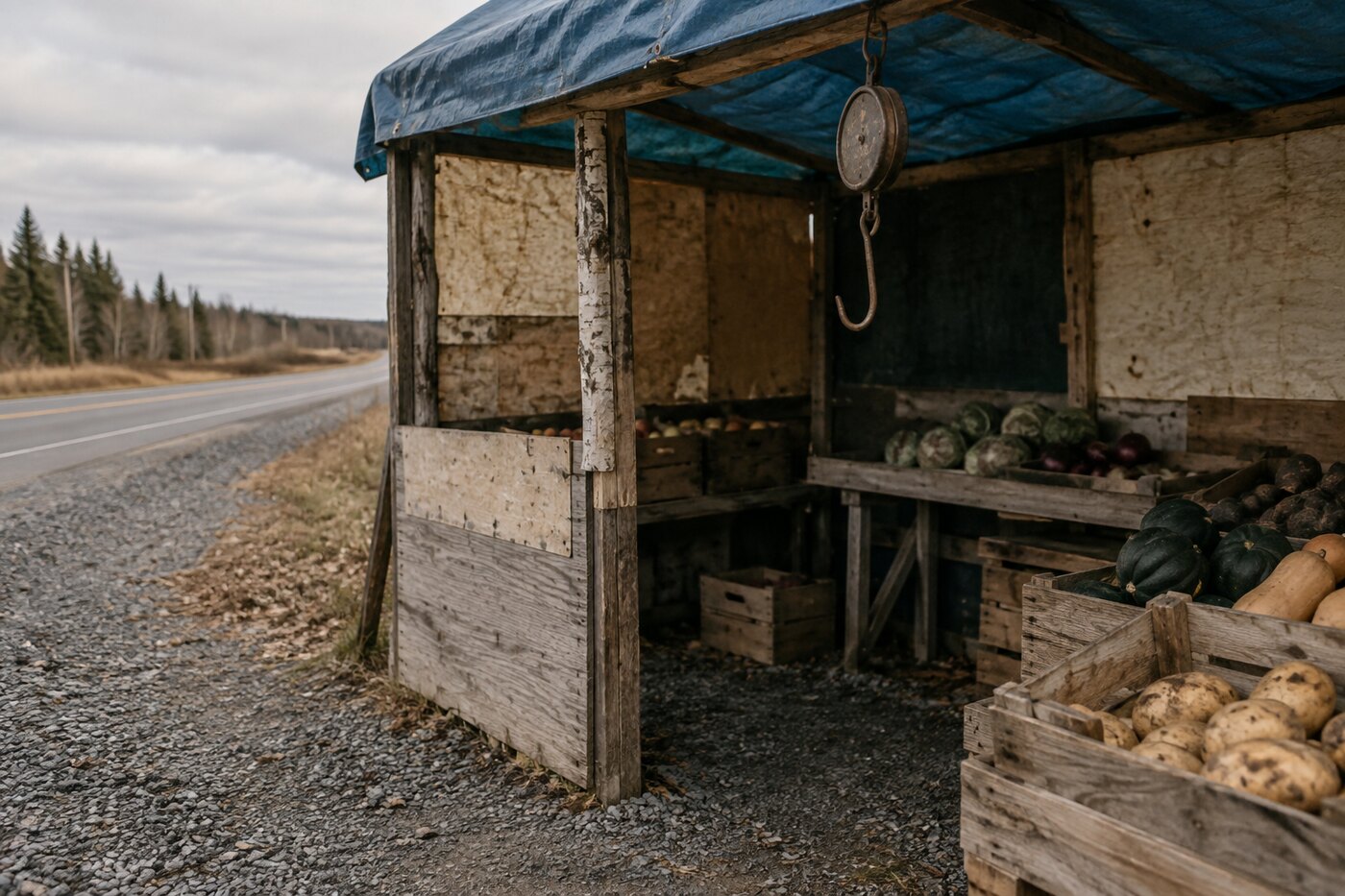
The stand sat back from the shoulder by the width of a truck, on the flat spot where the ditch gives up before the field starts. I pulled off onto the gravel and the gravel was packed hard in two lanes, one for coming in and one for going out, worn down to a paler grit than the loose stuff around it. Nobody had graded that. Tires had. Enough summers of the same slow turn off the highway and the ground remembers the turn.
The roof was a tarp. Blue once, now the gray-blue of a tarp that has spent its faith on four or five seasons of sun. It was lashed to a frame of two-by-fours with baling twine and, in two corners, with the ribbed orange cord you buy for tying loads. The twine had gone furred and soft. The orange cord still held its shape, still bit into the wood at the knot, and had worn a shine into the corner of the frame where it crossed. You could see which corner faced the prevailing wind by how deep the cord had cut. The northwest corner. The tarp bellied and slapped there even in the small breeze off the passing traffic, so the frame had been braced with a diagonal that wasn’t in the other three corners. Somebody had learned that the hard way, in a storm, probably at night, and had come back with a scrap of two-by-four and a fistful of screws and made sure it didn’t happen twice.
The sides were plywood, and the plywood was not from one year or one life. The back panel was the oldest, gone silver, the grain lifted into ridges you could read with a thumbnail, the knots standing proud where the softer wood around them had weathered down. Somebody had painted it green a long time ago and the green survived only in the low places, in the checks and the nail holes, like water finding the bottom of a field. Over that, a newer sheet, still faintly the color of a lumberyard, screwed on with the bright screws that hadn’t had time to rust. And a third piece, half a sheet, orange from a different project — you could see the ghost of a stenciled letter on it, part of an R, from whatever it had been before it was a wall. Three decades of plywood standing shoulder to shoulder, doing the same job, none of them matching, all of them square.
The table was one long door laid across two sawhorses, and it tilted. Not by accident and not by design either — by the ground. The downhill sawhorse had sunk into the softer dirt at the ditch edge over the years, a little each spring when the frost let go, and nobody had jacked it back up. Instead they’d put a flat rock under the uphill legs of a wooden crate, so the crate sat level even though the table under it didn’t, and the tomatoes in the crate didn’t roll. The correction was for the tomatoes, not the table. The table was allowed its tilt. You accommodate the part that complains.
There was a scale, or the hook for one, a bent nail up under the tarp’s ridge where a hanging scale had swung. The scale was gone, taken in for the night or taken in for good, but the hook stayed, and the wood around it was polished dark from a hand reaching up to steady the pan. Below it, screwed to the front rail of the table, a coffee can with a slot cut in the plastic lid. An honor box. The slot’s edges were furred white where thumbs had pushed folded bills through, year after year, softening the plastic the way a path softens grass. You could see the money had mostly been small and mostly been folded. The can didn’t lock. It didn’t need to. The whole structure ran on the arithmetic of a road where everybody would pass this way again.
What struck me, standing there with the traffic going by at highway speed a truck-width away, was how thoroughly this thing had been built to be taken down. Nothing was poured. Nothing was sunk. The sawhorses folded. The tarp untied. The plywood was screwed, not nailed, so it could come apart and go flat in the bed of a truck. Every joint was a temporary joint. It was a building that had been designed, from the first board, to leave in the fall and not be there in the winter. And it had leaked out of that intention entirely. The packed gravel lanes, the sunk sawhorse, the wind-brace in the northwest corner, the polished hook, the furred slot in the honor box — none of that was the plan. The plan was to be temporary. The use had voted otherwise. The ground had voted. The stand had been coming back to the same square of shoulder long enough that the shoulder had shaped itself to receive it, and the difference between temporary and permanent turned out to be nothing but repetition, done slowly, without anyone deciding.
I bought nothing, because there was nothing out yet — too early in the day, or too early in the season, the crates empty and stacked and waiting. The tarp moved. The orange cord held. Somewhere down the field a truck was probably loaded with the first of whatever would fill these crates by afternoon.
On the front rail, in the empty coffee can, a single quarter lay in the bottom, left over from some transaction that hadn’t quite squared, catching the light through the slot, too small to be worth reaching in for.