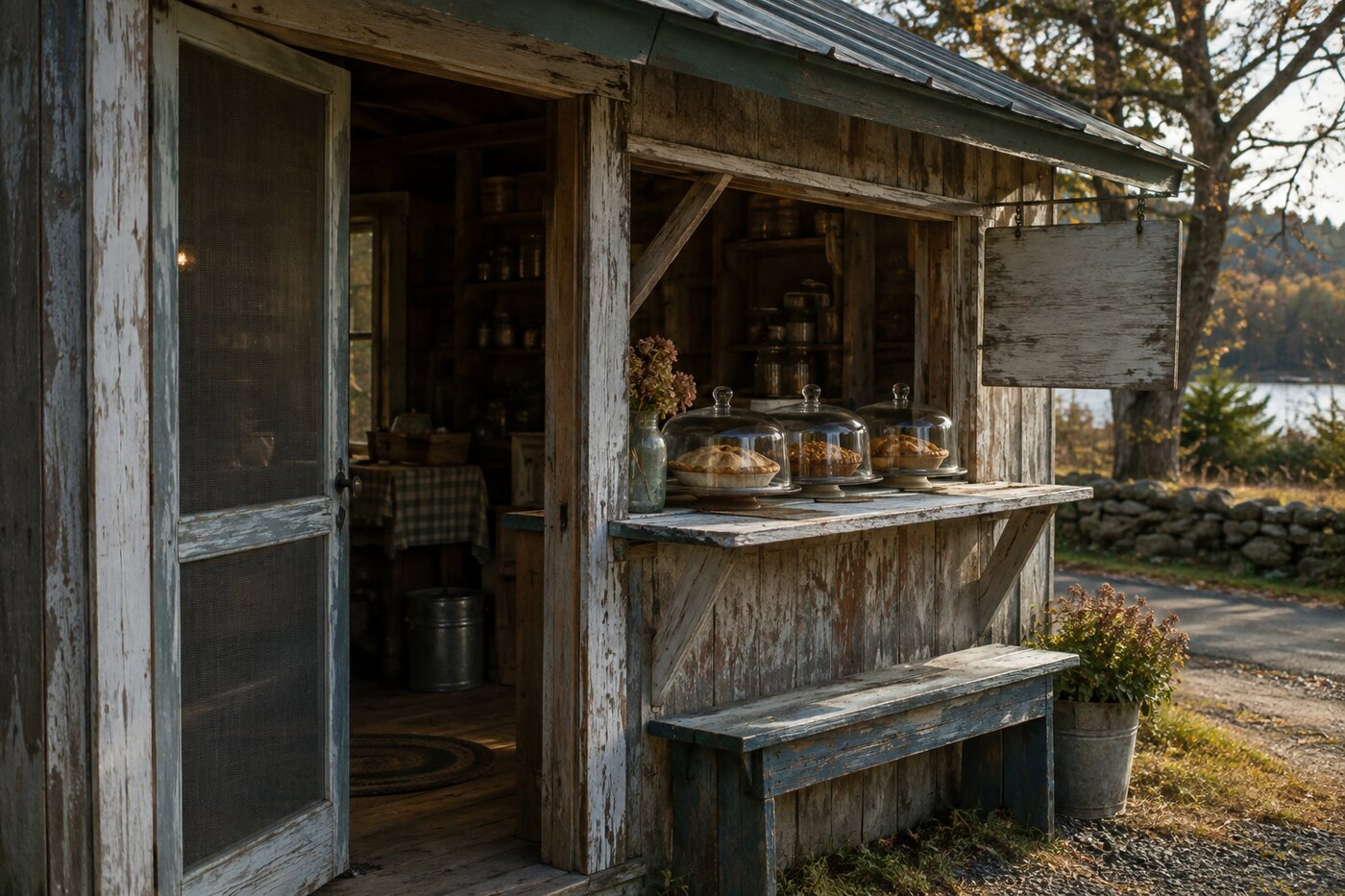
The shed was barely bigger than the counter inside it, which was the point. It held a person, a counter, and the pies, and it did not pretend to hold more. You could have touched both walls with your arms out. A building sized to a short season and a small perishable thing.
The screen door was the front of it, and the screen sagged in its frame, bellied out at the bottom where hands had pushed through instead of using the handle, a soft gray pouch with a shine where the pushing happened. It slapped shut behind you on a spring gone lazy, catching the frame with a wooden clap. The whole building announced every customer with that clap.
The board out front was hand-lettered, PIES in big paint and the kinds in smaller under it, one wiped off and rewritten so the wood showed a ghost of the old flavor under the new. Whoever lettered it had run the last word downhill, out of room, the way hand-lettering always runs out of room.
Inside, the pies sat under glass domes, and in the afternoon they were going warm. The sun came through the screen and lay across them and the domes held the heat, so there was a bead of condensation on the inside of the glass over each pie, the crust sweating under its own dome. The smell was fruit and butter and warm wood and the tin of the pie plates, close and thick in a space too small to let it thin out.
The counter’s edge was worn pale where the pies had slid across it, out from under the dome, into the box, out the sagging screen door to a car idling on the shoulder. All day the same short trip, until the wood was smooth as a handle.
A wasp had found the seam of one dome and was walking the glass, looking for the way in to the warm crust beneath, and the sun kept up its work through the screen, taking the pies one slow degree warmer toward evening.