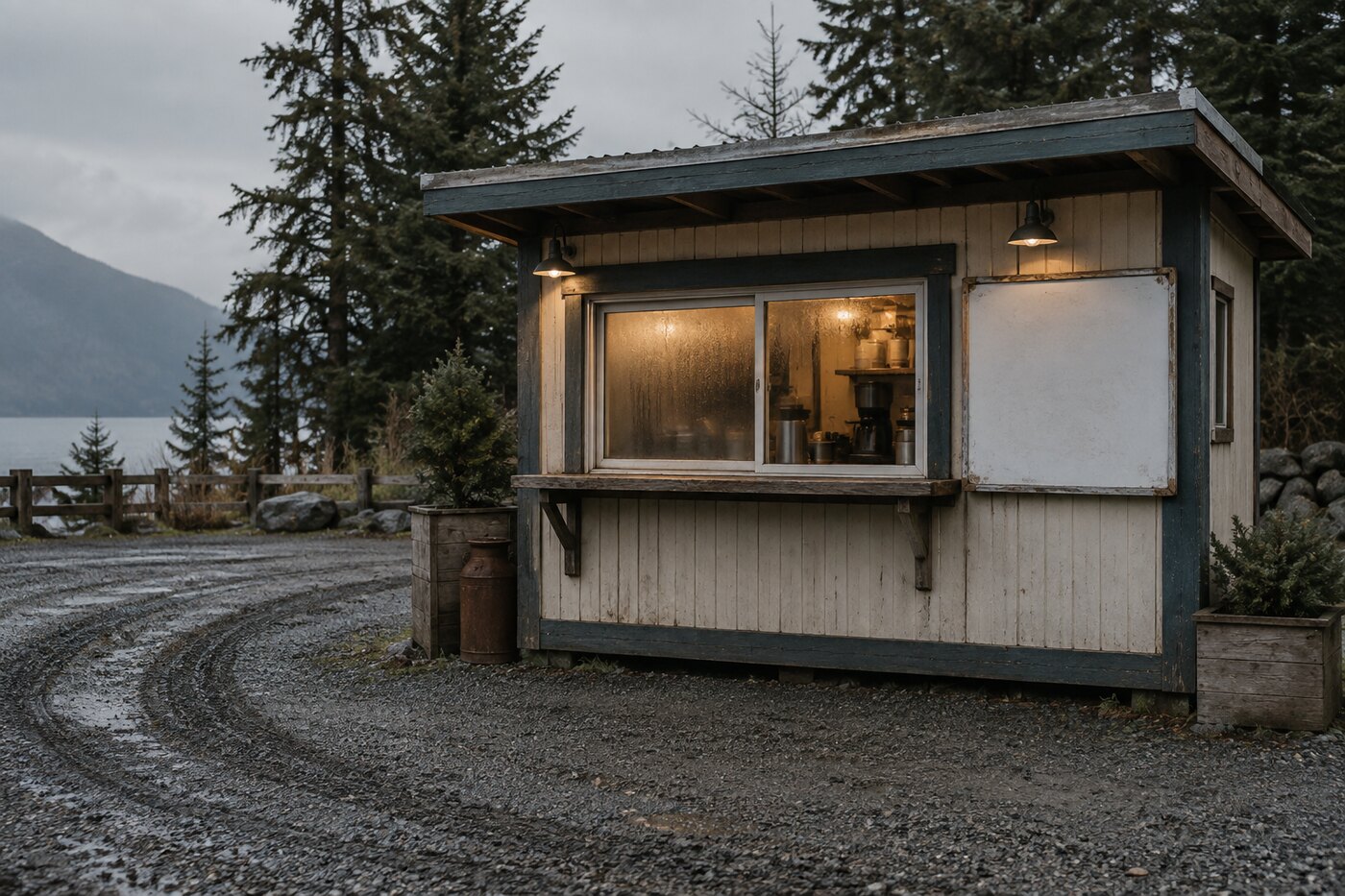
The hut was shed-sized, set at the edge of a gravel lot with its serving window aimed at the way cars would come in. One small building, one window, one job. Everything about it was arranged around the arc a car makes when it pulls off the road, slows, and rolls up to a window without the driver having to get out.
The window slid sideways in its track, and the track had gone bright, the aluminum worn shiny where the glass rode back and forth a hundred times a morning. The glass was fogged low down, a band of condensation across the bottom third, the breath of the machines inside meeting the cool outside. Above the fog you could see the whiteboard, the menu in marker, a price changed by wiping a thumb through the old number and writing the new one beside the smear.
The step told the most. Not a step up — a step down, the ground below the window worn into a shallow hollow, the gravel packed hard and dished where drivers had reached out and up a thousand times. The lot’s gravel was loose everywhere else and packed to concrete right there, in the one spot the whole business happened.
And the arc. Across the lot, curving in from the road to the window and out again, two worn tracks in the gravel, the tire path pressed in season after season along the same line, because the geometry of pulling up to a window is always the same. While the hut was closed the arc stayed, a pale double curve stained into the lot, the shape of a habit the building had taught the cars.
The window was shut now, the whiteboard wiped to a gray ghost of the last menu. On the inside of the glass the condensation had dried to a film with a few clear finger-streaks through it, where a hand had reached to slide the window. Outside, the lot kept the tire arc, waiting for the season to fill it in again.