The house had two front doors and only one of them worked, though both of them opened. The official one faced the road, up three painted steps, under a little roof with brackets somebody had once cared about. It had a brass knocker and a coat of paint newer than anything else on the house, and it was, for all practical purposes, a decoration. Nobody came in that way. The paint on it was newer because the paint on it never wore off, because a door that nobody touches does not wear.
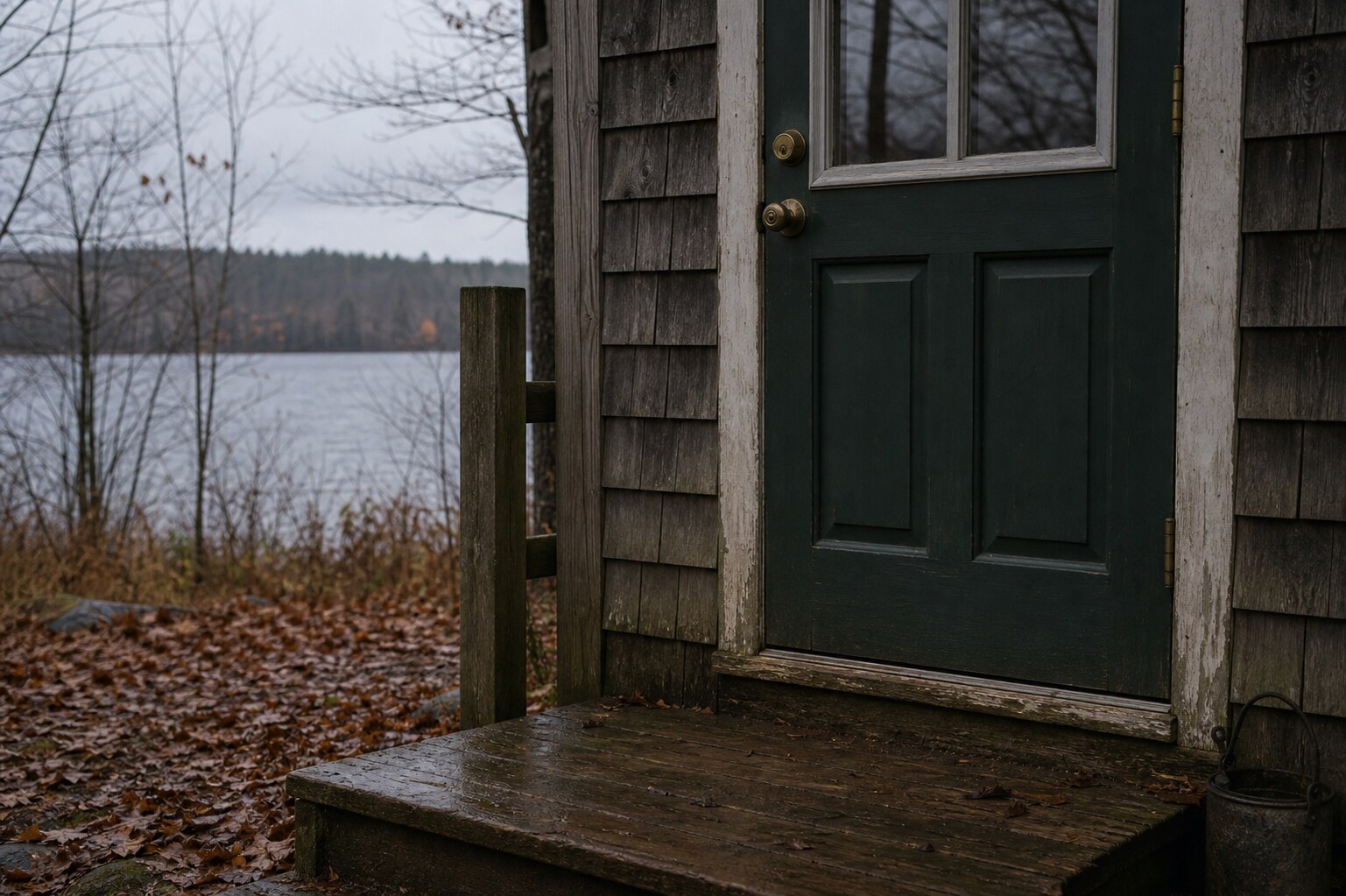
The real front door was around the side, off the porch, and it was where the house actually let people in and out. You could tell which was which without being told. The official door’s threshold had a fine bloom of grit on it, undisturbed, the dust that settles on a step no foot clears. The side door’s threshold was worn to bare wood in a curve exactly the shape of a stride, the paint scuffed off in a fan where a thousand boots had swung over it, each one taking a little.
The porch door was the honest one because it carried the traffic, and traffic is what makes a door into a door. The knob had gone the color knobs go when hands are the only finish — the paint worn off the neck of it, the brass under showing warm and smooth where palms had closed on it in every weather, so the metal had a shine that no polish gives, the shine of use. Around the knob, on the doorframe, the wood was dark and slightly greasy at hand height, the place where people push the door the last inch when their hands are full and the knob is already turned. A door tells you where the hands land. The hands land in the same place ten thousand times and the place goes dark.
Below the door the story got more physical. A boot scraper, a bent iron blade set in the porch board, worn bright on its edge. A mat gone flat and black past reading, the bristles laid down all one direction by the swipe of soles. Beside the mat, along the clapboard, the boots themselves lived — the actual boots, four or five pairs, because this was the door where footwear changed states, and a door that handles boots accumulates boots the way a shore accumulates driftwood. Rubber ones, leather ones, one pair caked and dried mid-stride. A house’s real entrance is always ankle-deep in the evidence of coming and going.
The porch itself had organized around the door’s job. The floorboards in the traffic lane — from the top step, past the boots, to the threshold — were worn pale and slightly dished, sanded down by grit and soles, while the boards over by the railing where nobody walked kept their gray paint and their nap. You could see the path across the porch as plain as a trail through grass, a lighter river of wood running from the steps to the door. The house had drawn its own map in wear. The map did not match the plan. The plan said the front was the front. The wear said the front was the side.
Everything that came to the house came to this door. The groceries came in here, and there was a shelf beside it, just a board on brackets, for setting a bag down while you got the door — worn in the middle, a pale hollow the size of a paper sack. The deliveries came here; there was a note taped inside the storm door glass, curled and sun-yellowed, that said in faded pen to leave packages on the bench, and the tape had gone amber and let go at one corner. The dogs came in here wet, and the bottom two feet of the door had the scratch marks to prove it, a hatchwork of pale claw lines in the paint where a hundred times a wet dog had asked to be let through faster than the person could manage the knob.
The storm door had a spring closer that had lost its argument with the years, so the door no longer shut on its own but stopped an inch short and hung there, and everyone who used it had learned the little backhand pull that latched it, a gesture the whole household knew and no visitor did. That is another way to tell the working door from the ceremonial one. The working door has techniques. It has a knack you inherit by living there. The ceremonial door just opens, correctly, for the few times a year it opens at all — a funeral, a formal guest, a piece of furniture too big for the side.
I went in the way the house wanted, around the side, over the worn threshold, past the boots. My hand found the dark grease spot on the frame without my telling it to, the last-inch push, the knack. Inside, the official front door stood at the end of its little hall with its newer paint and its brass knocker and its undisturbed threshold, shut and bolted and clean, facing the road, keeping up appearances for a traffic that had moved to the side of the house years ago and left the front to hold the address and nothing else.
On the porch behind me the storm door hung its inch short, not latched, because I had forgotten the backhand pull, and the spring that couldn’t close it also couldn’t quite hold it, so it moved a little in the draft off the steps, open and not open, the way it had hung for years.