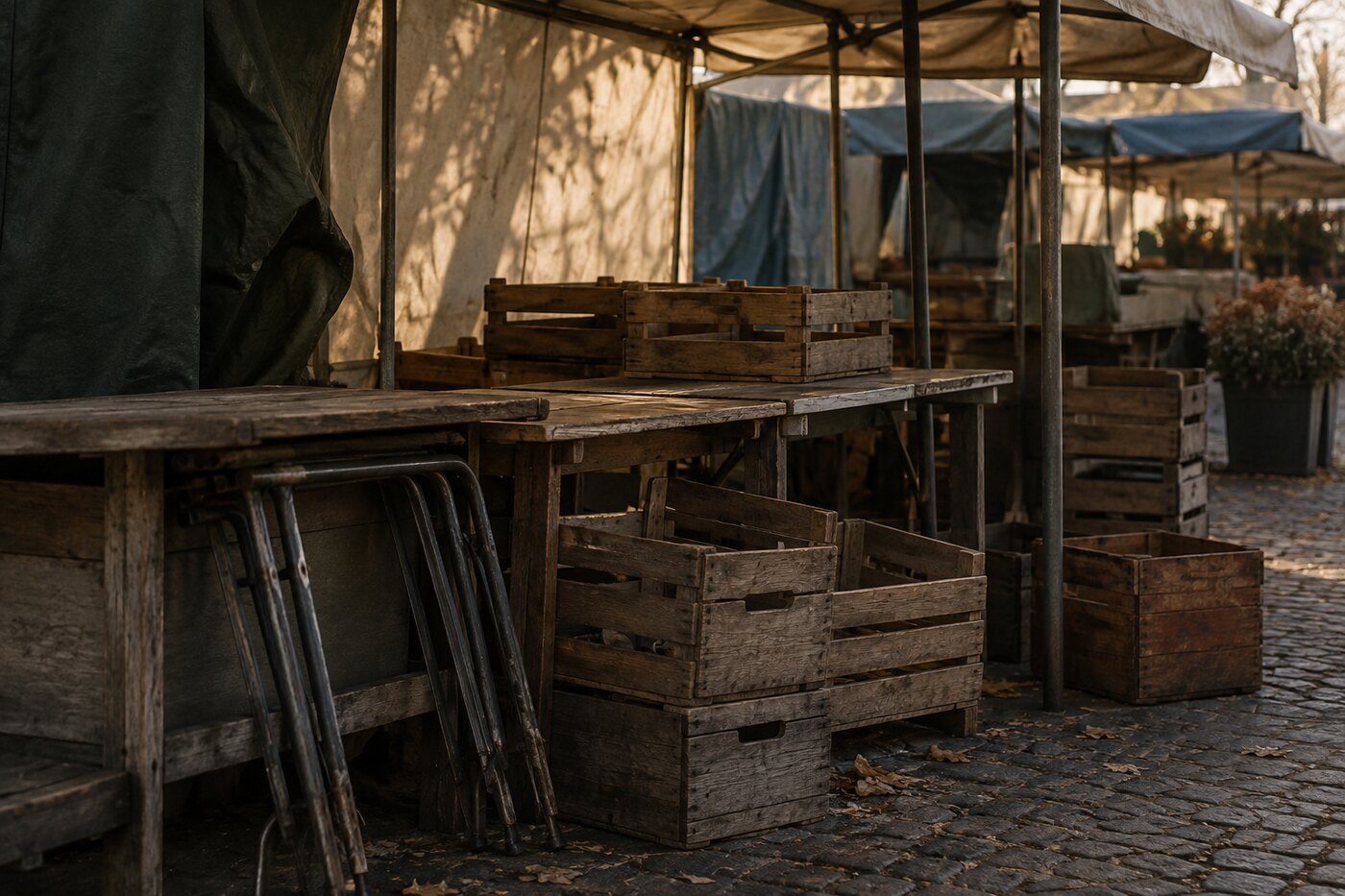
By the time I got there the selling was over and the structure was showing through. All morning the stall had been a wall of color, and color hides the frame the way a full house hides its floor plan. Now the produce was gone or nearly, and what was left was the thing the produce had been sitting on all day — the bones of a small building that assembled itself at dawn and would come apart before dark.
It was mostly a canopy and a habit. Four legs, a peaked top gone soft and gray at the creases where it folded, a frame that had been put up and taken down so many times the joints had worn loose and swung a little in any wind. The whole thing was a building only by agreement. But it had kept a day inside it, and now that the day was sold out you could see how the day had been shaped.
The crates told it first. Empty wooden ones stacked crooked at the back, each with a dark ring inside where the wet bottom row of something had sat and sweated all morning — a stain the shape of what had been there, beans or greens, a damp print of sold inventory. One crate still had three tomatoes in it, the soft ones, the ones with a shoulder gone or a split skin, set aside early and never sold and now not going to be. Bruised produce is honest about the day. The good ones leave. What stays is what the day couldn’t move.
The floorboards under the stall — not real floor, just two sheets of plywood laid over the grass to keep the mud down — were dark with tracked-in wet and the leaf litter of a morning’s handling. Trimmed radish tops. A curl of corn husk. The rubber bands that had held bunches together, snapped and dropped, a scatter of little red and brown loops all over the plywood like the day had been unbuckled. It smelled of that: cut greens and turned earth and the sweet-rot edge of fruit that had gone one hour too far in the heat under the canopy. The smell was strongest low, near the crates, where the day had settled.
There was a length of board across two upright posts with cup hooks screwed into it at intervals, and the hooks were empty now. In the morning they had held the plastic bags, a fat roll on each hook, and the herb bunches, and a hanging scale. Empty, the hooks just looked like a row of small questions. The scale was down and boxed. One hook still had a single bag on it, blown half-inflated by the breeze, holding the shape of an air nobody had bagged on purpose.
The cash setup was the most worn part of the whole structure, which is how you find the register in any building — follow the wear. One corner of one table, the near right corner, was rubbed pale and smooth where a thousand transactions had happened, where hands had leaned and coins had slid and a box had opened and shut all morning. The rest of the table was rough. That one corner was polished by commerce down to the grain. The box was gone now, taken to the truck first thing, the way the money always leaves before the lettuce.
They were folding the legs when I watched. That is the moment the building admits what it is. A woman knocked the catch on a table leg and the leg swung up flat against the underside, and the table stopped being a table and became a thing to carry. Then the other leg. Then the whole surface tipped and slid into the truck bed edge-first, and where it had stood there was a rectangle of flattened grass, greener than the grass around it, pale and pressed, the ground keeping the footprint of a store that had been there for six hours.
The canopy came last, always last, because it is the roof and you work under the roof until you can’t. They pulled the pins and the frame concertina’d down with that scissoring sound the joints make, and the peak sagged and came to the ground, and the little building exhaled and was a bundle. It went over a shoulder. The lot opened up where it had been.
What was left was almost nothing and told almost everything. The pressed rectangle of grass. A dark patch of ground under where the crates had leaked. A scatter of rubber bands and husk and one tomato that had rolled clear and sat by itself in the open, red going to the ground’s brown at the split. The plywood sheets, lifted, left two clean pale rectangles on the grass and a fringe of pale worms and startled beetles that had been living the good damp life under there since morning and now had the sun on them.
The truck pulled out. The stall that had been a wall of color at nine o’clock was a set of tan lines on a field by four, and the field was doing what fields do, which is not care. In a day the grass would stand back up. In three the rectangle would be gone.
The soft tomato stayed where it had rolled. A wasp had already found the split in it and was working the wet edge, unhurried, the only commerce left on the lot, taking what the day had marked down to nothing and left behind.