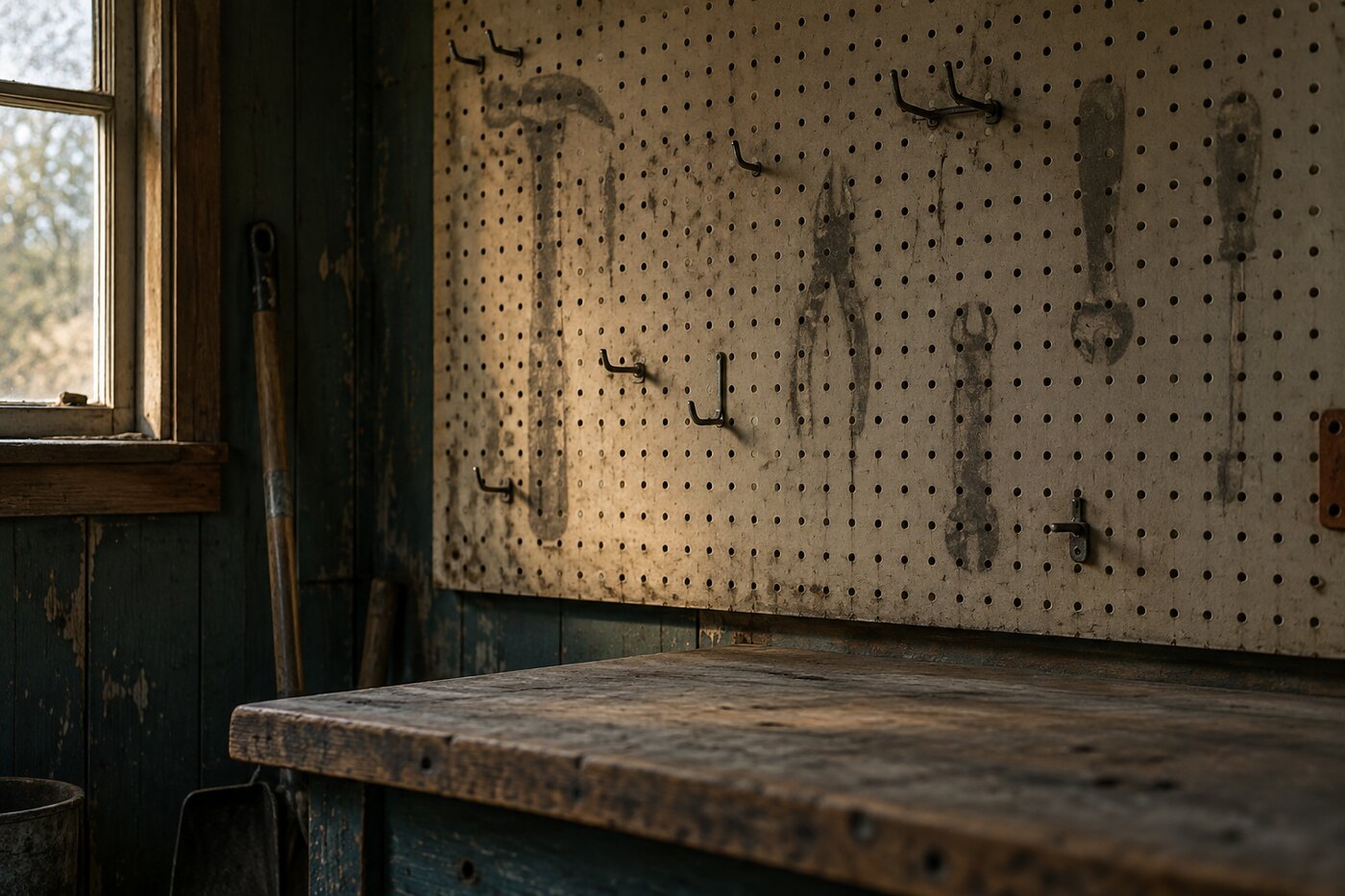
The wall was the color paint goes when it stops being white and starts being a surface. Not gray. Just used up, a flat skin of it over old board, gone the yellow of a callus. I had come in for the long bar clamp and stayed because the light was low and coming in sideways from the one window, and sideways light is how you read a wall like this. Straight on it says nothing. At an angle it gives up everything.
The first thing it gave up was the outlines. Somebody, years before my time in the place, had traced the tools in black marker where they hung. A hammer. Two hand saws crossed like a coat of arms nobody meant. A square. The paint had faded around the tools while they hung, so under each drawn shape sat a second shape, brighter, the wall’s true old color held in reserve behind the thing that shielded it. Ghost and outline both. The marker said where the tool went. The clean paint said how long it stayed.
Most of the tools were gone. The outlines kept their appointments anyway.
I ran a thumb across the pegboard. It had that soft chalk of old hardboard, the brown coming through where the finish had worn off around every hole that ever held a hook. The holes are the honest part. A hole that carried weight is bell-mouthed, worn wider on the lower edge where the hook pulled down against it for twenty years. A hole that never held anything is just a hole, sharp and round and innocent. You can read the work off the wear the way you read a road off its ruts.
There was a rectangle low and to the right, brighter than everything around it, the size and proportion of a socket set case. Unfaded. The plastic that had leaned there for a decade or two had kept the sun and the woodstove smoke off that patch, and when the case left it left its shadow behind in reverse — not a dark mark but a light one, a window of the original paint. The set was long gone. The wall was still holding its place.
Hooks without current assignments. That was most of them. A bent nail with a loop of baling wire that had once been an intention. A pair of screw-in hooks a hand-span apart, the right distance for a level, though no level hung there now and no outline said one ever had. Somebody had just known. The knowing was in the spacing. Two hooks the wrong distance apart for anything I owned, waiting on a tool I would have to go out and buy to make them make sense.
The smell was cold metal and the ghost of gear oil, and under it the mineral smell of concrete that never fully dries. When I leaned close to the pegboard there was creosote in it too, from the stove, soaked into the board grain along with everything else that had ever been in the air of the room. A wall breathes slow. It keeps a season behind the weather outside. In there it was still faintly last winter.
I found a shelf bracket screwed in at a height that made no sense until I stood back. Eye level for someone taller than me. A man reaches for the thing he uses most at the height his own arm finds without looking, and screws the hook there, and every reach after that is a small unconscious measurement of him. The wall had been arranged by a body I never met. I kept banging my knuckles on a hook set for a longer forearm.
Screw holes with no screws. Screw holes with the screw sheared off flush, a little steel freckle you only find with a fingernail. Two coats of paint, and where the top coat had chipped, the older color showed through — a green, industrial and confident, the green of a time when people painted a garage wall a real color and meant it. Someone had covered the green. The chips were slowly voting it back.
Down near the bench the wall changed character. Grease had gone into it there, worked in by shoulders and sleeves and the backs of hands, a dark polished band at the height a person stands to work. Not dirt sitting on top. Dirt that had become the surface, buffed by use into something almost deliberate. Above the band the wall was a record. At the band it was a habit still happening. My own sleeve added to it while I stood there reading the rest.
The clamp I had come for hung where the outline said clamps went, one of the few tools still keeping its drawn appointment. I lifted it off and the hook swung a little, empty now, and the bright rectangle behind it showed for the first time in years — the wall’s saved color, the true old paint, a clean bar of it exactly the width of the clamp, waiting to fade to match everything around it now that the shield was gone.
I took the clamp and left the wall to it. The light had moved off the pegboard and the outlines had gone quiet again, back to being marks. Behind me the fresh pale rectangle sat there in the dimness where the clamp had hung, already beginning, though you couldn’t see it yet, to catch up with the rest of the wall.