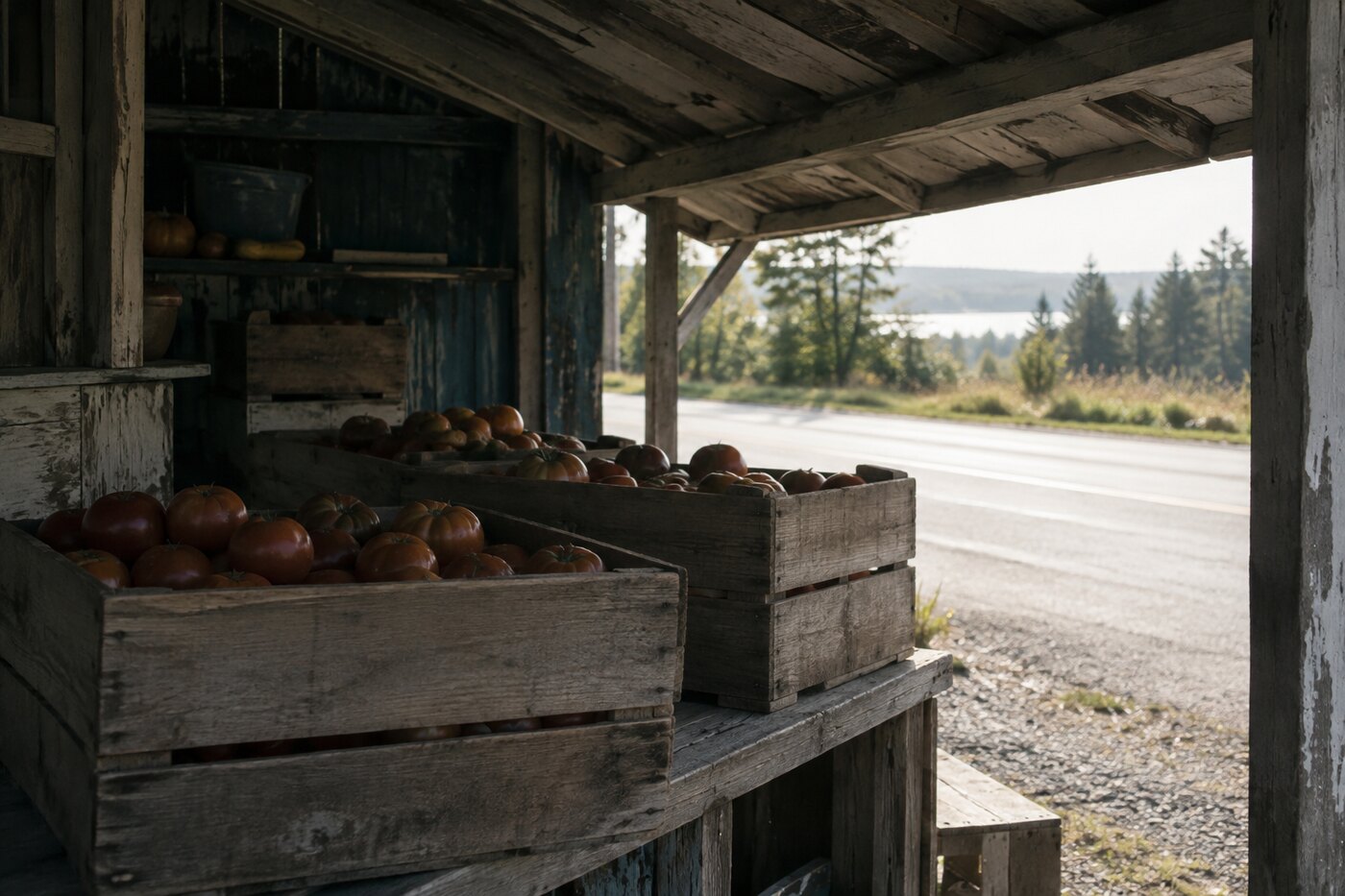
The roof was a sheet of tin on four two-by-fours, pitched just enough to run water off the front, and it was doing everything. You could stand at the stand and watch it work. It threw a hard line of shade across the crates, and the line moved through the morning, and the whole business of the stand had arranged itself along that line.
It wasn’t much of a roof. Corrugated steel, gone chalky, a rust bloom starting at every nail where the galvanizing had given up. Two of the sheets overlapped down the middle and the overlap wasn’t quite tight; you could see daylight through it in a thin seam, and under that seam, on the plywood counter, was a pale stripe where the sun had bleached a line that the rest of the counter, kept in shade, hadn’t taken. The roof told on itself. Wherever it failed a little, the failure printed on the goods below.
But mostly it did not fail. Mostly it held the sun off the tomatoes, and that is not a small thing, that is the entire reason the stand can exist in July. A tomato in direct sun on a plywood board at noon is cooking. An hour of it and the shoulders go soft and the skin checks and the whole crate slides toward pulp by afternoon. Under the tin they stayed firm. You could feel the difference with a hand — reach into the shade under the overhang and the air was ten degrees cooler and dry, and the tomatoes there were cool to the touch, and the two or three that had rolled out past the shade line into the sun were warm and giving and already on their way to being tomorrow’s problem. The roof drew the line between sellable and not. It drew it in shade, and it moved the line all day, and part of tending the stand was nudging the crates back under as the sun came around.
It kept the rain off the cash, too. The cash was in a coffee can with a plastic lid, back against the wall of the stand, in the deepest part of the shade, and when the rain came — and it came sideways up here, always — the overhang caught the first of it and ran it off the front edge in a curtain, and behind that curtain the can stayed dry, and the paper bags stayed dry, and the seller stayed dry from the waist up if they stood back. The front edge of the tin had a drip line worn into the dirt below it, a shallow trench the runoff had dug over years, dark and packed, with a fringe of moss on the stand-side lip where the splash kept it wet. That trench was the roof’s signature. It was the exact plan of the roof written on the ground — you could have looked at the trench with the roof gone and known where the roof had been and which way it pitched.
And it shaded the seller. That was the fourth job and maybe the first one, historically, the reason somebody nailed the tin up in the first place. A person can’t sit at the road all day in the open in summer. The overhang made a pocket of tolerable air, and the seller lived in that pocket, on a folding chair worn to the shape of them, and the chair had migrated over the season to the one spot that stayed shaded longest, back and to the left, where the post cast its afternoon shadow across the seat. You could read where the good shade was by where the chair had ended up. The dirt was packed hard under it and loose everywhere else.
This is the whole thing about a structure like this. It is a physical argument and every part of it is load-bearing in the argument. The pitch is an argument about rain. The overhang depth is an argument about how low the sun gets before it reaches under. The height is an argument about a standing person and a seated one and a truck bed to unload from. Nobody drew it. Somebody built it against the conditions, adjusted it when the conditions won a round — added a foot of overhang after a wet summer, you could see the newer, less-faded tin spliced onto the front — and what stands there now is the accumulated verdict of every argument the weather ever brought. It is more honest than a designed thing. A designed thing decides how it wants to look and then fights the weather to keep looking that way. This decided how to survive and let the looking fall out of that, and the looking is fine, better than fine, but nobody was aiming at it.
The crates underneath were the proof of all of it. Firm fruit in the shade, sorted rough, the seconds in a lower crate marked FOR SAUCE on a torn flap in marker, priced to move before the heat got them. The good ones up top in the deep shade where the line never reached. A hand-scale hung from a nail under the peak of the overhang, in the coolest, driest spot, its brass pan swinging a little when the wind came up the road, throwing a small moving coin of reflected light across the tin above it.
I bought a bag of the firm ones and a couple of the sauce seconds because they were cheap and already soft and honest about it. The seller weighed them on the swinging scale and the pan settled and I paid into the coffee can. Out past the drip line the road ran white and hard in the full sun. The line of shade had crept while I stood there. Two tomatoes that had been under it when I came were out in the light now, warming on the plywood, and nobody had moved them back yet.