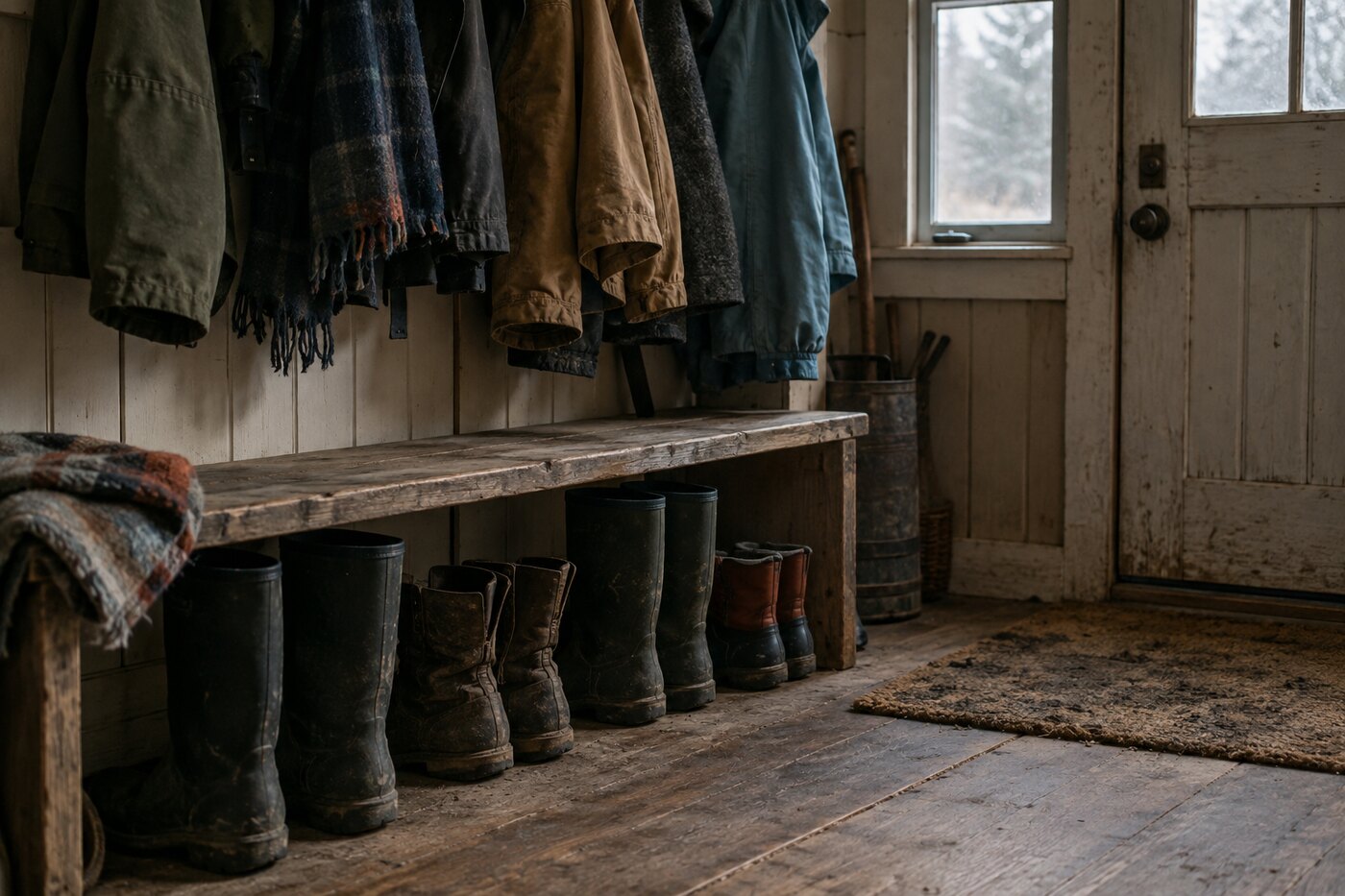
The boots line up under the bench in the order people came in. Tall ones and short ones, one pair still standing in its own small puddle, one tipped over, one with a sock stuffed in the top to dry. This is the mudroom, and it isn’t quite indoors and it isn’t outdoors either. It’s the room built for the crossing between them, and everything in it is about that crossing — the wet coming off, the dirt staying here instead of getting through, the wait while you change from an outside person to an inside one.
Thresholds are their own kind of building, or their own part of one, and they’re where I look first, because the crossing is where the weather and the house negotiate hardest. Fully inside, the house wins. Fully outside, the weather wins. In between there’s a strip of contested ground, and somebody built a room on it to manage the treaty.
The porch is the oldest of these. Roofed but open, floored but exposed, it’s a piece of outdoors the house has claimed without pulling all the way in. The floorboards run to a drip edge and slope a hair to shed rain. The furniture is furniture that doesn’t mind weather — a metal chair, a bench gone silver, a mat that’s really just a place to knock the mud off. You sit on a porch in a rain and you’re dry and you’re still out in it, both at once, which is the whole point of a porch and can’t be had any other way.
The mudroom is the porch enclosed and put to work. Hooks, and too many coats on them, and boots below, and a bench to sit and pull the boots off, and a mat that’s given up. It holds the transition in objects — the wet-weather gear that belongs to neither the house nor the yard but to the door itself. The breezeway is a cousin, a roofed pass-through between the house and the barn or the garage, open on both long sides, built so you can cross from one building to another without going out into the real weather. The wind funnels through it. Things pile along its walls, out of the rain, in the draft — firewood for the next few days, a sled, a bag of salt, the stuff you want near the door but not underfoot inside.
The lean-to is the plainest threshold there is, a single slope of roof against a wall, three sides open or two, sheltering whatever needs to be dry but not indoors. The wood for the week. The tools that live near their work. A place to stand out of the rain and light a smoke or wait out a squall. The entry shed does it with a little more enclosure — a small roofed box at the door where you stamp and shed and hang before you touch the real door, an airlock against the cold, and in the deep cold that’s exactly what it is, a pocket of merely-cold air between the outside and the warm, so the warm doesn’t rush out every time somebody comes home.
Even the covered market is a threshold if you look at it right — a roof over the ground and nothing else, an outdoors kept dry, a between-place for the exchange of goods. And the boathouse is a threshold between the land and the water, the place where you stop being a person on foot and become a person in a boat, where the gear for that crossing hangs and the smell of both worlds mixes. All of these are rooms for changing states. You go in one thing and come out another, and the room exists to hold you while you change.
What they have in common is that they take the abuse so the house doesn’t. The mud stays in the mudroom. The wet drips in the entry shed. The wind blows through the breezeway and not through the kitchen. The threshold is a sacrifice zone, built to get dirty and stay dirty, and that’s why it’s the most honest part of any place — nobody’s keeping it nice, because keeping-it-nice isn’t its job. Its job is to be the surface everything wipes off on before it gets to the part that’s kept.
The mat inside the mudroom door was worn through to the backing in one oval, right where the first foot lands. Under the worn place the floorboard had gone pale and slightly dished from the grit that mat had failed to catch, year after year, a shallow bowl worn into the wood by everyone who ever crossed here. There was fresh mud in the low part of it, not dry yet, tracked in that morning and going nowhere, waiting on the next mat or the next broom, whichever came first.