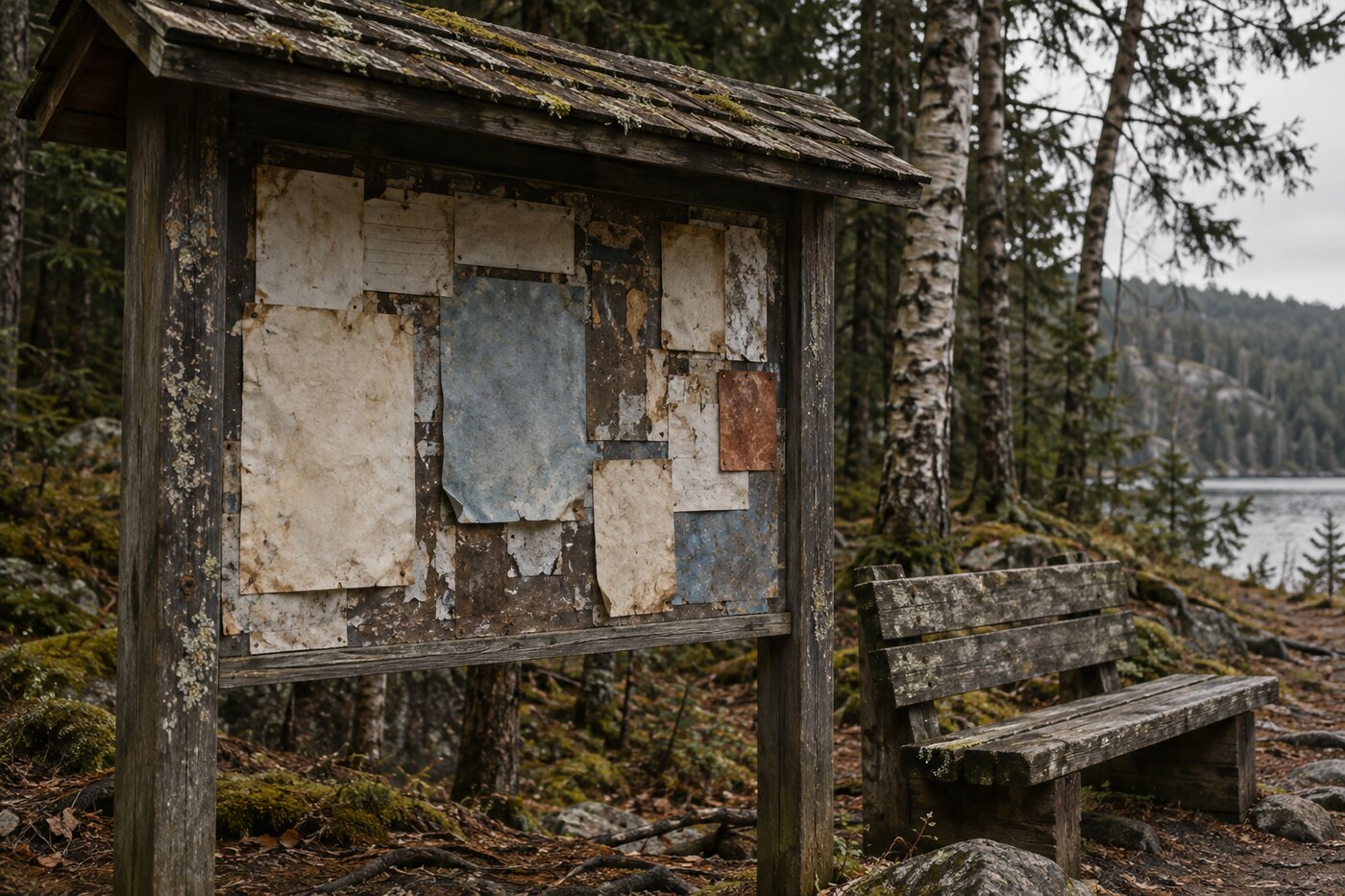
A grand building makes you work to read it. A small one hands you the whole place at a glance. Stand at a trailhead board — a sheet of plywood under a little shingled roof, on two posts, staples going back years — and you know the country in a minute. What’s dangerous here, what’s in season, whose dog is lost, when the last group signed the log and whether they signed back out. The staples tell the rest. Layers of them, most holding nothing now, a fur of rusted staples where notices went up and got weathered off and got covered and torn down, a whole history of announcements read in the metal that outlasted the paper.
These small public structures are the most legible buildings there are. They’re built to be understood at speed by a stranger, and they wear their use out in the open, and they’re specific to exactly one spot in a way a big building never manages.
The honor box is one. A locked steel box on a post with a slot in the top and a price in pen, standing in for a person who trusts you and can’t stay to watch. You read the whole social contract of the road off it. The bait counter is another — a plank window in a shack by the water, a hand-lettered board of what’s for sale, nightcrawlers and leeches and a chalk number that changes with the catch, the counter itself gone soft and dark where wet hands and wet cartons have rested on it for years, a scale hanging, a smell of the cooler behind. You learn what’s biting and what it takes to catch it, standing at that counter, faster than from any report.
The ferry shelter teaches waiting. It’s a three-sided box with a bench and a roof, set where the boat comes in, and its whole architecture is about the interval between boats — long enough to build a shelter for, short enough that the shelter can be small. The bench is worn in the middle and clean at the ends. The wall behind it has the schedule, faded, and under the schedule the small carved record of everyone who ever had twenty minutes to kill and a knife. The wind comes off the water and the shelter turns its closed back to it; you can tell the prevailing wind by which side has no opening.
The bus shelter in a small town does the same work on a dry land version of the same problem. So does the covered market — a roof on posts over a strip of stalls, open on all sides, built to keep the sun off the goods and the rain off the transaction and nothing else, no walls because walls aren’t the problem, only the sky is. So does the little dock shed where the life jackets and the gas and the spare line live, sized exactly to its inventory and no bigger, smelling of the lake. So does the town notice board outside the store or the post office, cork behind glass, a lock nobody uses, index cards for a truck for sale and a room for rent and a cat, thumbtacked in drifts, the oldest cards gone yellow and curled at the corners behind the new ones.
None of these were designed to impress. They were built to work, cheap and quick, by someone who needed the thing and made it out of what was on hand, and then the place used them hard, and the hard use is what makes them worth looking at. A courthouse is trying to tell you something about power and it’s usually lying a little. A bait counter isn’t trying to tell you anything. It’s just soft where the wet cartons sat, and that unintended fact tells you more that’s true — how many cartons, how many years, how many hands — than the courthouse manages with all its columns.
You could map a whole region by its small structures and it would be a truer map than the road atlas. Where the honor boxes are, people trust each other and the traffic is thin and known. Where the trailhead logs are full, people come from away. Where the ferry shelters have the deepest-worn benches, the crossings are long and the boats are few. The small buildings keep the record because the record is just their use, and their use is out in the weather where anyone can read it.
I stopped at a trailhead board once to leave a note about a washed-out section, and the board was so thick with old staples there was hardly bare wood to staple into. I pressed my slip over somebody’s faded lost-dog flyer from a year I couldn’t read and drove the staple home, and it went in crooked and stood proud on one leg, one more piece of metal that would outlast the paper it held, and I left it standing like that and walked on.