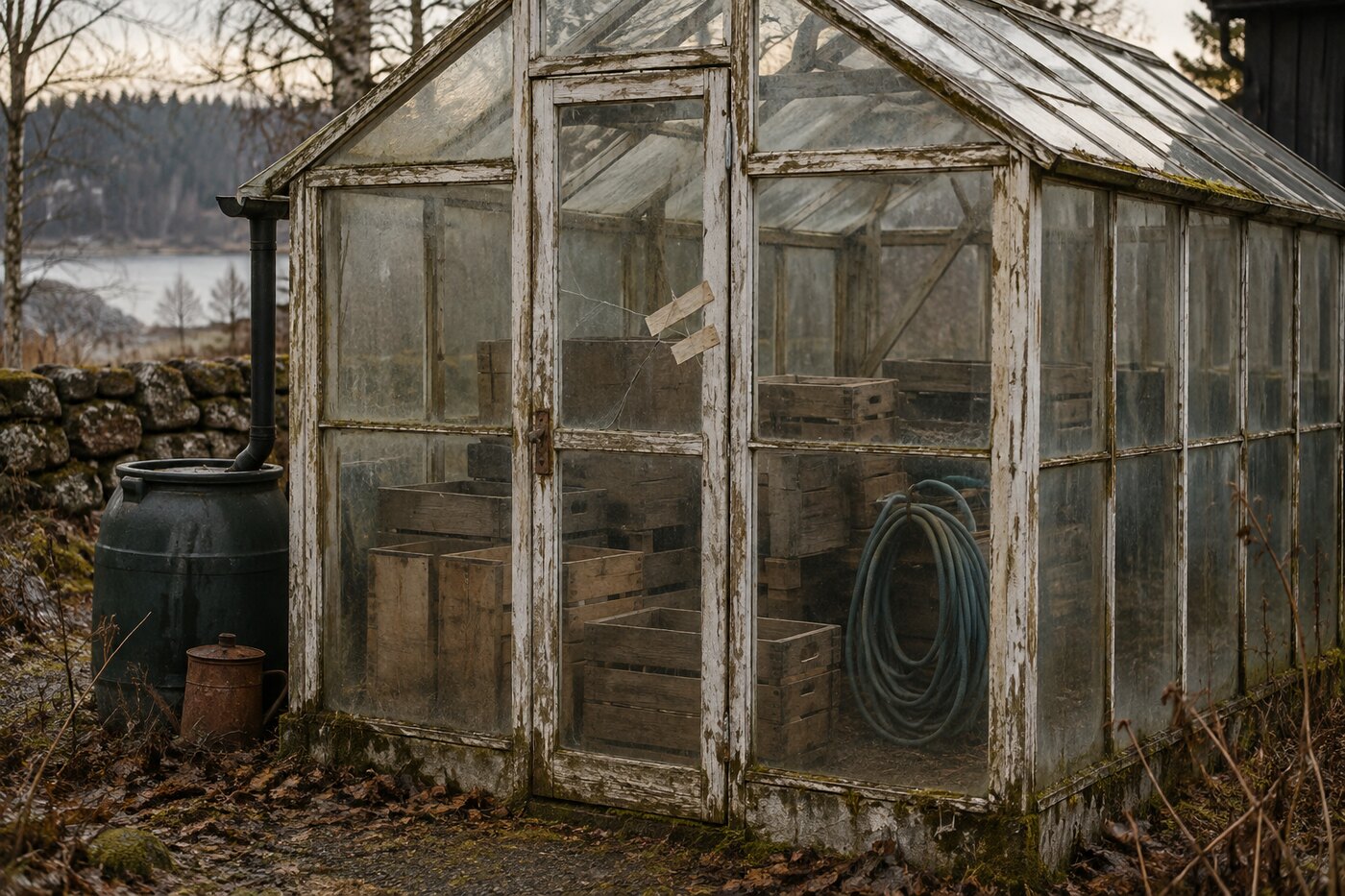
The greenhouse is full of everything but plants. Panes gone cloudy with age and algae, one cracked and taped, the whole frame still angled to catch a sun that nothing inside needs anymore. It holds crates now, and a coiled hose, and the storm windows for the house stacked on edge along one wall, and a bag of something hardened past use. But it’s warm in there. Absurdly warm, even in the shoulder seasons, because the glass still does its one trick whether or not anyone asked it to, and the stored things sit and bake in a heat that was meant for seedlings. The building changed jobs. Its talent didn’t.
That’s the thing about these conversions. The old use is gone but never quite erased, and the leftover is the whole character of the place. Nobody says adaptive reuse out here. Somebody just needed somewhere to put the crates and the greenhouse was empty, and now it’s a hot glass shed for junk that gets a suntan.
The woodshed became seating. When the wood moved to a new lean-to, the old shed — open on its one dry side, a roof and three walls — turned into the place you sit. Somebody dragged in a bench and a couple of chairs, and it’s a fine place to sit out a rain, dry and facing the yard. But the floor is still driven full of bark, and the low wall where the rounds used to lean has a polished dark stripe at exactly the height a stacked log rode, and you put your coffee down on a shelf that was a shelf for the maul and the wedge, and the wedge’s rust is still printed on the wood in an oval. You sit in a woodshed that has stopped being a woodshed and refuses to forget it was one.
The barn stall is a workshop now. The horse is decades gone. But the stall was built for a horse and it stays a stall — the boards are chewed along the top rail, cribbing marks, a scalloped edge worn by teeth, and the workbench is bolted right over them so your vise sits above a rail some animal gnawed through long winters. The floor drains toward the old center gutter. The light is dim and low the way a stall is kept dim. You do fine work in there and the building keeps handing you the horse.
A porch becomes a mudroom the moment somebody encloses it against the weather, and you can always tell, because a mudroom that used to be a porch still has the porch in its bones. The floor slopes a hair toward the outer edge, built to run rain off, so everything you set down drifts slowly toward the wall. The old porch posts are still in the walls, boxed in, and where a railing used to be there’s a line in the floor. It’s a room now, with the coats and the boots and the wet-gear hooks, and it’s still trying to be a porch, still tilting its floor toward a rain it no longer lets in.
The market booth is the honest one, because it converts itself on a schedule and admits it. Same frame, same counter, every season, and each season a different crop moves through it. The sign gets repainted over the old sign — you can see the ghost of last year’s greens under this year’s berries — and the little bins get rearranged for whatever’s ripe, and the price hooks hold a new number over the pale rectangle where the old number hung. Same building, new argument, over and over, and it wears all its past arguments faintly at once, a stack of seasons showing through the latest coat.
The tool room is the pantry overflow now. Shelves built for cans of oil and boxes of screws hold cans of tomatoes and boxes of pasta, and the shelves are spaced for the old inventory, too tall in one bay and too short in another, and a pegboard on the wall still has the painted outlines of wrenches behind the mason jars. You reach past the ghost of a crescent wrench to get the flour.
None of these finished the change. That’s the point. A conversion out here is never a clean overwrite; it’s a new use moved into a building still furnished for the old one, and the old one keeps surfacing in a slope, a smell, a chewed rail, a painted outline of a tool that isn’t there. The residue is not a flaw in the conversion. The residue is the conversion.
I set a jar of last summer’s beans on a shelf in the old tool room, in the pantry it is now. The shelf had a groove worn in it, dead straight, where something heavy used to slide in and out — a metal tray, a long box, hard to say. The jar didn’t fit the groove and sat rocking on it. I nudged it back against the wall and it rocked once more and settled, and the groove kept going past it, worn for a thing I never saw.