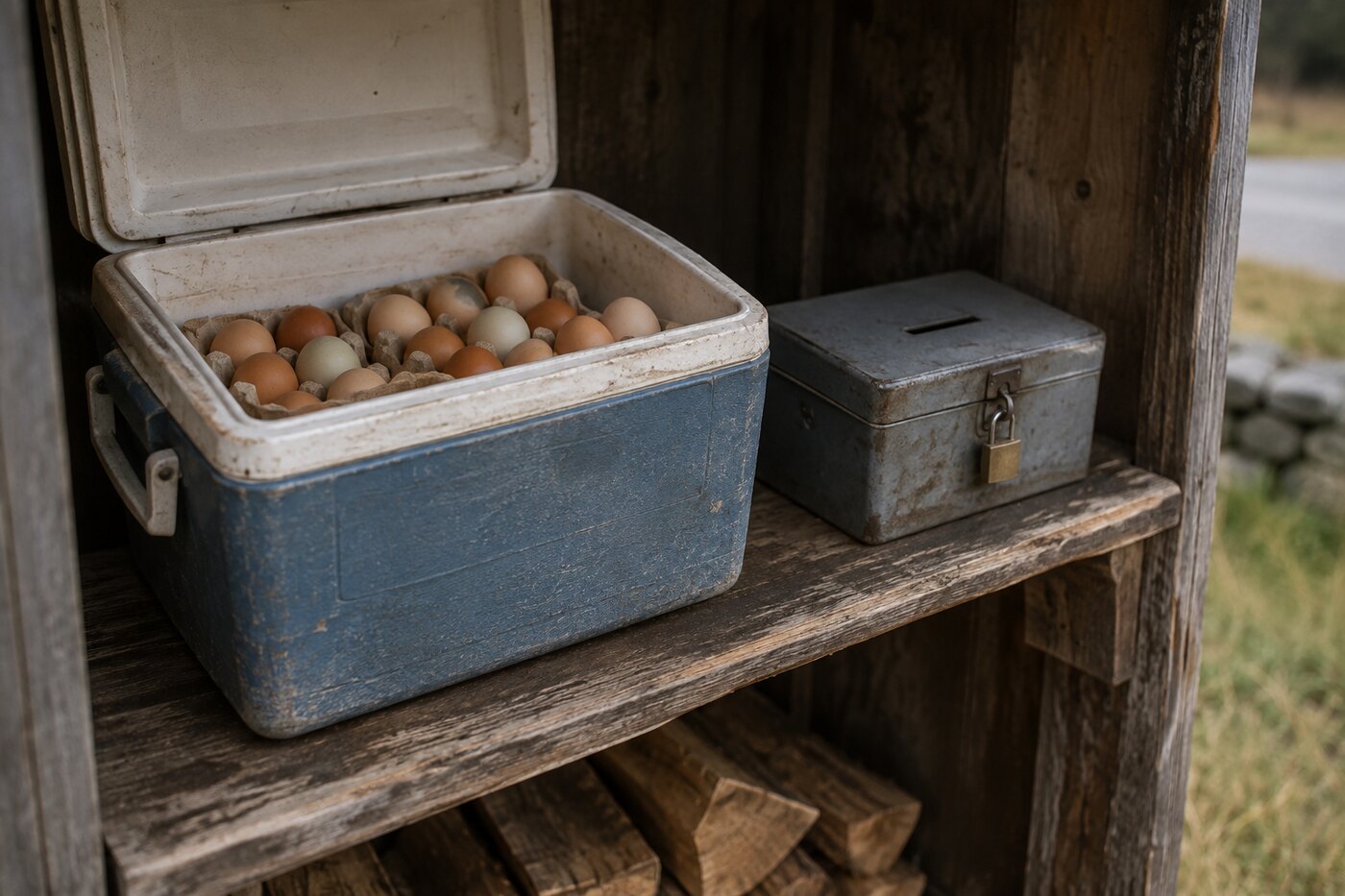
The box was gray steel, the kind that used to sit in a desk drawer with a little tray inside for the coins. Somebody had taken it out of retirement and screwed it down to the shelf of the stand, four screws through the bottom, so it couldn’t be carried off. A slot had been cut in the top with a hacksaw. You could see the saw marks around the slot, bright where the paint was gone, and a slight roll to the metal at the edge where the blade had wandered. The lock was a small brass one, warmed by the sun, and a person could have popped it with a screwdriver in a minute. Nobody had. The box counted on that.
Above the slot, taped to the wall of the stand under a strip of packing tape gone amber, was the price. Handwritten. EGGS $4 A DOZEN. EXACT CHANGE PLEASE, and under that, smaller, THANK YOU, and under that, smaller still and squeezed in later, no bills bigger than a 20. The tape had lifted at one corner and been pressed back down more than once; you could see the ghosts of the old adhesive around the current edge. The pen had been gone over where it faded. Somebody came out here and maintained this small paragraph, the way you’d maintain any working part.
The eggs were in a cooler with a brick on the lid. Not to keep them cold — the brick was to keep the lid down against the wind and whatever animals came at night. Inside, cartons, mismatched, gray pulp and clear plastic and one foam, refilled from whatever the kitchen had emptied. The eggs themselves were not sorted for looks. Brown and cream and one carton of pale green ones, different sizes, a feather stuck to one, a smear of the coop still on another. Nobody had polished them. Polishing them would have been a different kind of operation and a different kind of price.
There is a choreography to it and the box sets the steps. You slow, you pull off onto the gravel, the tires crunch and stop. You get out into the quiet — it is always quiet at these, just wind and maybe a dog somewhere and the hens themselves out of sight around the barn. You lift the brick. You choose a carton. You open it and look, because you always look, and you turn a couple of the eggs to check for a crack, and you close it. Then the money. You dig for it. This is the part the box has arranged. It wants exact change and you rarely have it, so you stand there doing arithmetic against your pocket, and you make a decision — round up, leave the extra, because the slot doesn’t give change and the box can’t. You fold the bills small to fit the slot. You feed them in. There’s a moment where they catch and you push them the rest of the way with a finger, and they drop, and you hear them land on whatever’s already in there, a soft sound, not the ring of coins, just paper on paper. Then you leave. You set the brick back. You get in and pull out onto the road and that’s the whole transaction, done with nobody, witnessed by nobody, closed by the small soft sound of your money hitting the bottom of a locked steel box.
The box is a building standing in for a person. That’s the trick of it. Somewhere there is a woman or a man who has the hens and gathers the eggs and writes the sign and empties the box, and they can’t stand at the road all day, so they built a thing that does the standing. The lock isn’t security. Anyone determined could have it. The lock is a statement. It says this is not free, it is trusted, and there is a difference, and you are being asked to know the difference. And people do. Box after box up these roads, going for years, and the boxes stay full enough and don’t get pried, because most people, given a small steel proof that they are trusted, would rather be worth it.
You can read the traffic on the box if you look. The slot is worn shiny at the mouth where thousands of folded bills have gone in over it. The paint is thin around the lock where thumbs have steadied it while a key turned, though your thumb isn’t the one that turns the key. The screws in the corners have rust weeping down from them onto the gray, four little tracks, from every rain the stand has stood through. The shelf under the box is stained where the cooler sweats. None of this was designed. All of it is use, laid down faster than anyone would ever bother to sand off, and it is the whole record of the arrangement — how many stops, how many rains, how many folded fours.
I put in a five for a four-dollar dozen because I didn’t have singles and the box doesn’t argue. The bill caught in the slot the way they do. I pushed it through with one finger and felt it go, and heard it land on the others, soft, and there was no receipt and no thanks except the one already written on the wall in pen gone over twice. I set the brick back on the cooler lid. It didn’t sit flat. It rocked on a high corner, and I left it rocking, and drove off with the eggs on the seat, unwashed, one of them still wearing its feather.