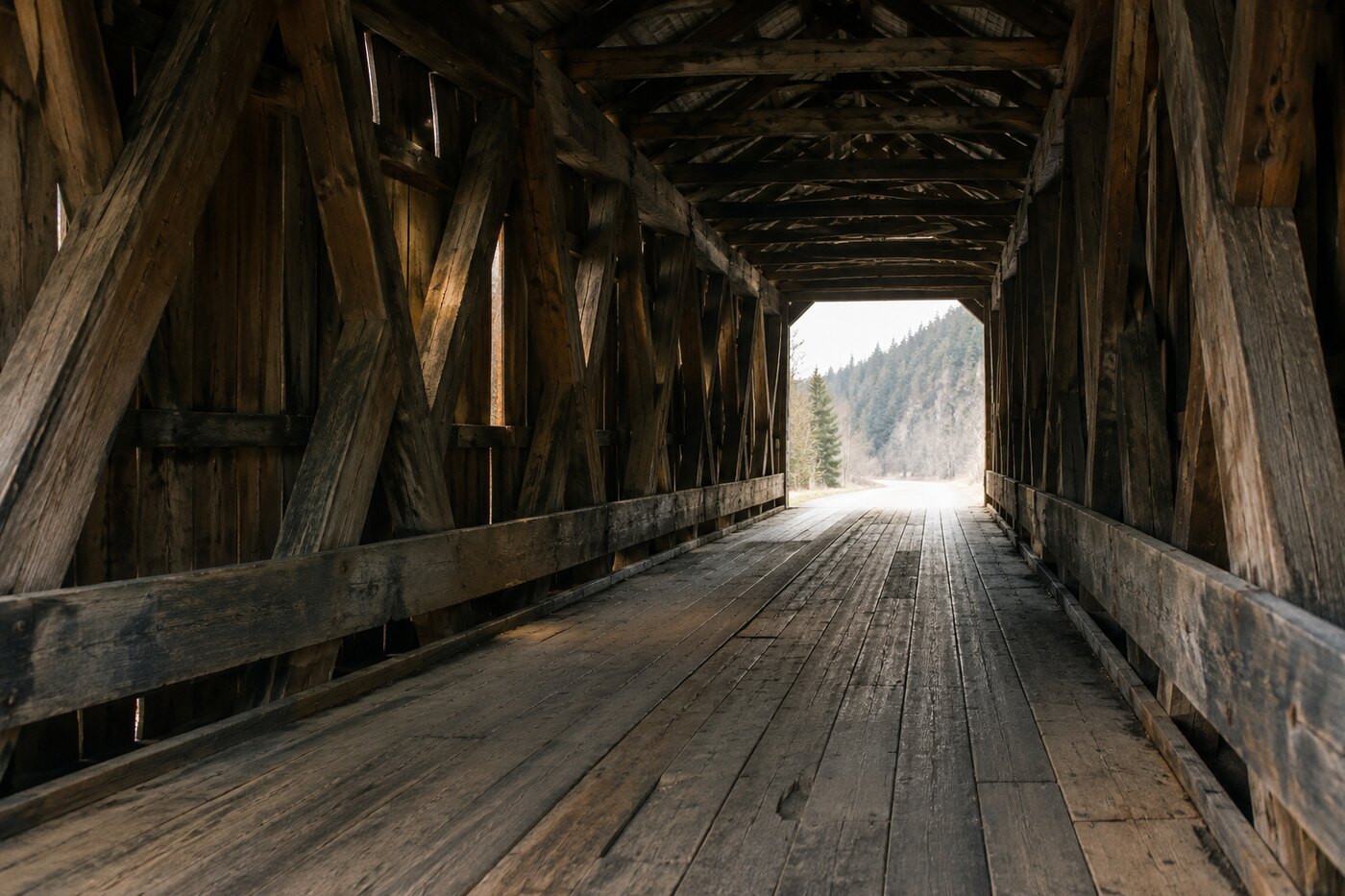
You feel it before you’re in it. The road runs bright and hot toward the mouth of the bridge, and then there is a line, an exact line at the eave shadow, and you cross it and the air changes. Cooler. A degree of it you feel on the back of your hand at the top of the wheel, or on your face if you’re walking. The bridge holds its own weather. It made the weather on purpose and it keeps it.
The light goes with the heat. Outside it had been the full flat glare of a clear day, and inside the light draws down to a brown dimness that your eyes take a moment to accept. The sun comes through the gaps in the siding in narrow bars, dust turning in them, and lays stripes across the deck. Between the stripes it is nearly dark. There is a bright rectangle at the far end where the road picks up again, and the whole inside of the bridge is arranged around aiming you at it.
Then the sound. On a road that had been quiet tar, the planks under the tires start to boom. A hollow, rolling knock, plank after plank, each one loose enough to speak, and the sound goes up into the trusses and comes back doubled. On foot it is worse and better — bootheels on the deck, and the boom answering from under you, from the space between the deck and the water you can hear but not see. Your own steps sound like more people than there are. The bridge amplifies whatever you bring into it and hands it back with the damp on it.
Because it smells of damp. Wet timber that never fully dries, even in August, because the river breathes up through the deck all day and the roof holds the breath in. It is an old cold smell, close to a cellar, close to the boathouse but without the fuel — just wood and water and the mineral edge of the stones in the abutments. You’d know it blind. You could be led into a covered bridge with your eyes shut and you would name it from the smell and the drop in temperature and the boom, before anyone told you.
The timbers are enormous and they are marked. Every reachable surface has names on it. Cut in with a knife, the old ones, gone dark and furred at the edges where the fibers lifted and weathered. Scratched in with a nail, the middle ones. And over all of it, the newer layer, the paint pen and the marker, initials and dates and hearts and the flat declarations people make when they think a thing will last longer than they will. The layers don’t erase each other. A name from a marker sits on top of a name gouged deep enough to still be legible under it, and both of them cross a knot in the beam that neither one could cut, so the letters bend around the knot the way water goes around a stone. You could read down through the layers if you had the light and the patience. It would not tell you anything you needed to know. It would only tell you that a great many people stopped here in the cool and the dark and wanted to leave a mark on the one surface that felt permanent.
Halfway across is the strangest part. You are over the water and you cannot see it. You hear it — a steadier sound than your feet make, running under everything — and through the gaps in the deck, if you look down, there’s a moving glitter, the river working along below in its own light. You are inside a building and outside a building at the same time. The walls are close and the roof is over you, and yet the whole thing is a tunnel with the country pouring through both ends, wind coming through, a leaf skittering the length of the deck and out the far mouth into the sun.
The bridge is a decision about weather made in wood. Somebody understood that a deck left open would rot in a decade, checked and split and soft, and that a roof over it would let it last a century. So they built a barn and put a road through it. Everything about the inside comes from that one decision. The dimness is the roof. The cool is the roof. The boom is the deck kept dry enough to stay loose and springy instead of swelling shut. The names are there because the roof gave people a wall and a reason to stand still. Use accumulated in it faster than anyone ever came out to polish it, and the accumulation is the whole character of the place.
Coming out the far end is its own event. The bright rectangle grows and then you’re through the line again, the eave shadow, and the heat closes back over you and the light comes up hard and the road goes quiet under the tires. The bridge lets you go. Behind you it keeps its cold and its boom and its damp for the next one.
I stopped once on foot in the middle, where the dark was deepest, and put my hand flat on the lower chord of the truss. The wood was cool and slightly wet, the way a stone is wet without any water you can point to. There was a name cut there under my palm, deep, old, the letters worn round. I could feel it but I couldn’t read it, and I took my hand away without finding out whose it was.