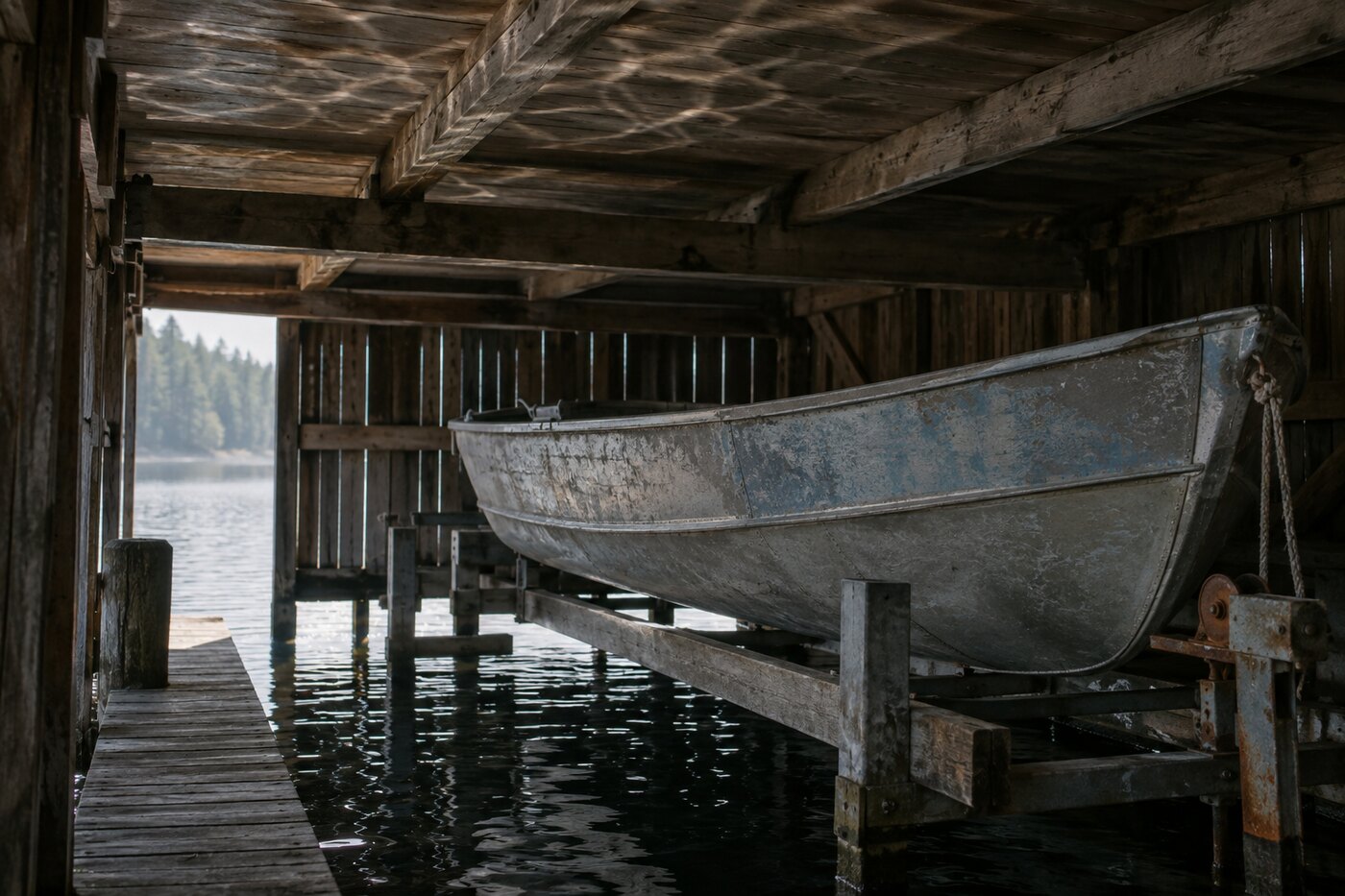
The door swung on a hook and a bent nail, and the smell came out before the light did. It always did. You opened the boathouse and it exhaled at you, a full breath held since the last time, and you stood in it a second before you stepped in.
It was not one smell. It was a stack of them, laid down in order, and the nose read the layers the way a thumb reads a check in a board. Rope first — hemp gone soft and gray, a coil of it hung on a peg, giving off that dry animal smell manila has when it has been wet and dried a hundred times. Under the rope, fuel. A red plastic can with a cracked spout, and the outboard leaning on its own weight, and the fuel had gotten into the wood of the shelf and stayed. Under the fuel, water. Not clean water. Lake water, which is a green smell, algae and the underside of lily pads and whatever the ducks leave. And under all of it, oldest, the wood itself. Cedar and fir gone damp and staying damp, never quite drying between rains, holding the wet the way a sponge left in the sink holds it.
The floor was planks with gaps, and the lake ran under the floor. You could hear it more than see it. A slap and suck against the pilings, patient, working. Light came up through the gaps, moving, and threw itself on the underside of the roof in a net that never held still. When a boat went by out on the open water you heard the wake arrive a while later, lifting the skiff on its lift, setting it back, the whole building shifting its weight from one foot to the other.
The boards along the waterline had a mark on them. A pale line, then a darker one, then a stain that went up and stopped. That was the high water from some spring I wasn’t there for. The wood remembered it. Above the line the plank was gray and dry-checked. Below it the plank was dark and swollen and soft enough to take a thumbnail. The building kept its own gauge, and read it out to anyone who looked.
Bumpers hung along the inside wall. Old ones. Some were the white cylindrical kind gone yellow and scuffed to the weave, and one was just a coil of rope worked into a fat knot, a fender someone made when they didn’t have a store nearby or didn’t feel like driving to one. It had done years of work. It was flattened on one side where it had taken the hull over and over, and the flat side had a smear of bottom paint on it, red, from a boat that wasn’t here anymore. The knot held the shape of the job. You could set it down and it would lie on its flat.
There was sand in the corners. There is always sand in the corners of these places. It comes in on feet and in the cuffs of waders and it migrates to the low edges and stays, a fine drift of it, gritty underfoot, mixed with a little dried algae and a lost split-shot sinker or two. I ran a broom through it once and the broom found the sinkers by the sound, a small hard tick, and I picked them out of the pile and set them on the shelf with the fuel, where small heavy things go.
The hardware was mixed. Nothing matched. A galvanized cleat next to a bronze one gone green, screws of three different heads, a hinge that had been replaced with a hinge that didn’t fit and had been made to fit with a washer and a shim of cedar. Every repair was somebody’s afternoon. You could see the afternoons if you looked. The shim was cut with a knife, not a saw. Whoever cut it was in a hurry to get back on the water, and the shim had held for years anyway, because a knife cut in dry cedar is enough when the load is only a door.
I keep photographs of the lake. They are fine. They show the water and the trees on the far shore and the light, and they are accurate about all of it and wrong about the thing that mattered. A photograph of the boathouse would show the skiff and the bumpers and the net of light on the roof and it would leave out the whole argument the place was making. Because the argument was the smell. The fuel in the shelf and the algae under the floor and the manila giving up its dry breath, all of it stacked and held in the dark until the door swung and let a season of it out at once. No lens takes that. You would have to stand in the doorway and let it hit you and know, before your eyes had adjusted, exactly where you were and roughly what month it was.
I latched the door on the way out. The hook dropped into the eye and the smell sealed back inside to go on curing. On the plank by the sill there was a wet ring where the fuel can had stood and been moved, and it hadn’t dried yet, and I did not wipe it up.