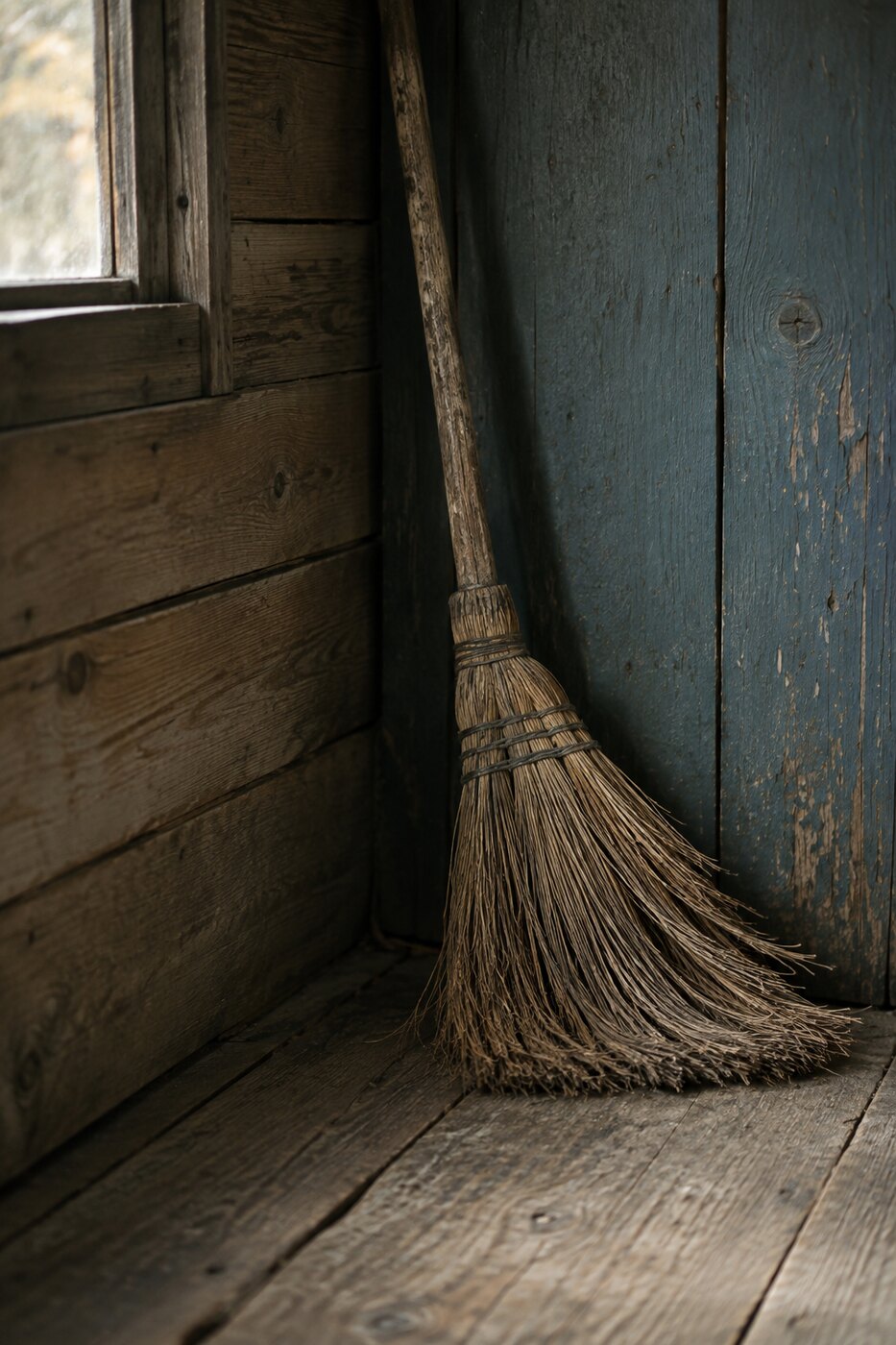
The broom stands in the corner by the back door and it does not stand straight. It leans, and its head leans harder than the handle does, splayed out to the left like something caught mid-stride and told to hold still.
You notice it when you set it down flat. It won’t sit flat. Stand it on the floor and let go and the bristles roll it a quarter turn onto their bent edge, the way a boot worn to one side won’t sit level on a shelf. The straw has taken a set. It went in straight, once, all those bristles cut to a line at the factory, a blunt even mouth of them. Now they curve. Most curve left. The outer ones curve hardest, the way the outside of a herd runs widest on the turn.
I swept the kitchen with it this morning and I could feel what the bend does. A new broom bites all across its width. This one bites on the left corner only. The rest of the head skates. So you sweep and only the leading edge is really working, the outer inch or two, and the rest of the straw drags behind it doing nothing but making a sound. You end up steering with that corner. You dig it into the joint where the cabinet meets the floor and pull, and it goes in there like it was made for that joint, because in a way it now is.
It leaves a line. That’s the tell. A broom that bites flat sweeps a clean band. This one leaves a faint streak up the middle of its path where the slack bristles pass over the dust without lifting it. You have to go back over. Or you learn to angle the whole broom so the good corner covers the streak the first pass missed, which is what the hands do after a while without being told. The dust piles up on the left of the pile, always the left, because that’s the side that’s doing the pushing.
Nobody bent it on purpose. That’s the part I keep turning over. No one sat down and trained this broom to curve. It curved because it was swung ten thousand times the same way by the same arm, pressed down at the same angle, pulled toward the same corner, and straw is soft enough to remember and stiff enough to keep the memory. Every stroke was a vote. The bend is the count.
And it’s a particular arm. I know whose. You can read the handedness in it — the head is worn to the pattern of a right hand pulling toward the body, weight on the near edge, the far bristles barely touched. There’s a person in the shape of it. Not a picture of them, nothing so clear. Just the posture. The exact habitual slant of one body’s way of getting a floor clean, pressed into corn straw and kept there after the arm is done with it.
Chores have handwriting. I hadn’t thought about it in those words until the broom made me. A hoe wears to a slant. A stair dips in the middle where the feet always land. A doorknob goes shiny on one shoulder. The house is full of these — tools and surfaces that have taken the print of a body doing the same thing at the same angle until the thing itself remembers the motion. You could hand a stranger this broom and they’d fight it. They’d sweep straight and it would fail them and they’d think it was worn out. It isn’t worn out. It’s just literate in a language they don’t speak.
I tried to sweep against the bend, once, to even it out. Held it the wrong way for me, pushed with the neglected edge, made the straw work the side it never works. It fought back the whole time. The head wanted to roll back onto its trained corner and I had to hold it off its own habit, and the sweeping was worse for it, streaks everywhere, dust squirting sideways out from under the head. I gave up after half a floor. You can’t unteach it in one morning. Maybe not ever. The set is too deep. The straw has picked its side.
There’s a smell to it down low, when you tip it up — dust and dry straw and something like the inside of a barn, and under that the faint sourness of a thing that’s been wet more than once and dried in a corner. The tips are frayed to soft brush where they’ve done the most work. The left corner is worn shortest, ground down by all that biting, so the bend and the wear point the same way, agreeing with each other about which part of this broom has lived.
I finished the floor and stood it back in its corner. It didn’t stand straight there either. It leaned into the wall the way it always leans, head cocked to the left, bristles resting on their bent edge, holding the shape of a stroke that wasn’t happening, waiting for the arm that would swing it the only way it knows how to be swung.