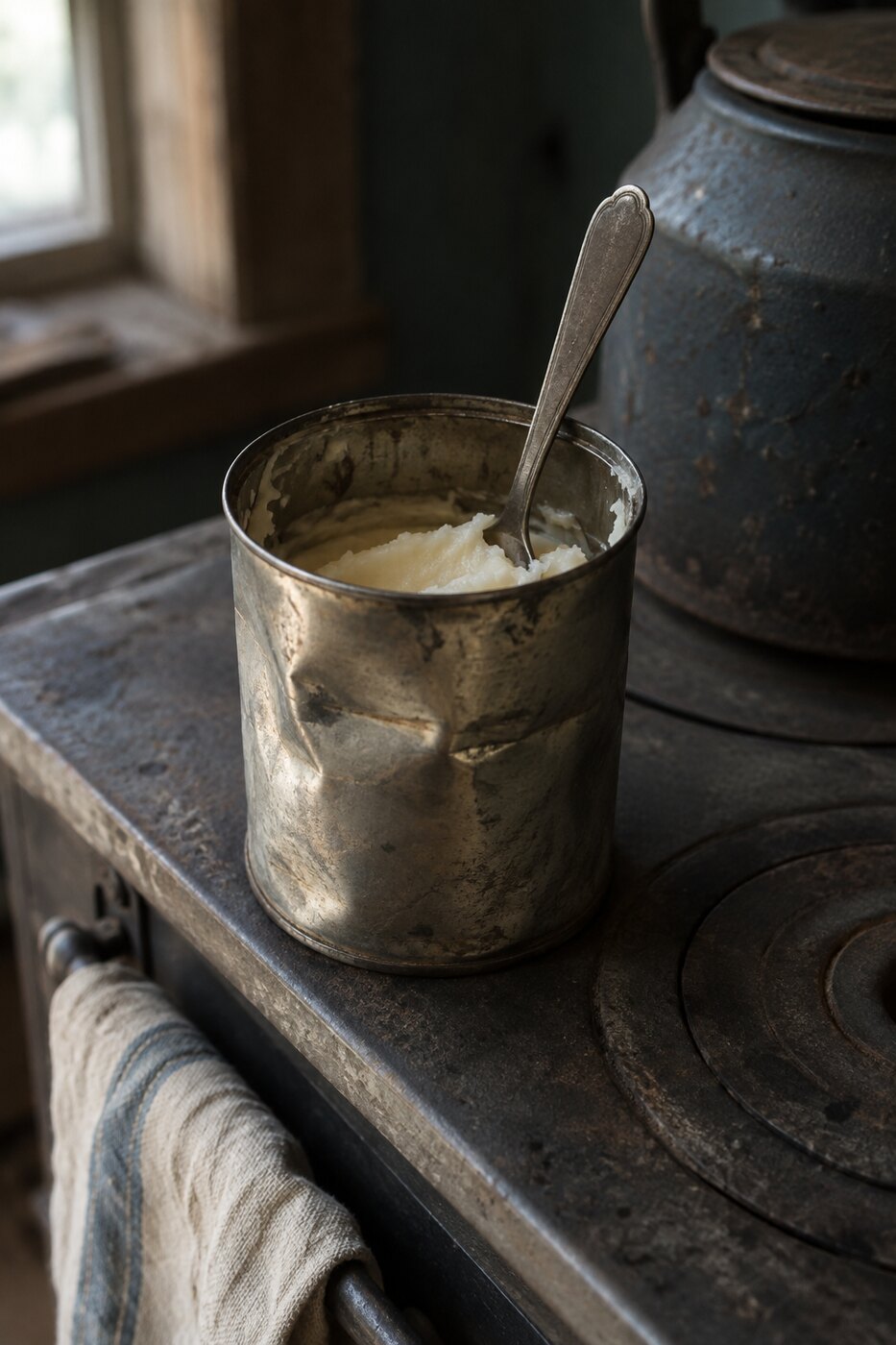
The pan was still ticking when I poured. Bacon done, lifted onto the paper, and what was left in the skillet was the good part — hot and clear and moving, the color of weak tea held up to a window.
I poured it through a square of screen laid over the mouth of the tin. The screen was old, cut from a window that had failed somewhere else first, and it caught the black flecks and the burnt threads and let the rest go through. The fat hit the older grease and hissed once, a small complaint, then quieted. For a minute it lay on top clear and hot, its own layer, refusing to mix.
The tin had held coffee once. You could still read part of the word if you turned it right, a red letter under the film that never quite comes off. Now it held this. It had held this longer than it held coffee.
By morning the pour was solid. That is the part I never get tired of. Liquid at night, and in the morning a pale opaque disc, the white of old candles, firm enough to take the shape of the spoon when you press it. It goes from something you could drown in to something you could carve. The change happens in the dark, on the back of the stove, while the house is cold and no one is watching it happen.
There is a smell to the tin that is not the smell of bacon. It is quieter. Bacon is loud, all smoke and salt and the front of the mouth. The tin is the memory of bacon, banked down, with something mineral under it from the metal and something faintly sweet from the layers that have been in there longest. I lift the lid and it meets me before I’ve got it all the way off. It is not a bad smell. It is not exactly a food smell either. It sits in between, the way the grease itself sits between garbage and supper.
If you dig with the spoon — and there is a spoon that lives in the tin, a bent teaspoon that does nothing else now — you can read the layers. The top is this week, still pale, still soft at the center. Under it a firmer band, a little more yellow. Under that, down near the tin’s old red word, a darker ring, almost amber, packed hard. That ring is months of mornings. It does not get used. It just gets built on. The new grease keeps the old grease company and the old grease anchors the new, and somewhere in the middle is a stratum that came from a breakfast I couldn’t name if you paid me.
None of it is written down. That is the thing about the tin. A recipe gets written down. A grocery list gets written down and then thrown away, which is its own kind of honesty. The grease is a record no one kept on purpose. Each pour is a meal that already happened, strained down to its fat and set aside on the chance that it will be useful later. It is thrift with no ledger. It is the opposite of throwing something out, done so many times it stopped being a decision and became a shelf.
The paying out comes later, and it comes small.
Eggs, most mornings. A spoon of the tin into the black pan, and it melts back the way it came — solid to clear, the night’s work undone in ten seconds of heat. The eggs go in and the whites lace at the edges the way they only do in fat that has done this before. There is a taste in it. People argue about whether you can taste it. You can. It is the taste of every breakfast that fed this one.
Potatoes are where the tin earns its corner. Cold boiled potatoes from the night before, cut thick, laid down in a slick of the grease and then left alone longer than feels right. You don’t stir them. You let the fat and the iron do the work. When you finally turn them there’s a crust the color of the amber ring at the bottom of the tin, and the underside comes up in one piece, and the kitchen smells like the loud version of the tin’s quiet smell. That is the grease spending itself. That is the whole point of having saved it, arriving months after the saving, on a plate, gone in ten minutes.
Cornbread wants a spoon of it in the skillet, smoking, before the batter. Greens want it. A pan that has gone dull and grabby wants a wipe of it and a low flame and then it remembers what it’s for. The tin pays out in every direction, a little at a time, and then the pan is scraped and there’s a new pour to strain and the level in the tin never really drops and never really climbs. It just turns over. New on top, old going down, the whole thing slowly composting into itself.
I set the lid back and put the tin at the back of the stove where the pilot keeps it soft. The spoon stood up in it on its own, the way it does when the top layer is fresh. Below the spoon, down where the light doesn’t reach and the red word waits under the film, the oldest grease had gone the brown of a saddle, packed and patient, a sediment of breakfasts nobody wrote down and nobody would, waiting to be potatoes.