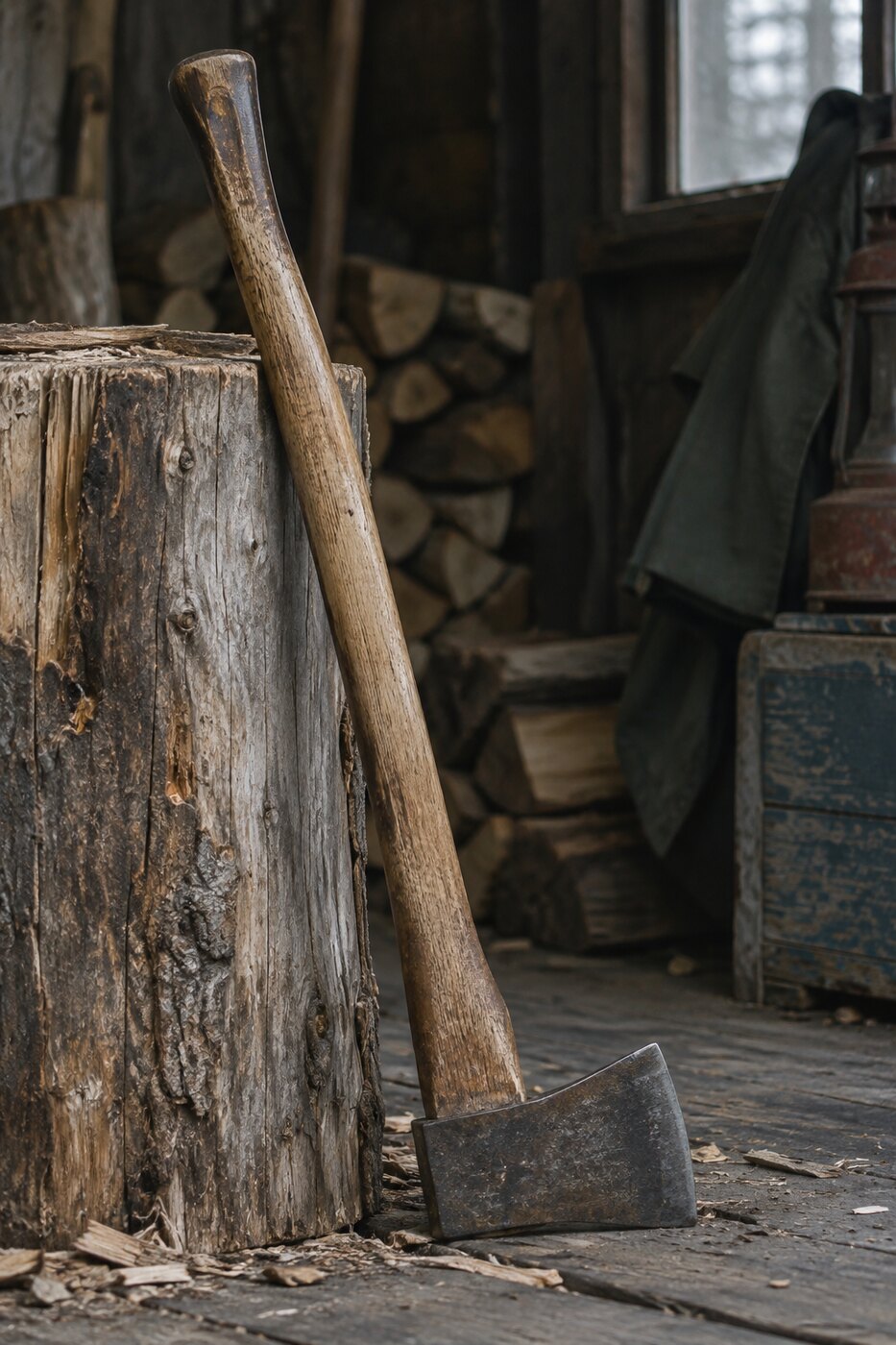
The hickory grain ran straight from the eye to the flare.
The factory varnish was long gone. It had started flaking off during the first hard freeze, lifting in brittle yellow scales. What the cold didn’t peel away, rough leather gloves rubbed down to bare wood. The shaft was matte and pale gray near the top, where it took the occasional miscalculated strike. But there was one bright band low on the handle, right above the flare. It caught the afternoon light like polished bone.
Years of the same grip, closing in the exact same place, had burnished it to a shine.
It was new once. I remember it arriving square-shouldered and a little too slick. It smelled like a hardware store—dust, rubber, and chemical sealant. There was a paper sticker near the head with a barcode and a brand name. The adhesive was stubborn. It took three winters of snow and wet bark to wear the paper down to white fuzz, and another year for the residue to finally turn dark with dirt and disappear. For a long time, there was a pale rectangle there where the sun hadn’t reached the wood.
When a handle is new, it feels like an argument. It resists the hand. It wants to bounce in the palm. It transfers the shock of a bad strike directly into the wrist, ringing the bones of the forearm. It does not know the angle yet. It is just a piece of timber cut to a shape on a lathe somewhere, identical to a thousand others in a bin.
Repetition shaped it. The wood gave way in increments too small to measure, taking instruction from the work. A slight hollow formed where the thumb naturally crossed on the downswing. The lower flare, designed to keep the axe from flying out of sweaty hands, softened its sharp factory edge. The checking in the wood started near the middle—tiny, hairline vertical cracks where sweat, rain, and dry winter air had worked their way in, swelling the fibers and shrinking them again.
Wood is dead, but it still behaves like a lung. It breathes the weather. It remembers the heavy humidity of July mornings. It remembers the brittle, snapping cold of February. Most of all, it remembers salt.
The grip was stained dark from the oil and salt of a bare hand. I used gloves when it was cold enough to matter, but on autumn afternoons, the leather came off. Bare skin on wood is a better gauge of tension. The hand sweats. The wood drinks. Over time, the handle darkened in the exact shape of my grip.
A tool becomes more accurate as it becomes less new. The friction of use takes away everything that is not necessary. The handle stopped being a generic piece of hickory and became a specific map of one person’s mechanics. It learned the rhythm. It knew the slight hesitation before bringing the blade down on a knotted round of elm. It knew the overcorrection on a twisting swing. It fit one hand.
If someone else picked it up, they would feel the strangeness of it immediately. It would feel like putting on another man’s work boots. The hollows would be in the wrong place for their fingers. The balance would sit strange in their palm. The axe had calibrated itself to a single set of shoulders.
It kept a forensic record of every swing it took. A deep gouge near the neck meant a missed strike against a frozen log of birch, the wood deflecting the steel and punishing the hickory. A scrape on the left side meant it had been dropped in the gravel driveway when a stack of split wood tumbled over. The head itself was pitted and scarred, the poll mushroomed slightly from being used as a hammer when no hammer was around, which is a sin against the tool but a reality of the yard.
It did not try to look clean. It only tried to work.
I leaned it against the chopping block. The day was ending, and the air was taking on that sharp blue edge that means frost by morning. The polished band near the bottom of the handle sat quiet against the bark of the block. The grain there was tight and bright, sealed by years of friction and effort.
I walked back toward the house. My palm felt empty, still holding the ghost of the diameter, the muscles twitching slightly in the memory of the swing. The wood remembered the grip better than the hand remembered the wood.