
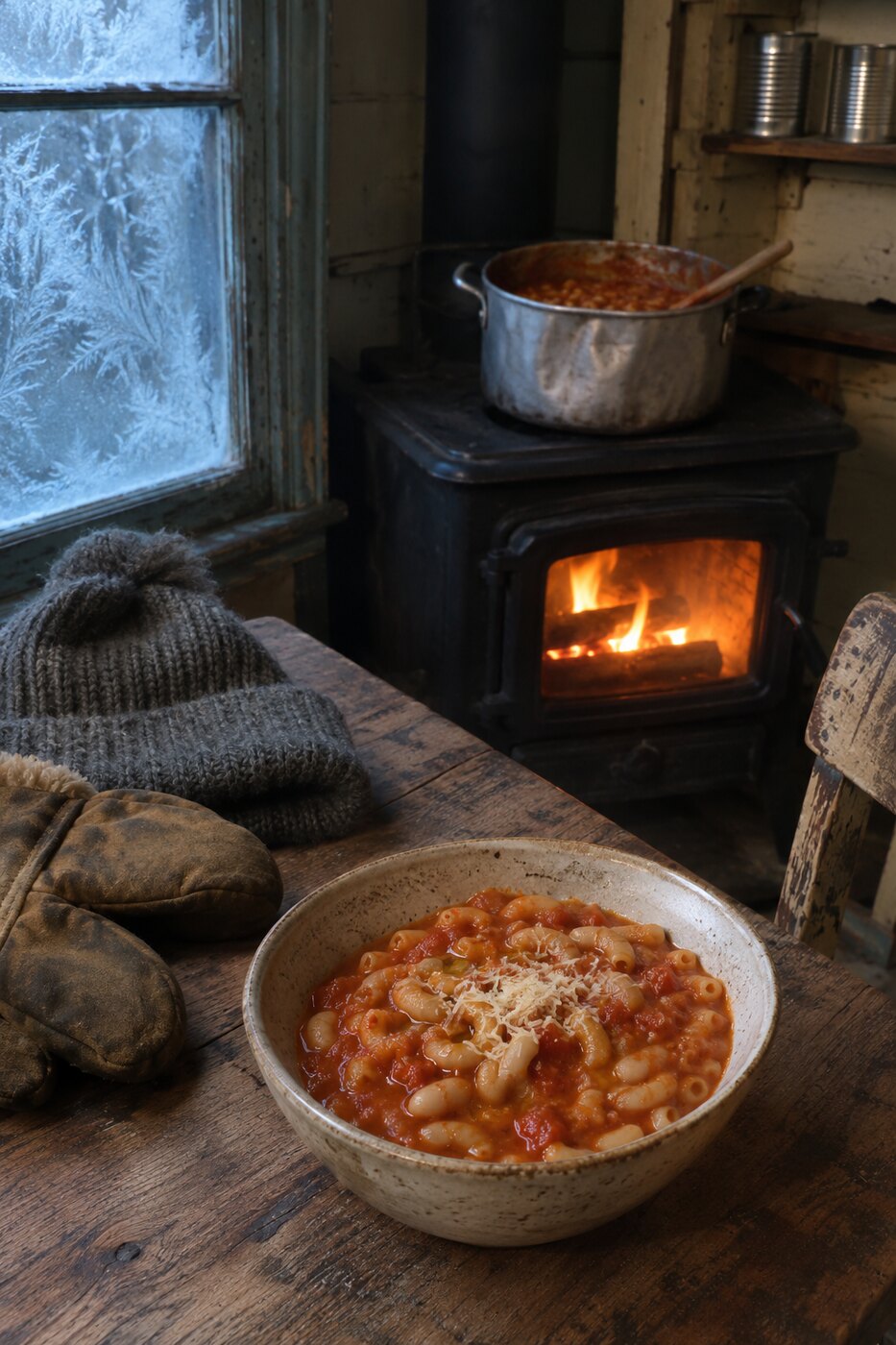
A cottage that’s closed for winter and checked once a month freezes through. Anything left on the shelf with water in it freezes too, and water swells as it freezes. Can seams split. Jars crack. Ends that should be flat go domed.
The shelf can still give you supper, but only after you’ve sorted it, and the sorting matters more than the recipe. This is a second-night supper. The first night, you eat what you brought, sort the pantry, start the fridge, put the cans you’re keeping in to thaw, and set the beans to soak. The second night is pasta and beans in tomato: oil, salt, pasta, dried beans and a can of tomatoes, all things that live through a frozen winter or can be judged when you get there.
Ingredients
- 200 g (about 1 cup) dried white beans, or one 540 ml (19 oz) can of beans that passed the sort
- 45 ml (3 tbsp) olive or canola oil, plus a little for the bowls
- 1 onion and 3 cloves garlic, brought in with you
- 1 can (796 ml / 28 oz) whole or diced tomatoes that passed the sort
- A pinch of chili flakes, and a bay leaf or 5 ml (1 tsp) dried oregano
- 200 g (about 2 cups) small dried pasta: elbows, ditali, broken spaghetti
- About 1 litre (4 cups) water
- Salt
- Hard cheese for grating, if you brought some
Method
-
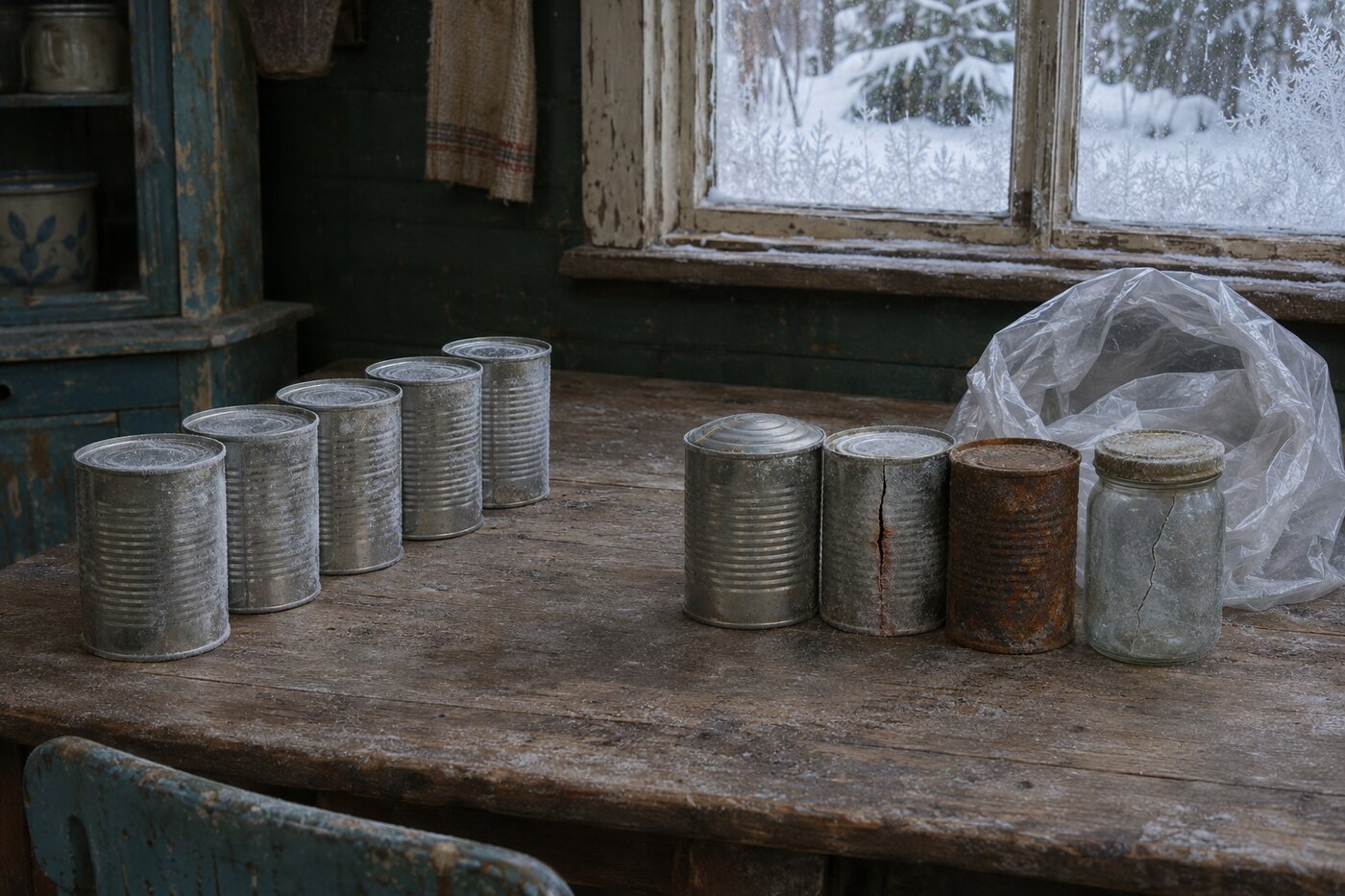
Sort the shelf before anything else. Out, unopened: any can that is swollen or bulging, leaking, split or burst at a seam, deeply dented on a seam, or heavily rusted; any jar that is cracked or whose lid is loose or domed. Out too: any can that froze and has since thawed in the building, or may have thawed and refrozen since you were last here. Double-bag the rejects in plastic, tie them shut, and put them in the outside garbage, not the recycling.
-
Keep only intact cans that are still frozen solid and that you know stayed frozen. Stand them on a tray in the fridge to thaw slowly; a tray shows you a leak. Rinse the dried beans and leave them to soak overnight in plenty of water.
-
Next day, open the thawed tomatoes. If anything looks or smells wrong, or the can spurts when you open it, it goes. Don’t taste it to check. Drain the beans, cover them with fresh water and boil them hard for 30 minutes, then simmer until one squashes easily against the roof of your mouth. Drain, keeping a cup of the liquid. Rinse the pot.
-
Warm the oil in the pot and cook the onion until soft and gold at the edges, about 10 minutes. Add the garlic and chili flakes for a minute, until they smell.
-
Add the tomatoes, crushing them against the pot, and the bay leaf or oregano. If you’re using a can of beans that froze, add it now too, liquid and all. Bring it all to a full rolling boil and keep it there for 10 minutes, plus a minute for every 300 m (1,000 ft) of elevation above the first 300 m. This boil is the USDA’s rule for any can that froze; it isn’t for flavour.
-
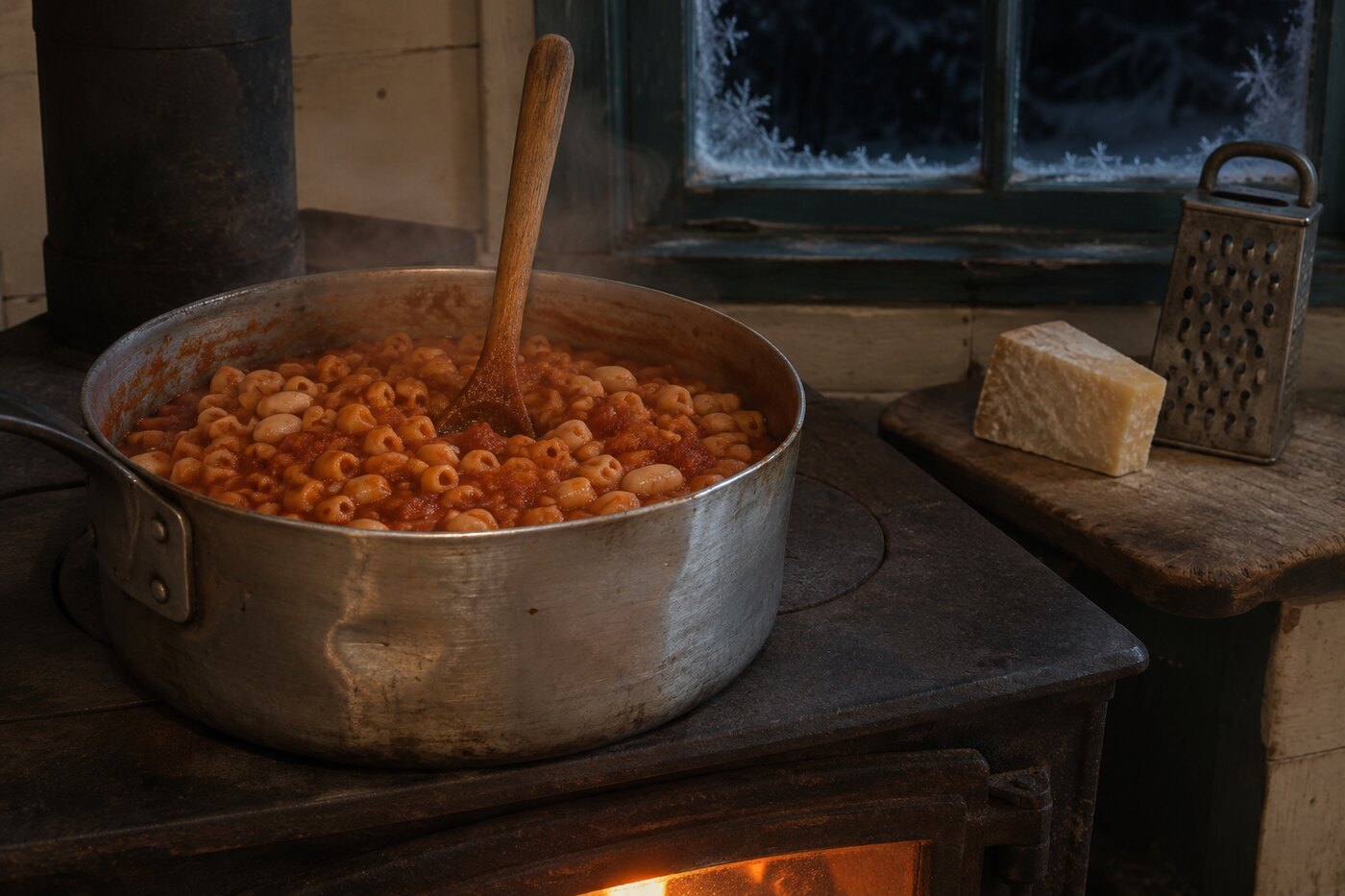
Add the cooked beans, the litre of water and a good pinch of salt, and bring it back to a boil. Add the pasta and stir often; it sticks. Add water or bean liquid when it’s covered by less than a finger’s width. It’s done when the pasta is tender and the pot is thick enough to stand a spoon in briefly, about 12 minutes. Salt to taste, and finish each bowl with oil and cheese.
What goes wrong
Not knowing what the cans went through. The USDA’s rule is strict. A can that froze and hasn’t thawed can be thawed in the fridge and used. A frozen can that thawed at 4 °C (40 °F) or warmer goes. A can that thawed and then refroze is not safe. A monthly-checked building can warm in a mild spell and freeze again between visits, and the can looks the same either way. A min-max thermometer on the pantry shelf is the only thing that will tell you. Some extension services are more lenient about intact cans; I go with the USDA.
A swollen can. It may only have swelled from freezing. It may also be botulism or spoilage, and from the outside you can’t tell which.
Glass. A jar that cracked in the cold can have glass in the food, and Oregon State and Kansas State extension both say not to use it. It goes, contents and all. So does a jar whose seal let go and whose contents have thawed.
Mayonnaise. The USDA’s storage chart has one entry for mayonnaise under the freezer: do not freeze. A jar that spent the winter on a cold shelf goes in the garbage, and I treat creamy dressings the same way.
Kidney beans. If your dried beans are red kidney beans, the FDA’s rule is a soak of at least five hours and a hard boil in fresh water for at least 30 minutes. A gentle simmer is not that. I hold every dried bean to the same boil. What the Beans Did in the Dark is about the soak.
When it’s different
Opening in April. By break-up the building has usually warmed in the sun and frozen again at night more than once, so assume every can on the shelf has thawed and refrozen and throw it out. The dry goods are still good if they were in tins the mice couldn’t get into: pasta, rice, dried beans, salt. Bring the tomatoes in with you.
No fridge running. The frozen cans stay frozen where they are until you can thaw them in a fridge. Supper is pasta with oil, garlic, chili flakes and the cheese you brought, and the cans wait.
Next October. The easiest frozen can to deal with is the one that went home. Take the cans, jars and anything with water in it back with you when you close, and leave dry goods in metal tins, oil and salt.
Sources
- USDA FSIS, Shelf-Stable Food Safety: the frozen-can rules (swollen, thawed at 40 °F or higher, thawed and refrozen, thaw in the fridge), do not taste, the 10-minute boil and altitude rule, rust, dents, cracked jars, double-bagging.
- Oregon State University Extension, Safety of canned food that freezes: glass jars that crack in freezing, and broken seals.
- Health Canada, Home canning safety: never eat from dented, leaking or bulging cans; botulism doesn’t change colour, odour or taste.
- USDA FSIS, Basics for Handling Food Safely: mayonnaise, do not freeze.
- Kansas State University Extension, Are frozen canned foods still safe to eat?: broken glass and broken seams mean discard.
- US FDA, Natural toxins in food: soaking and boiling dried kidney beans.