
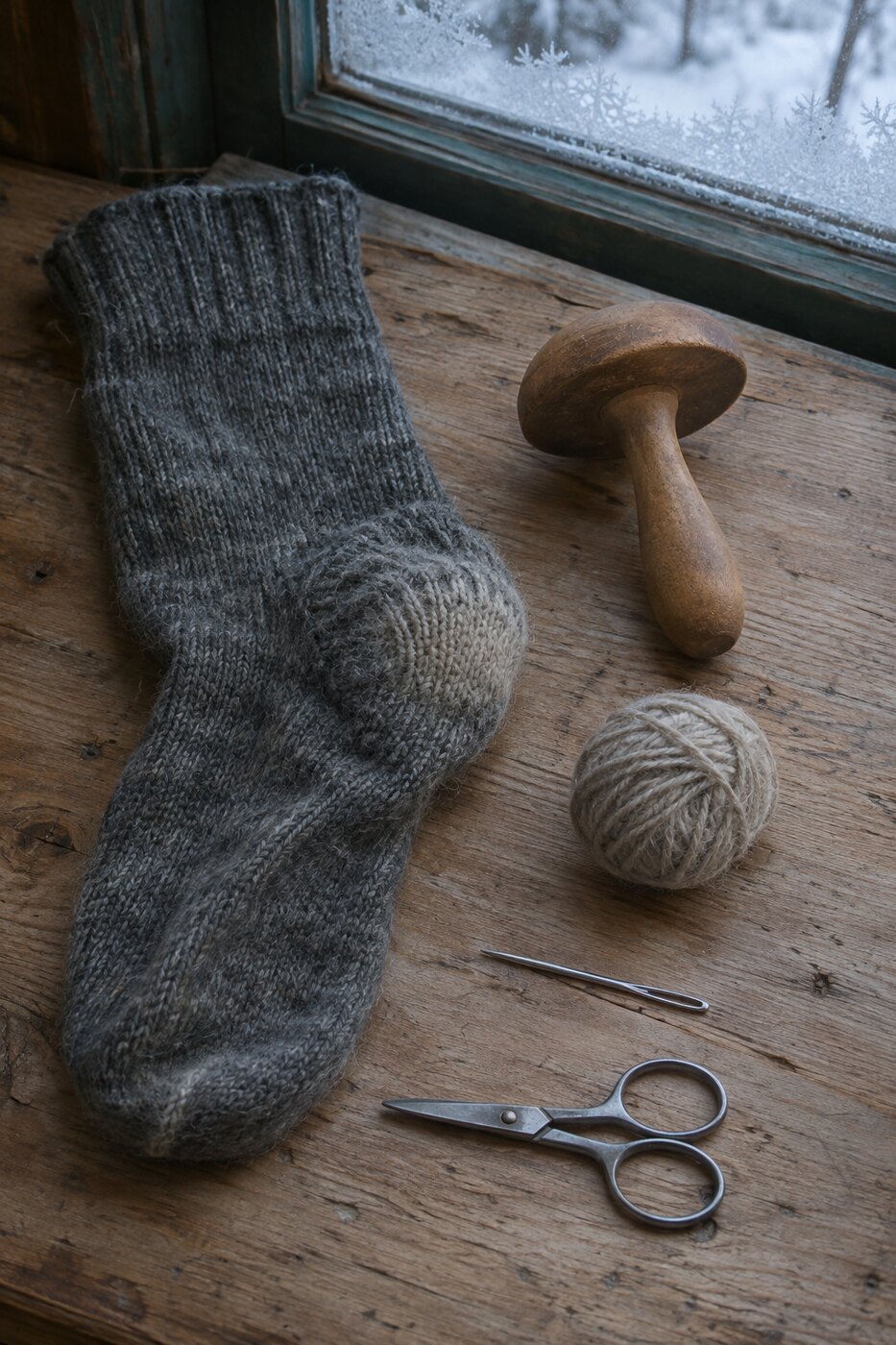
A wool sock in boots at thirty below does a lot of work. The heel and the ball wear first, and they wear thin a long time before they wear through. Hold the sock up to the window and the light comes through there first, in an oval where the knit has gone flat and fuzzy. That’s the time to darn it.
A thin patch is a quicker job than a hole. The knit is still there to stitch into, the patch keeps its shape while you work, and you cover the area once. Leave it and you’re bridging a gap with nothing under it, and a hole in a heel grows fast. A 1936 extension pamphlet from North Carolina put it plainly: “worn places become holes, and soon the garment is gone.” Its advice was to watch heels and toes and reinforce them “at the very first sign of wear.” It holds up.
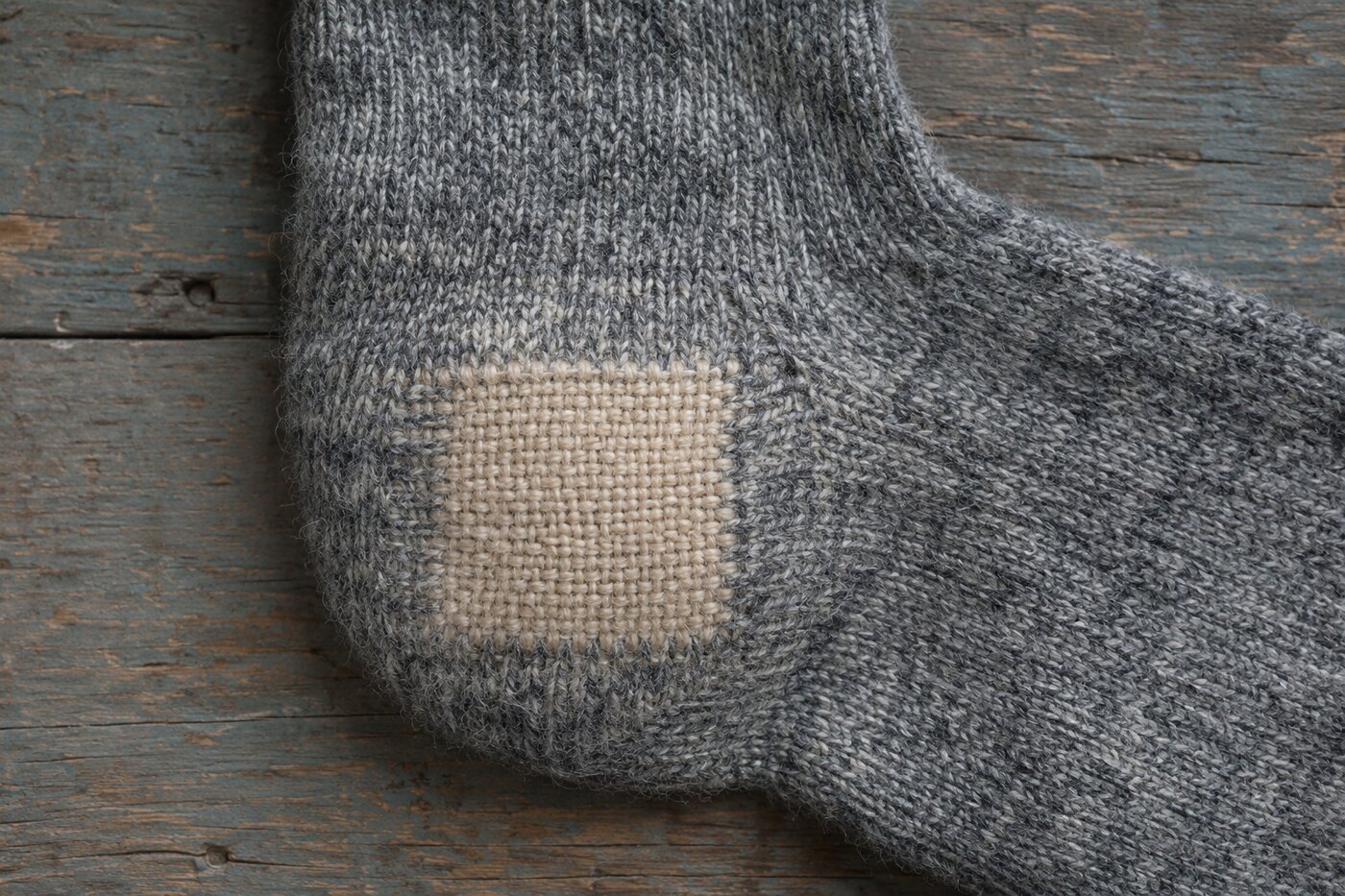
Two different things get called darning on knits, and it’s worth knowing which you’re doing. A woven darn lays rows of yarn one way across the worn patch, then weaves rows the other way through them, over and under, making a small square of plain-woven cloth. A Swiss darn, also called duplicate stitch, follows the path of the sock’s own knit stitches with new yarn, stitch for stitch. The Swiss darn keeps the stretch and can be nearly invisible, and knitwear menders recommend it for threadbare knit. The woven darn doesn’t stretch, but it needs no reading of the knit, it takes a hole as well as a thin patch, and worked over a mushroom it stays the shape of the heel. On a heavy boot sock I’d use a woven darn.
You need
- The sock, washed and dry
- Wool yarn close to the sock’s weight: sock or fingering yarn for an ordinary sock, heavier only for a heavy one
- A blunt darning or tapestry needle with an eye big enough for the yarn
- A darning mushroom or egg, or anything rounded and hard: a smooth stone, an orange, a jar
- An elastic band, if you’re using a mushroom
- Small scissors
How
-
Find the edges of the thin patch. Hold the heel up to a lamp and look for where the knit has gone see-through or fuzzy and flat. The darn has to cover all of that and about 5 mm of sound knit around it, because a darn anchored only in worn fabric pulls away with it.
-
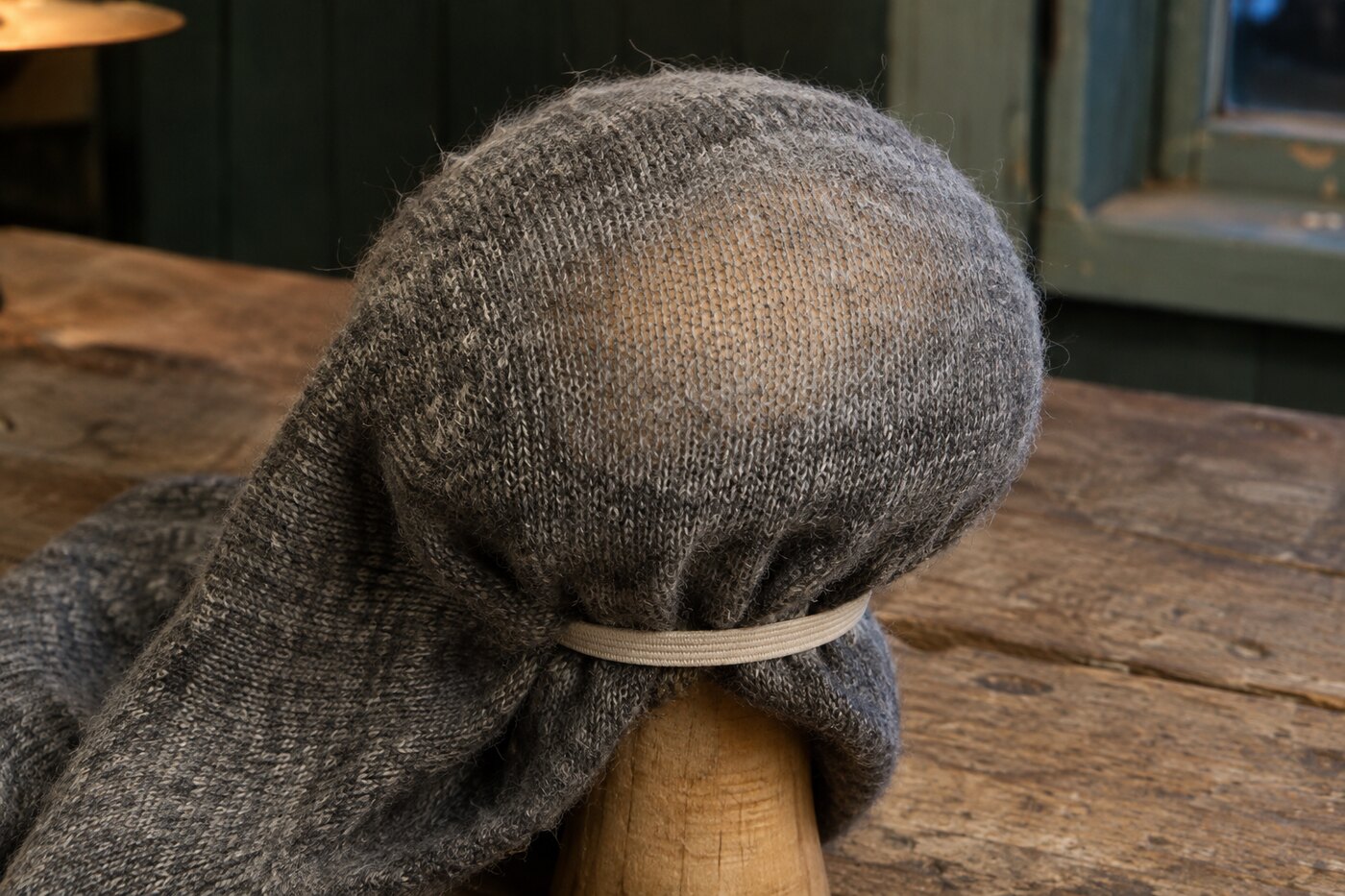
Put the mushroom or egg inside the sock with the thin patch centred over the dome and the knit gently stretched, the way it sits on a heel. On a mushroom, wrap an elastic band around the stem to hold the sock. It should be firm and smooth under your fingers, not tight enough to open the stitches.
-
Thread the needle with an arm’s length of yarn and no knot; leave a short tail on the surface to weave in later. Lay the first layer: rows of small running stitches up and down through the sock, starting 5 mm outside the thin patch, each row close beside the last, until the whole area and its margin are covered. Pull each row firm but not tight: if the knit around it puckers, ease it back.
-
Turn the work a quarter turn. Now weave across the first rows: over one, under the next, all the way across, taking a small stitch into the sock at each side. On the way back, go under where you went over. Push each new row snug against the last with the needle tip. Keep going until the patch is a small square of plain weave with no gaps.
-
Run each tail back through the darn for a couple of centimetres and trim it close. Take the sock off the mushroom and look: the patch should lie flat, without ridges or a pucker around it. Turn it right side out and put it on. If it feels like a lump under the heel, the yarn was too heavy or the rows too tight.
What goes wrong
It puckers or the sock fits tight. A woven darn has no give, so it fixes the knit at whatever size it was when you worked it. Work it over the mushroom with the knit stretched to the heel’s shape, and pull the rows firm, not tight. If you darn the sock flat in your lap, it won’t fit the way it did before.
A ridge under the heel. The yarn was too heavy. The North Carolina pamphlet’s rule was thread “not too large for the stocking.” Wool of about the sock’s weight wears in; a heavier yarn sits proud of the knit and you walk on it all day.
The darn lets go at the edge. It stopped at the worn patch instead of reaching into good knit. Next time take every row past the thin area into sound fabric.
A knot you can feel. Leave the knots out. The tails, run back through the weave, hold well enough, and a knot under the heel is something you walk on all day.
You left it too late. Do the same darn over the hole. The first rows simply span the gap between sound edges, and the second set weaves across them. It takes longer, and the patch is bigger.
When to do something else
Fine socks, or when the stretch matters. Use a Swiss darn (duplicate stitch). Knit Picks teaches it for exactly this: strengthening worn heels and toes before they become holes.
When it shows. Matching yarn hides a darn; the 1936 pamphlet wanted it inconspicuous. A contrasting colour makes it a visible mend, the repair left on show like the patches on an old tarp. That’s a choice, not a different technique, and on a boot sock nobody sees it but you.
When the whole heel is gone. If the knit around the hole is thin too, there’s nothing sound to anchor to. The sock has done its work.
Sources
- N.C. Agricultural Extension Service, Repair of Clothing (1936): mend worn places early; reinforce heels and toes at the first sign of wear; thread matched in colour and not too heavy, no knot, stitches carried past the damage, a plain weave.
- The Knitter / Simply Yarn, How to darn socks: sock stretched and centred on an egg or mushroom, band around the stem, rows starting 5 mm beyond the damage, over-and-under weaving, firm but not tight to avoid puckering; Swiss darning to reinforce.
- Flora Collingwood-Norris, Different types of darning: woven darn vs Swiss darn (duplicate stitch); darning is not stretchy; Swiss darning for threadbare knit; tapestry needle.
- Knit Picks, Sock Darning Part 1: Duplicate Stitch: duplicate stitch, also called Swiss darning, to strengthen worn heels and toes before they hole.
- Darn Tough Vermont, How to Darn Socks: wash first; yarn similar in weight to the sock; anything rounded in place of a darning egg.