
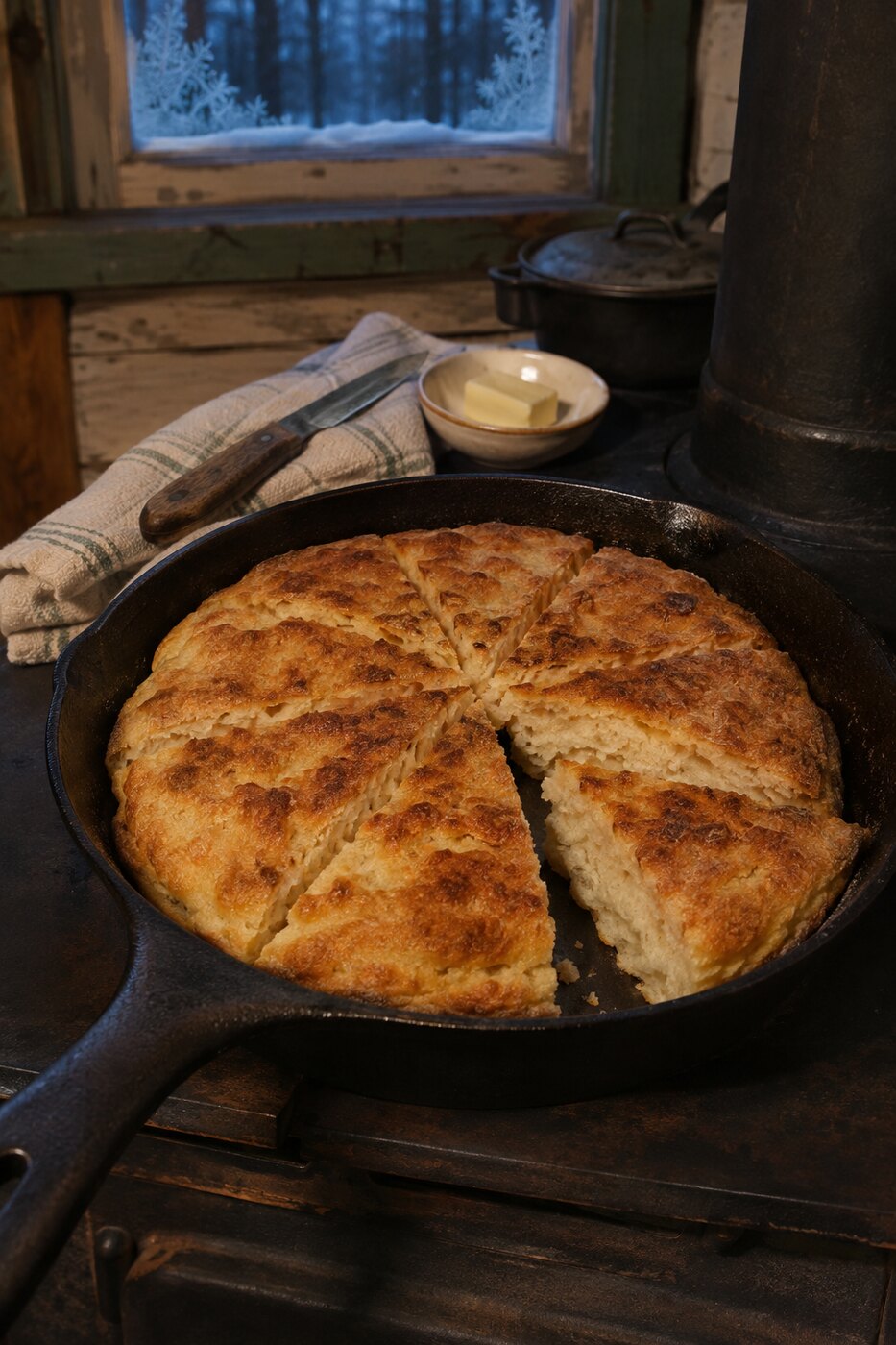
Bannock is flour, baking powder, salt, fat and water. A cold pantry keeps all of them for a long time. It needs no yeast, no rise and no oven, only one pan and some heat you can control. That makes it the bread for a cottage in January: the stove is lit anyway, and nobody is driving to town for a loaf.
The word comes from the Gaelic bannach, a morsel. In Scotland it was a flat cake of barley, peameal or oatmeal, cooked on a griddle stone set before the fire. Wheat-flour bannock came to this country with the fur trade and became a staple for voyageurs, traders and prospectors. For First Nations it has a harder history. Once people were moved onto reserves and could no longer hunt as before, the government rations of flour and lard made bannock a necessity against starvation. Some nations already had bread-like foods of their own, made from bracken root, camas and other plants. Bannock is now at powwows and family tables across the country. Most nations have a version and a name for it.
The recipe here is the one Parks Canada publishes from Rocky Mountain House National Historic Site in Alberta, adapted from a traditional Métis recipe and made there by Métis interpreters. It has no salt; I add the teaspoon that Parks Canada’s Bar U Ranch version uses. The weights are the source’s. Weigh the flour if you can, because a scooped cup can come out well short of the 153 g a cup works out to here. If you’ve never judged a dough by hand, this is how it goes.
Ingredients
- 460 g all-purpose flour (3 cups as Parks Canada measures it; weigh it if you can)
- 15 g baking powder (3 tsp)
- 5 g salt (1 tsp)
- 40 g vegetable oil or melted lard (3 tbsp, 45 ml)
- 250 g cold water (1 cup, 250 ml)
- A spoonful of lard or oil for the pan
Method
-
Weigh the flour, baking powder and salt into a bowl and stir them together. Add the oil or melted lard and stir until it has disappeared into the flour and the mix looks evenly damp and crumbly.
-
Pour in the cold water and mix, then knead in the bowl until the dough is smooth, soft and no longer sticky, and comes away from the bowl and your hand in one piece. If it stays tacky, work in flour a spoonful at a time; if it cracks, a spoonful of water.
-
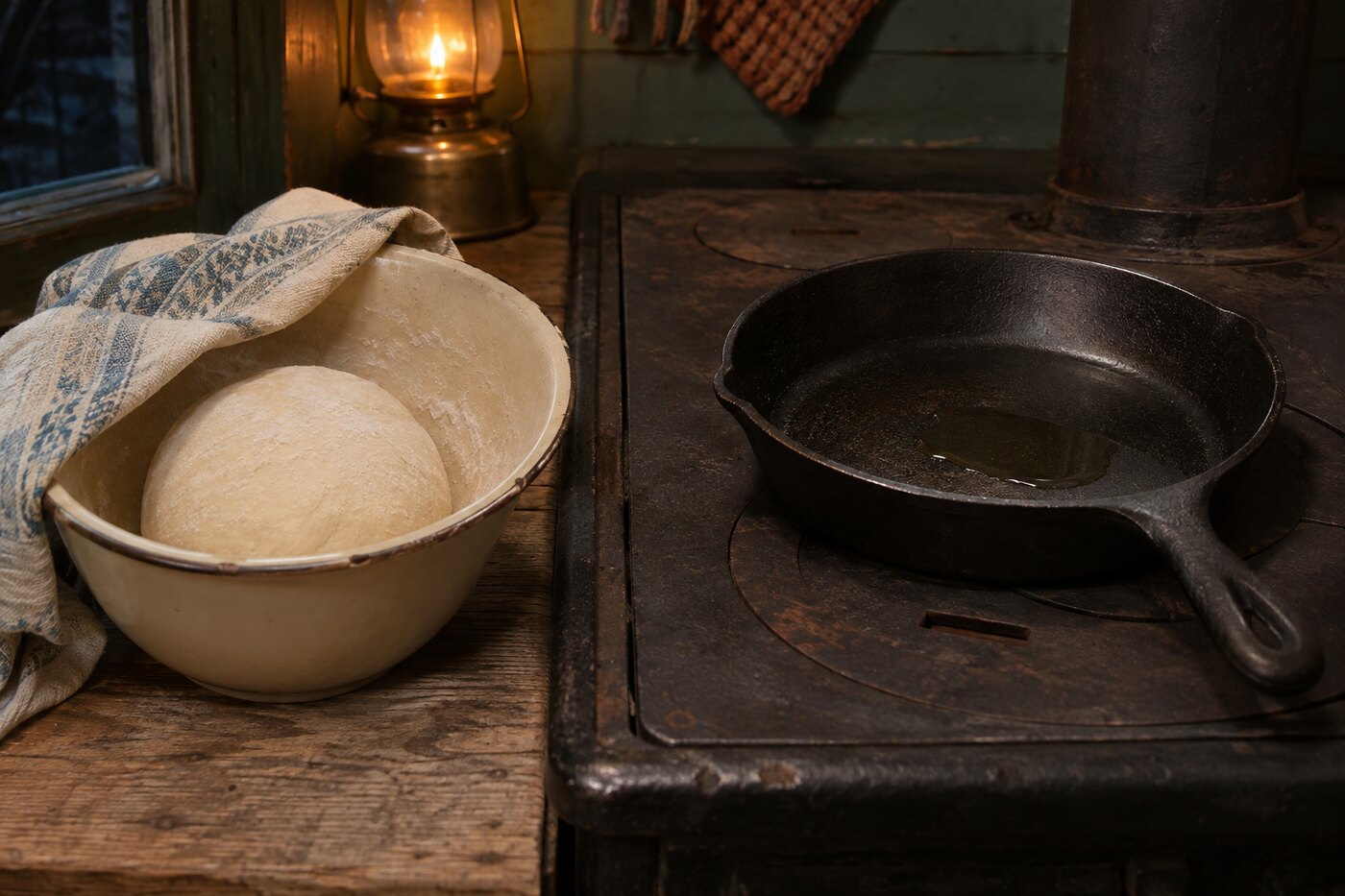
Shape it into a ball, cover the bowl with a towel and let it rest 10 minutes. While it rests, put the pan on the heat with the spoonful of fat. On a wood stove, start it toward the middle and watch it.
-
When the fat shimmers and runs thin across the pan but isn’t smoking, press the ball into the pan and flatten it out to the edges, about 2 cm thick. Put the lid on. On a wood stove, slide the pan toward the cooler edge now: you want the bottom to brown slowly while the middle cooks.
-
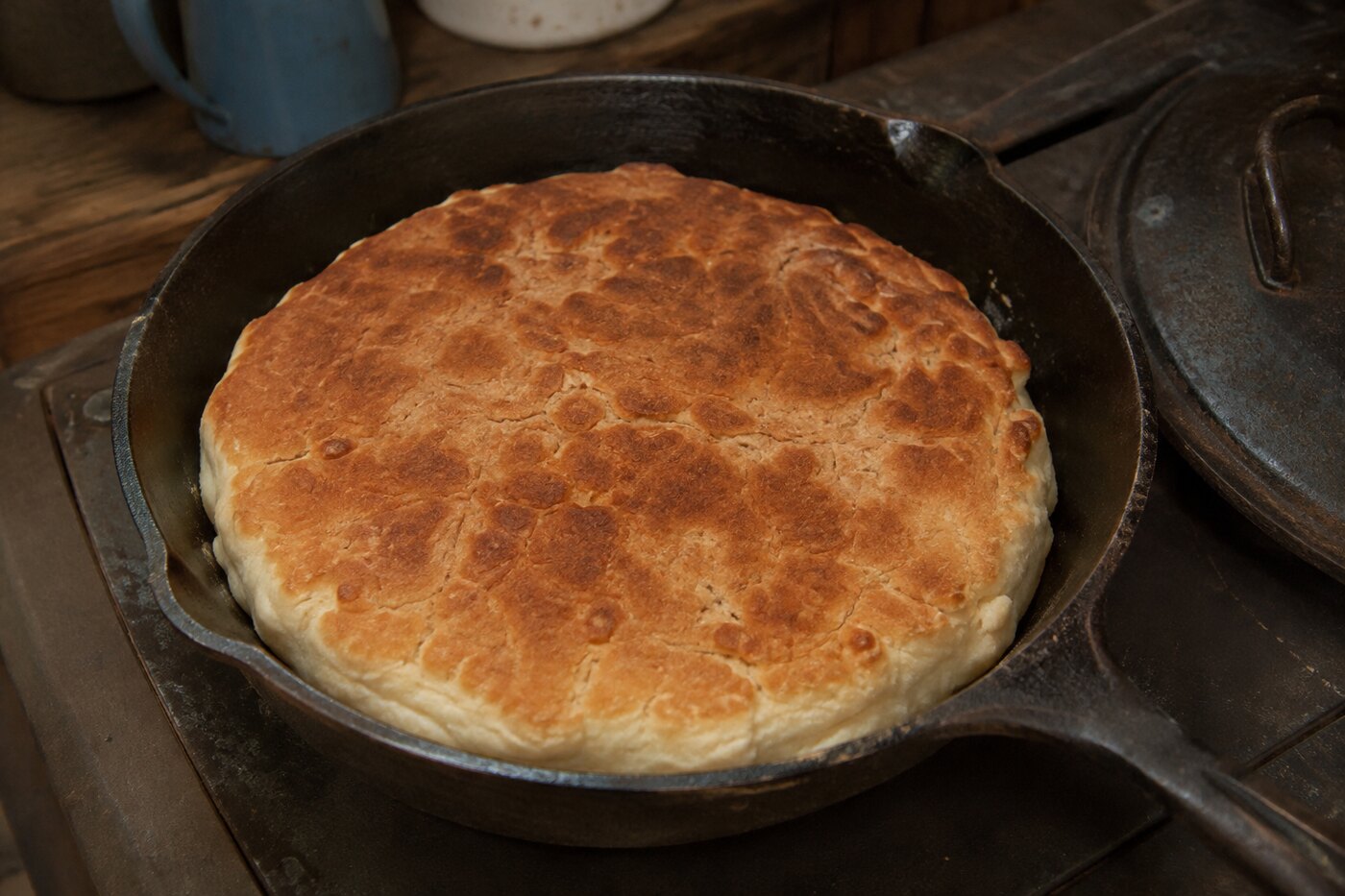
Cook until the underside is golden-brown and crusted, the edge looks dry and set, and the round has puffed and slides when you shake the pan. Give the pan a quarter turn now and then, because a stovetop is never even. Then flip it: loosen it with a spatula, slide it out onto the lid or a plate, and turn it back into the pan browned side up.
-
Cook the second side the same way. It’s done when both sides are golden-brown, a knock on the bottom crust with a knuckle sounds hollow rather than dull, and a thin knife pushed into the thickest part comes out with no wet dough on it. Over an open fire Parks Canada puts the whole cook at about 15 minutes; on a gentle stovetop it takes longer. Score it into wedges while it’s still warm.
What goes wrong
Burnt outside, raw inside. The heat was too high. On a burner, turn it down. On a wood stove you don’t turn the heat down, you move the pan: the middle of the stovetop, over the firebox, is the hot part, and the edges run cooler. Put the lid on so the top half cooks as well as the bottom. A thinner round cooks through faster, so next time press it out to the edges.
Smoking fat. The pan got too hot before the dough went in. Pull it to the edge of the stove and give it a minute. A well-seasoned pan (this one, for example) wants very little fat anyway.
Flat and heavy. Check the date on the baking powder tin. Oven-baked bannock is denser by nature; the Canadian Encyclopedia describes oven bannock as heavy and pan-fried bannock as lighter.
It sticks when you flip it. It wasn’t ready. A round that has crusted underneath lets go of the pan on its own when you shake it.
When the constraint changes
Over a fire, in summer. Ontario Parks mixes the dry ingredients at home in a zip bag and adds the water and oil at the campsite. Flatten pieces of dough thin, wrap them around a green stick, and turn them slowly over hot coals rather than flame, about 10 to 15 minutes, until they’re cooked through. Thin dough is the trick: a thick wrap browns outside and stays raw against the stick. Check for a fire ban before you light anything.
In the oven. The Rupertsland Institute’s Métis culture card bakes bannock in a lightly greased cast-iron pan at 230 °C (450 °F) for 20 to 30 minutes, the top pierced with a fork first. This dough can go the same way. Expect a denser bread than you’d get from the pan.
A monthly check-in. Bag the dry mix (flour, baking powder, salt) at home and carry it in. At the cottage you need only fat, water and the pan. Lard that has sat in a cold building comes out hard; melt it in the pan first and pour it into the bowl.
Milk. The Canadian Encyclopedia lists milk, salt and sugar as common additions. With no fresh milk at the cottage, I stir milk powder in with the flour and leave the water as it is.
Sources
- Parks Canada, Bannock (Rocky Mountain House NHS): the ratio (460 g flour, 15 g baking powder, 45 ml oil, 250 ml cold water), the 10-minute rest, hot cast-iron pan, about 15 minutes over a fire, scoring while warm, Métis origin of the recipe.
- Parks Canada, Campfire Bannock (Bar U Ranch NHS): 5 g salt; brown one side, flip, cook the other.
- The Canadian Encyclopedia, Bannock: the Gaelic word, Scottish griddle bannock, the fur trade, reserve rations, pre-contact breads, oven vs pan texture, common additions.
- Rupertsland Institute Métis Culture Card, via the Otipemisiwak Métis Government: oven method, greased cast iron, 450 °F for 20–30 minutes.
- Ontario Parks, Less-Mess Bannock: dry mix bagged at home, thin dough on a stick over hot coals, 10–15 minutes.
- King Arthur Baking, How to tell if bread is done: the hollow knock on the bottom crust.
- Health Canada, Safe handling of flour: raw flour and E. coli; cook dough before eating.
- Health Canada, Cooking safety: watch heating oil, keep a lid nearby, never water on an oil fire.