Sandpaper Is a Way of Listening
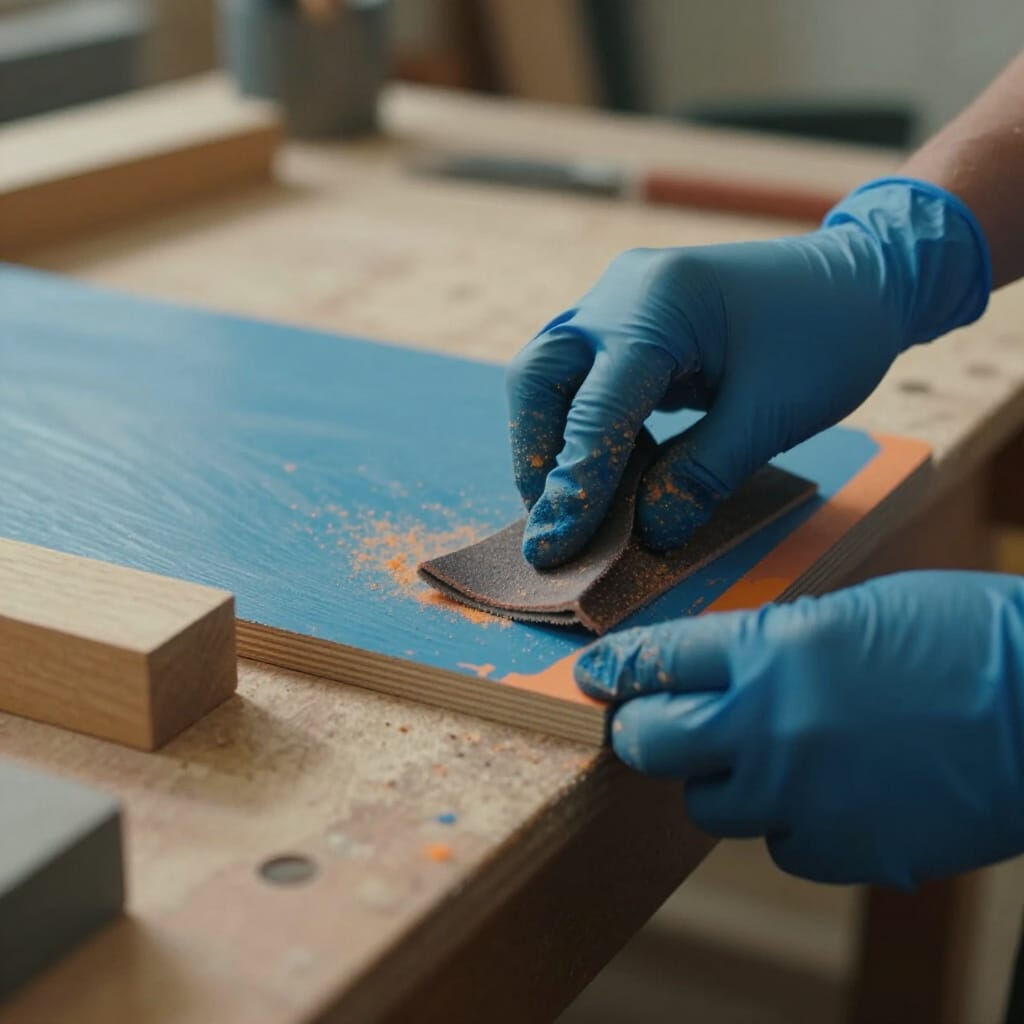
Sandpaper has its own vocabulary. Fresh paper on dry paint makes a rough, crunchy sound. Worn paper goes quiet. Somewhere in between it clogs and you tap it against the trash can and a small cloud comes out.
The grit numbers are printed on the back. Sixty, one-twenty, two-twenty. They sound like highway speeds. I keep a few sheets folded on a nail by the bench. They curl from humidity.
I picked one-twenty. Not too fast. Not too polite.
The first pass took the sheen off the blue. The surface went matte. Then the blue started to come away in streaks. Underneath, the orange came back in patches, like a map of somewhere that doesn’t exist.
A sanding block makes straight decisions. Your bare hand makes curved ones. I did both. Block for the flat areas. Fingers for the corners and the places where the plywood bowed.
The ridge from the early drip stayed raised. It didn’t want to be erased. Paint can be sanded down, but it doesn’t always sand evenly. Thick spots protect themselves. Low spots keep their color because the paper can’t reach them without you pushing too hard.
Dust settled everywhere. In the cracks between the floorboards. In the cuff of my pants. On my knuckles. I found a smear of blue on my sock later, sitting on the couch like I’d walked through a tiny sky.
I wiped the surface with a damp rag. The colors darkened for a moment. The layers showed themselves more clearly when they were wet. Orange under blue. A pale band where the gesso had sunk in. A raw corner where I’d stayed too long with the paper.
Then it dried and everything went quiet again.
Some people talk about sanding like it’s fixing. It isn’t. It’s revealing. Not evenly. Not on command.
There was a ghost of that first egg-shape near the center. I hadn’t thought about it in days. The sandpaper brought it back because the paint was a different thickness there, a different little topography. It appeared and disappeared as I moved my hand. Like it didn’t want to be named.
I changed the sheet when it stopped cutting. The old one was clogged with a purple-gray paste where orange and blue met each other. I rinsed the rag in the sink and the water ran purple for a few seconds. Then it went clear. The color didn’t disappear. It just moved.
Back at the bench, I ran my palm across the board. Not checking for smooth. Reading it. Here’s where the brush was almost dry. Here’s where the paint pooled. Here’s where I pressed because I was in a hurry.
The ridge was still there. Smaller. Still catching the light.
I set the board down. The dust in the air took its time.